Tag Archives: China

image_pdfimage_print

Transcript of remarks of press conference

     The Chief Executive, Mrs Carrie Lam, held a press conference this afternoon (March 23). Also joining were the Secretary for Security, Mr John Lee, and the Secretary for Food and Health, Professor Sophia Chan. Following is the transcript of remarks of the press conference.
 
Reporter: Thank you, Mrs Lam. On the new border control measures, can you explain why you are doing this now? Why couldn’t it have been done when you issued the red travel alerts earlier? And secondly, we’ve seen the pro-establishment and the pro-democracy camps call for this full border closure just today. Are you bowing to political pressure by agreeing to do this? And finally, on changing the requirements for selling of alcohol, that could have a huge impact on people working in that industry. Will the Government offer any sort of guarantees in terms of jobs and salaries, and how would that be enforced?
 
Chief Executive: Thank you for the two questions. First of all, there are several regimes that we could resort to in ensuring the objective of reducing people flow either from overseas countries or from the Mainland. One is of course what you have mentioned, the travel alert, the red travel alert, but that’s outbound. That’s warning Hong Kong people not to go to these places.
 
     The second measure is the quarantine measure. That is for inbound travellers, arrivals, we imposed certain quarantine arrangements which will have a deterrent effect. I have told you two experiences. On February 8, when we imposed this 14-day quarantine arrangement on arrivals from Mainland, we have seen a 90 per cent drop in arrivals, whether it’s Hong Kong residents or non-Hong Kong residents. And then on March 19 when we introduced this 14-day quarantine arrangement at the airport, we saw a drastic drop in other visitors, but the Hong Kong residents returning had not seen a similar decrease because a lot of Hong Kong people are rushing back because of the flu situation in the overseas countries.
      
     The third measure is immigration policy. Under the Immigration Ordinance, we could impose requirements disallowing people to come to Hong Kong for various reasons. What I have mentioned today is using the immigration policy, that from Wednesday onwards we will disallow non-Hong Kong residents coming from overseas countries arriving at the Hong Kong International Airport to enter Hong Kong. You have to understand we have different regimes. And in the last two months in leading this fight against the virus, I have time and again emphasised we are basing our decisions on science, on facts and figures, on evidence, and also have the expert advice of the four professors on the expert advisory panel. Politics or pressure are not something that come into the formula because it would be very risky to base public health decisions just because certain people have demanded for it. The difference between Saturday and today, one is of course the changing circumstances, which make people even more worried about these imported cases coming into Hong Kong. Secondly, we have to understand the impact of the measure imposed on March 19 and identify who are the people that despite a 14-day quarantine, they were still coming into Hong Kong so that when we deny entry, we know exactly who are the people to be affected and whether there are alternative ways to cater for the interests of these people. There is this category which I’ll share with you. I explained on Saturday that amongst the five to six hundred arrivals still coming into Hong Kong after the 14-day quarantine requirement, there was a large number of Macao residents, because you understand that we are an aviation hub and a lot of Macao residents overseas have to come in through the Hong Kong International Airport and they want to go back to Macao. The Macao Government wants to welcome them back to Macao even if they are coming back from a highly infectious place because these are their people. So we have an agreement with or understanding with the Macao Government that they will ask these Macao residents overseas to register with the Macao Government. We will have the name list of these Macao residents, so upon arrival we’ll allow them to come in and then immediately – they will not stay in Hong Kong – the Macao Government will send a coach to take them back to Macao via the Hong Kong-Zhuhai-Macao Bridge.
      
     While I said that from Wednesday onwards we will deny entry of non-Hong Kong residents, this special arrangement with Macao will continue because as far as we could gather from Macao, there are over 1 000 Macao residents still waiting to come back to Macao. This is why I have to explain that sometimes certain decisions of the Government twill give rise to certain consequences, so it’s much more prudent to understand the consequences of our policy decision and try to reduce the adverse consequences that will affect people or cause people hardship to a minimum.
 
Reporter: And about the bars, Mrs Lam?
 
Chief Executive: It’s not just the bars. I’m afraid that many sectors, many enterprises, are being severely hit by this coronavirus. Despite the fact that the Government has rolled out a $30 billion package under the Anti-epidemic Fund, and another $120 billion under the recent Budget initiatives, I understand that there is this demand or aspiration for more support from the Government. And on this occasion, when bars – actually it’s not just bars, it’s all the restaurants and bars that have a liquor licence – will not be allowed to sell or supply liquor, certainly their business will be affected. We will certainly consider what further measures we should put in place to help these establishments.

(Please also refer to the Chinese portion of the transcript.) read more
CHP investigates 39 additional cases of COVID-19

     The Centre for Health Protection (CHP) of the Department of Health (DH) announced that as of 4pm today (March 23), the CHP is investigating 39 additional confirmed cases of COVID-19, taking the number of cases to 357 in Hong Kong so far (comprising 356 confirmed cases and one probable case).
 
     The newly reported cases announced today involve 22 males and 17 females aged between 18 and 66. Among them, 31 had travel history during the incubation period. The CHP’s epidemiological investigations and relevant contact tracing on the confirmed cases are ongoing. For case details and contact tracing information, please see the Annex.
 
     For information on flights that patients of the confirmed cases have taken, please refer to the following webpage: (www.chp.gov.hk/files/pdf/flights_trains_en.pdf). Passengers who travelled on the same flights and sat within two seats surrounding those patients are urged to call the CHP hotlines 2125 1111 and 2125 1122.
 
     The CHP again urged members of the public to maintain an appropriate social distance with other people as far as possible in their daily lives. In particular, they should go out less and avoid social activities such as meal gatherings or other gatherings to reduce the chance of contacting infected persons, who may not present any symptoms, and minimise the risk of outbreak clusters emerging in the community.
 
    A spokesman for the CHP said, “In view of proliferation of the disease and continuous increase in the number of cases reported around the world, members of the public are strongly urged to avoid all non-essential travel outside Hong Kong.”
 
     “The CHP also strongly urges the public to maintain at all times strict personal and environmental hygiene, which is key to personal protection against infection and prevention of the spread of the disease in the community. On a personal level, members of the public should wear a surgical mask when having respiratory symptoms, taking public transport or staying in crowded places. They should also perform hand hygiene frequently, especially before touching the mouth, nose or eyes.”
 
     “As for household environmental hygiene, members of the public are advised to maintain drainage pipes properly, and regularly pour water into drain outlets (U-traps); cover all floor drain outlets when they are not in use; after using the toilet, they should put the toilet lid down before flushing to avoid spreading germs.”
 
     The CHP will report the cases to the World Health Organization, National Health Commission, Health Commission of Guangdong Province, relevant health authorities and the Hospital Authority.
 
     The CHP has set up the hotlines (2125 1111 and 2125 1122), which operate from 8am to midnight daily, for public enquiries. As at 4pm today, a total of 46 727 calls were received.
 
     Moreover, the Government has launched the website “COVID-19 Thematic Website” (www.coronavirus.gov.hk) for announcing the latest updates on various news on the COVID-19 infection and health advice to help the public understand the latest updates.
 
     To prevent pneumonia and respiratory tract infection, members of the public should always maintain good personal and environmental hygiene. They are advised to:
 
• Wear a surgical mask when taking public transport or staying in crowded places. It is important to wear a mask properly, including hand hygiene before wearing and after removing a mask;
• Perform hand hygiene frequently, especially before touching the mouth, nose or eyes, after touching public installations such as handrails or door knobs, or when hands are contaminated by respiratory secretions after coughing or sneezing;
• Maintain drainage pipes properly and regularly (about once a week) pour about half a liter of water into each drain outlet (U-traps) to ensure environmental hygiene;
• Cover all floor drain outlets when they are not in use;
• After using the toilet, put the toilet lid down before flushing to avoid spreading germs;
• Wash hands with liquid soap and water, and rub for at least 20 seconds. Then rinse with water and dry with a disposable paper towel. If hand washing facilities are not available, or when hands are not visibly soiled, performing hand hygiene with 70 to 80 per cent alcohol-based handrub is an effective alternative;
• Cover your mouth and nose with tissue paper when sneezing or coughing. Dispose of soiled tissues into a lidded rubbish bin, then wash hands thoroughly; and
• When having respiratory symptoms, wear a surgical mask, refrain from work or attending class at school, avoid going to crowded places and seek medical advice promptly. read more

Hong Kong Customs seizes suspected illicit cigarettes (with photos)

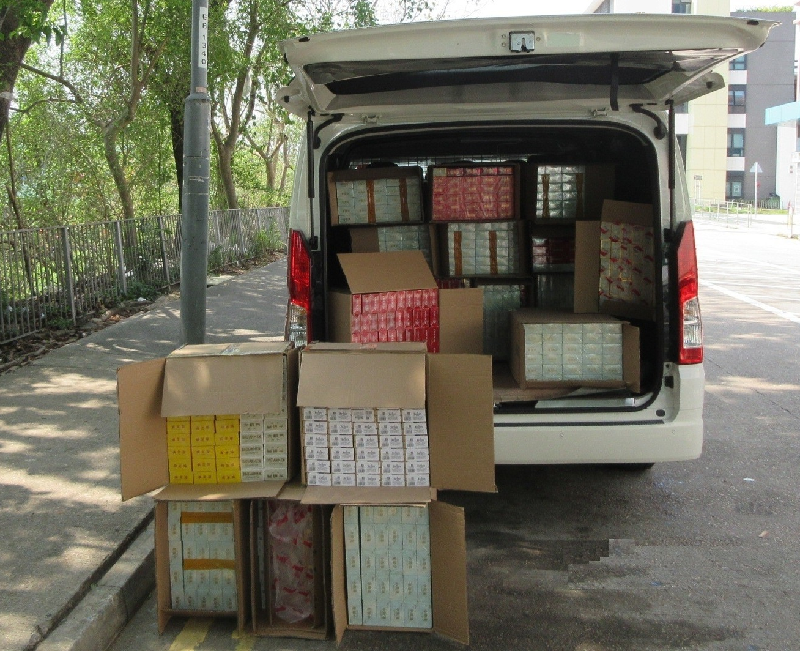
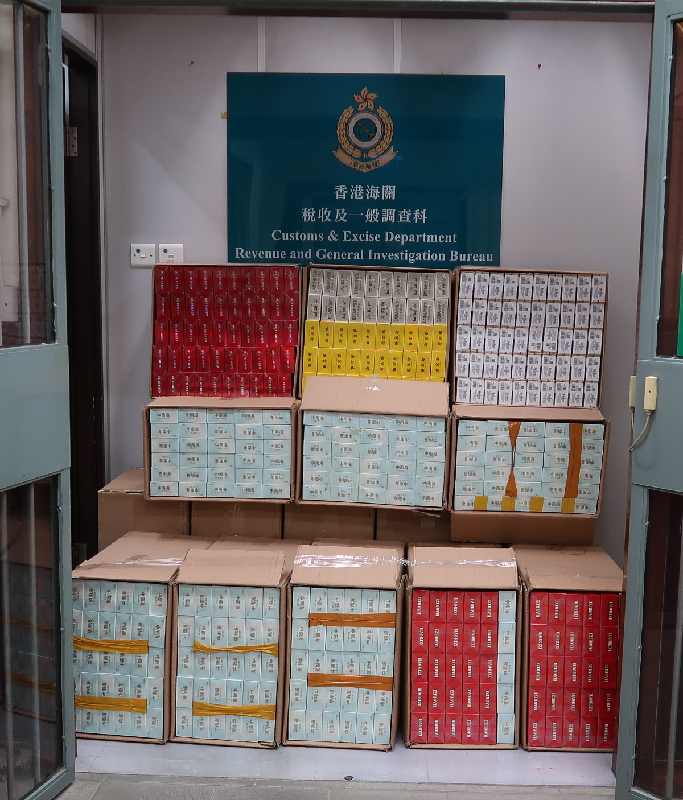
     Hong Kong Customs today (March 23) seized about 200 000 suspected illicit cigarettes with an estimated market value of about $600,000 and a duty potential of about $400,000 in Sheung Shui.

     Customs officers conducted an anti-illicit cigarette operation in Sheung Shui this afternoon and intercepted a light goods vehicle suspected of distributing illicit cigarettes. The batch of suspected illicit cigarettes was seized on board the vehicle.

     The 69-year-old male driver and the 56-year-old male passenger were arrested and the light goods vehicle was detained. 

     An investigation is ongoing.

     Under the Dutiable Commodities Ordinance, anyone involved in dealing with, possession of, selling or buying illicit cigarettes commits an offence. The maximum penalty upon conviction is a fine of $1 million and imprisonment for two years.

     Members of the public may report any suspected illicit cigarette activities to Customs’ 24-hour hotline 2545 6182 or its dedicated crime-reporting email account (crimereport@customs.gov.hk).

Photo  Photo  
read more