Tag Archives: China

image_pdfimage_print

DH clinics service arrangement

     The Department of Health (DH) today (March 27) announced that following its earlier announcements on service adjustments in response to the latest situation of COVID-19, some services will also be further adjusted starting next Monday (March 30).

     The services and opening hours of Elderly Health Centres (EHCs) will be adjusted, with seven EHCs providing services twice a week and the remaining 11 EHCs providing services once a week. All EHCs will only provide booked medical consultation services. All other services are suspended, details of which can be found on the following website: www.elderly.gov.hk/eindex.html. The staff of the centres will make separate arrangements for affected users with prior appointments.

     Separately, while the DH continues to receive and handle applications related to the regulation of private healthcare facilities, pharmaceutical products and Chinese medicines, the relevant services have also been adjusted owing to the latest development and the processing time of these applications may be lengthened. The public and relevant traders may visit the respective websites for details (Office for Regulation of Private Healthcare Facilities: www.orphf.gov.hk; Drug Office: www.drugoffice.gov.hk; Chinese Medicine Regulatory Office: www.cmro.gov.hk).

     Apart from the above, some non-urgent services including the Student Health Service Centres, School Dental Clinics, Woman Health Centres, Social Hygiene Clinics, Families Clinics and Education and Training Centre in Family Medicine, dental clinics as well as telephone and online bookings for HIV testing of the DH’s AIDS Counselling and Testing Service have also been adjusted or suspended. For enquiries, please contact the relevant clinics and service units.

     In addition, in order to enhance infection control measures including minimising flows of people and social contacts, the DH advised that family members and friends should avoid accompanying clients to visit Maternal and Child Health Centres (MCHCs) or other clinics/facilities unless there are special reasons to do so. The DH also advised that: 
 

  • No more than two parents may accompany a 1 month old or below newborn baby to MCHCs; and 
  • No more than one parent/relative/friend may accompany the service user to clinics/facilities.
read more

Reminder to members of public on suspected fraudulent phone calls purporting to be made by CA or OFCA

     The Office of the Communications Authority (OFCA) today (March 27) reminded members of the public again to stay alert to suspected fraudulent calls purporting to be made by the Communications Authority (CA) or OFCA.

     A spokesman for OFCA said, “OFCA has received over 500 reports from members of the public on various kinds of suspected fraudulent calls purporting to be made by the CA or OFCA for over a month. Most of the calls were in the form of pre-recorded messages in either Cantonese or Putonghua claiming that the recipients’ telephone services would be suspended because of anomalies with their telephone services. Most of the callers instructed the called parties to press a designated numeric key (e.g. ‘1’ or ‘9’) for further enquiries, and asked for the called parties’ personal information. OFCA has already reported the matter to the Police.

     “Notwithstanding the contents of the calls, we wish to reiterate once again that the CA and OFCA have never made and will not make such phone calls. In addition, members of the public should beware of calls from numbers with a ‘+’ sign as a prefix displayed on mobile phones, which indicates that the calls originate from outside Hong Kong even though the calling numbers may be masqueraded as Hong Kong phone numbers.”

     The spokesman added, “We also urge members of the public to stay alert and report any suspected fraudulent calls to the Police, irrespective of whether a ‘+’ sign is displayed as a prefix to the calling numbers. If they have any questions regarding the status of their telecommunications services, they should contact their telecommunications operators for details direct. Under no circumstances should they disclose their personal information in answering the calls.” 

     More details about the alert to members of the public on suspected fraudulent calls purporting to be made by the CA or OFCA can be found at the following hyperlink: www.ofca.gov.hk/en/consumer_focus/education_corner/alerts/AllServices/reminder_to_members_of_the_public_on_suspected_fra/index.html. read more

Update on dengue fever

     The Centre for Health Protection (CHP) of the Department of Health today (March 27) reported the latest number of dengue fever (DF) cases, and strongly urged the public to maintain strict environmental hygiene, mosquito control and personal protective measures both locally and during travel.
 
     From March 6 to 26, the CHP recorded three imported DF cases. The patients had respectively been to Indonesia (two cases) and the Philippines (one case) during the incubation period.
 
     As of yesterday (March 26), a total of 18 cases of DF had been recorded in 2020, all of which were imported cases from countries including the Philippines (seven), Indonesia (four), Malaysia (two), Thailand (two), Vietnam (two) and Cambodia (one).
 
     The CHP has been closely monitoring the latest DF situation in neighbouring and overseas areas. According to the Health Commission of Guangdong Province, as of February 29, 15 cases have been recorded in Guangdong in 2020. In Taiwan, as of yesterday, 49 imported cases (none local) have been recorded in 2020.
 
     Detailed information on the latest DF situation in Hong Kong as well as neighbouring and overseas countries and areas has been uploaded to the CHP’s website (www.chp.gov.hk/files/pdf/df_imported_cases_and_overseas_figures_eng.pdf). Members of the public should stay vigilant and carry out effective mosquito prevention and control measures.
 
     ​”Apart from general measures, travellers returning from areas affected by DF should apply insect repellent for 14 days upon arrival in Hong Kong. If feeling unwell, seek medical advice promptly and provide travel details to the doctor,” a spokesman for the CHP said.

     The public should take heed of the following advice on mosquito control:
 
• Thoroughly check all gully traps, roof gutters, surface channels and drains to prevent blockage;
• Scrub and clean drains and surface channels with an alkaline detergent compound at least once a week to remove any deposited mosquito eggs;
• Properly dispose of refuse, such as soft drink cans, empty bottles and boxes, in covered litter containers;
• Completely change the water of flowers and plants at least once a week. The use of saucers should be avoided if possible;
• Level irregular ground surfaces before the rainy season;
• Avoid staying in shrubby areas; and
• Take personal protective measures such as wearing light-coloured long-sleeved clothes and trousers and apply insect repellent containing DEET to clothing or uncovered areas of the body when doing outdoor activities.
 
     DEET-containing insect repellents are effective and the public should take heed of the tips below:
 
• Read the label instructions carefully first;
• Apply right before entering an area with risk of mosquito bites;
• Apply on exposed skin and clothing;
• Use DEET of up to 30 per cent for pregnant women and up to 10 per cent for children*;
• Apply sunscreen first, then insect repellent; and
• Re-apply only when needed and follow the instructions.
* For children who travel to countries or areas where mosquito-borne diseases are endemic or epidemic and where exposure is likely, those aged 2 months or above can use DEET-containing insect repellents with a DEET concentration of up to 30 per cent.
 
     The public should call 1823 in case of mosquito problems and may visit the following pages for more information: the DF page of the CHP and the Travel Health Service, the latest Travel Health Newstips for using insect repellents, and the CHP Facebook Page and YouTube Channelread more

DH urges public not to buy or use topical product with undeclared controlled ingredients (with photo)

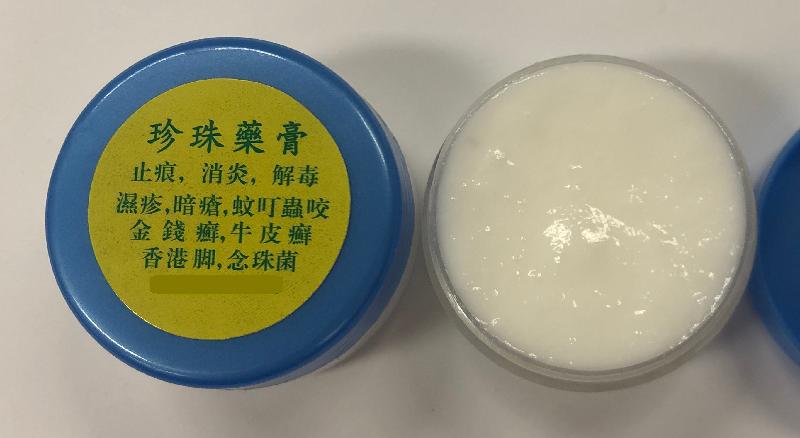
     The Department of Health (DH) today (March 27) appealed to the public not to buy or use a topical product (no English name on the package, see photo) as it was found to contain two undeclared controlled drug ingredients.

     Acting on a public complaint, the DH purchased samples of the above product for analysis. Test results from the Government Laboratory revealed that the products contained triamcinolone acetonide and miconazole, which are Part 1 poisons under the Pharmacy and Poisons Ordinance (PPO) (Cap 138). The DH’s investigation is continuing.
 
     Triamcinolone acetonide is a steroid substance for treating inflammation. Inappropriate or excessive application of steroids could cause skin problems and body-wide side effects such as moon face, high blood pressure, high blood sugar, muscle atrophy, adrenal insufficiency and osteoporosis. Miconazole is used for the treatment of fungal infection with side effects that include local irritation and sensitivity reactions. Products containing triamcinolone acetonide and miconazole should be used under a doctor’s directions and be supplied in a pharmacy under the supervision of a registered pharmacist upon a doctor’s prescription.      
 
     According to the PPO, all pharmaceutical products must be registered with the Pharmacy and Poisons Board of Hong Kong before they can be legally sold in the market. Illegal sale or possession of unregistered pharmaceutical products and Part 1 poisons are criminal offences. The maximum penalty for each offence is a fine of $100,000 and two years’ imprisonment.    
 
     The public should not buy or use products of doubtful composition or from unknown sources. All registered pharmaceutical products should carry a Hong Kong registration number on the package in the format of “HK-XXXXX”. The safety, quality and efficacy of unregistered pharmaceutical products are not guaranteed.    
 
     People who have purchased the product should stop using it and consult healthcare professionals if in doubt or feeling unwell after use. They can submit the product to the DH’s Drug Office at Room 1856, Wu Chung House, 213 Queen’s Road East, Wan Chai, during office hours for disposal.

Photo  
read more

Appointments to Hong Kong Committee for Pacific Economic Cooperation

     The Government today (March 27) announced the membership of the Hong Kong Committee for Pacific Economic Cooperation (HKCPEC) for the new term of two years from April 1, 2020, to March 31, 2022.
 
     Professor Matthew Lee Kwok-on has been reappointed as the Chairman of the HKCPEC, and Professor Chan Wai-sum, Dr Buston Chu, Mr Geoffrey Kao, Professor Syaru Shirley Lin and Professor Emily Nason have been reappointed as members. Mr Kelvin Lau and Ms Edith Law have been appointed as new members of the HKCPEC.
 
     “I thank the members for accepting the appointments. Their experience and expertise in respective sectors will facilitate the HKCPEC’s work in promoting regional economic development initiatives. I would also like to express our gratitude to the three outgoing members, namely Mr Guy Chambers, Mr Nicholas Kwan and Mr Kevin Lam, for their contributions to the HKCPEC’s work in the past,” the Secretary for Commerce and Economic Development, Mr Edward Yau, said.
 
     The HKCPEC is a tripartite forum, comprising members from the academic, business and government sectors, to co-ordinate Hong Kong’s participation in the Pacific Economic Cooperation Council (PECC), a non-profit, policy-oriented regional organisation with 23 member economies dedicated to the promotion of regional economic development. Over the years, apart from contributing actively to the discussion on the PECC front, the HKCPEC has also been promoting locally the importance of regional trade and economic issues through a series of internship and youth programmes.
 
     The new membership list of the HKCPEC is as follows:
 
Chairman
Professor Matthew Lee Kwok-on
 
Vice Chairman
Deputy Director-General of Trade and Industry
 
Members
Professor Chan Wai-sum
Dr Buston Chu
Mr Geoffrey Kao
Mr Kelvin Lau
Ms Edith Law
Professor Syaru Shirley Lin
Professor Emily Nason
Government Economist or his/her representative
Director of Research of the Hong Kong Trade Development Council or his/her representative read more