As part of the innovative initiatives under the “White Revolution” umbrella Schemes, the Department of Animal Husbandry, Dairying and Fisheries has supported the National Dairy Development Board(NDDB) developed initiative of “Quality Mark” Award Scheme for dairy Cooperatives to promote and encourage enhancement of safety,
Commerce and Industry Minister Smt. Nirmala Sitharaman has said that Government believes in active sharing of ideas and responding to citizen’s queries. On completion of one year of Twitter Seva/MOCI Seva she said
21 April 2017 – Noting increases in number of migrants, including children, attempting to reach European shores using the Central Mediterranean route, and consequent rise in number of deaths, the United Nations Children’s Fund (UNICEF) has called for safe and legal pathways for those who are fleeing conflict, poverty and depravation.
According to UNICEF estimates, at least 849 people, including more than 150 children, perished at sea while trying to make the perilous crossing since January this year.
“It is deeply concerning that vulnerable people, including thousands of children, are risking their lives to reach Europe’s shores using this incredibly dangerous route,” Afshan Khan, the UNICEF Regional Director and Special Coordinator for the Refugee and Migrant Crisis in Europe, said in a news release today.
Since the start of the year, nearly 37,000 refugees and migrants – 13 per cent of them children – have reached Italy by sea via the Central Mediterranean. This is an increase of 42 per cent compared to the same time period last year.
In particular, unaccompanied and separated children are at most risk, and these numbers too have seen a dramatic increase. In January and February this year, some 1,865 unaccompanied and separated children arrived in Italy, an increase of 40 per cent compared to the same period last year.
This is further evidence that when safe and legal pathways to migration are cut off, desperate children and families will do whatever they can to flee conflict, poverty and depravation
UNICEF also noted that recent good weather and calmer waters in the Mediterranean have been accompanied by a surge in refugees and migrants attempting to cross. During the Easter weekend (last weekend) alone, more than 8,300 were rescued from the sea between Libya and Italy. At least eight migrants were reported to have drowned over the weekend.
“This is further evidence that when safe and legal pathways to migration are cut off, desperate children and families will do whatever they can to flee conflict, poverty and depravation,” noted Ms. Khan.
As part of its global policy for children on the move, the UN agency has been calling for more action to protect child refugees and migrants, particularly unaccompanied children; end the detention of children seeking refugee status or migrating; and to promote measures to combat xenophobia, discrimination and marginalization in countries of transit and destination.
It has also underlined the need to keep families together as the best way to protect children and give children legal status; to ensure that all refugee and migrant children have opportunities to learn, access to health care and other quality services; and to address the underlying causes of large scale movements of refugees and migrants.
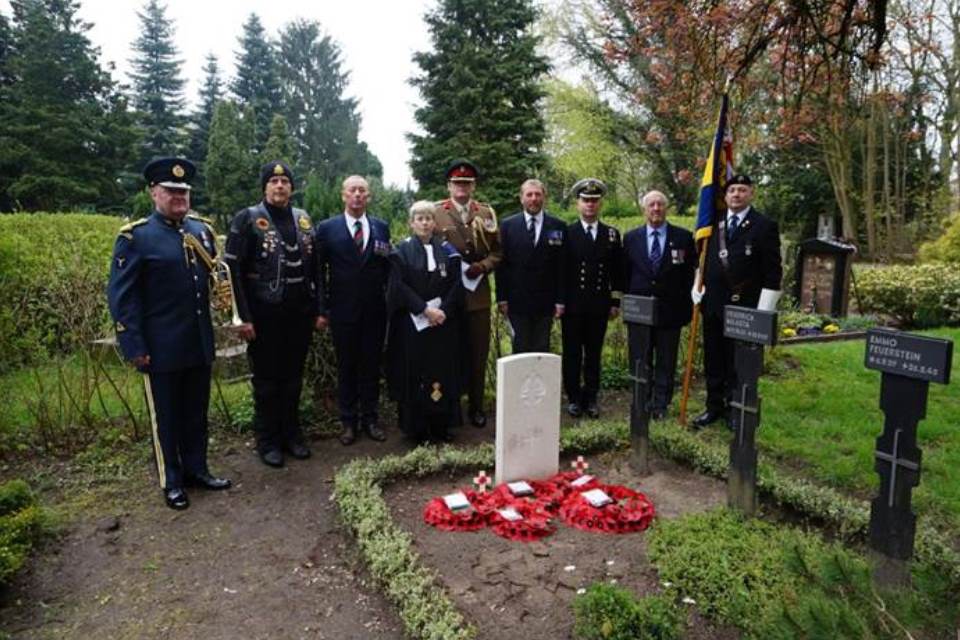
A new headstone has been installed and a rededication service took place in a moving ceremony on Friday 21 April 2017 at Wittenburg Cemetery, Germany.
The service, arranged by the MOD’s Joint Casualty & Compassionate Centre (JCCC), part of Defence Business Services was led by the Reverend Heather Rendell (Chaplain to the Forces), Regimental Chaplain, HQ Westfalen Garrison.
(L to R) Phil Richards, Alan Culshaw, Major Pat Ralph, Reverend Heather Rendell, Colonel David Moreton, Steve Foster, Cdr Ian Harrop, Bob Jones, Keith Orton, Crown Copyright, All rights reserved
Nicola Nash, JCCC said:
Private Thompson and his comrades were faced with a tortuous march after years of captivity. We are glad to be able to confirm his final resting place and honour him as he so richly deserves.
Private Thompson was born on 4 April 1919 at Tynemouth, Northumberland. Before enlisting, he was recorded as working as a glazier and lived with his sister, Elizabeth, on Penman Street in North Shields. George enlisted on 16 October 1939 and was sent, as a Private, to France on 28 February 1940 as part of the British Expeditionary Force.
He was reported missing on 19 June 1940 after being captured at Athies, France. His status as a Prisoner of War (POW) was confirmed a month later.
Pte Thompson was sent to Stalag XXA, located in Toruń, Poland. He was imprisoned for nearly 5 years, until in early 1945 and with the threat of the advancing Russians, the Germans forced the POWs to march towards the West. This ‘Long March’ was a tortuous undertaking for men that were already weakened from years of imprisonment.
It was one of the worse winters on record, with temperatures dropping as low as -25°C. The men were without adequate clothing, supplies or medical equipment and were forced to march up to 40 kilometres a day, many succumbed to hypothermia, disease and death. Tragically, George lost his life during this march and having suffered dysentery, he passed away near the town of Wittenburg, Germany on 3 March 1945.
Private Thompson was just 25 years old when he died.
(L to R) Phil Richards, Alan Culshaw, Major Pat Ralph, Reverend Heather Rendell, Colonel David Moreton, Steve Foster, Cdr Ian Harrop, Bob Jones, Keith Orton, Crown Copyright, All rights reserved
Reverend Heather Rendell said:
It was a privilege to give a name to the grave of a soldier that died in conditions that should never happen again.
A record of these POWs, including George, was kept by Staff Sergeant (S/Sgt) Aitken of the Royal Army Ordnance Corps. He kept a list of each man that died and where they were buried. He also attempted to intervene with the German guards to get better treatment of his men.
George’s burial place had remained unknown, until the grave of an ‘Unbekampt Englander Soldat’ (Unknown English Soldier) was found at a civilian cemetery in Wittenburg, where George’s burial place had been listed by S/Sgt Aitken.
This grave was brought to the attention of the Ministry of Defence by researcher, Steve Foster who has spent many years researching the final resting places of the POWs on S/Sgt Aitken’s list.
After extensive historical research by Mr Foster and the JCCC into this unknown grave and the circumstances surrounding George’s death, the MOD have now confirmed that this Unknown Soldier is actually Private George Henry Thompson.
Steve Foster said:
It was an honour to help find the grave of Private Thompson 70 years after he died in dreadful circumstance.
A new headstone bearing Private Thompson’s name has been provided by the Commonwealth War Graves Commission, who will now care for his final resting place in perpetuity.
Today, the Secretary of State, Rt. Hon. James Brokenshire MP, has announced plans for a shared UK-Ireland commemoration ceremony on 7 June 2017 to mark the centenary of the Battle of Messines Ridge.
The battle has considerable historic and symbolic significance for the UK and Ireland, as Messines was the first time that the 36th (Ulster) and 16th (Irish) Divisions fought alongside each other during the Great War. The UK and Irish governments have now committed to working together to deliver a shared ceremony of commemoration, in the spirit of the 36th (Ulster) and 16th (Irish) divisions at the battle.
Making the announcement today, Rt. Hon. James Brokenshire MP said:
I am pleased to announce this shared UK-Ireland ceremony to mark the centenary of the Battle of Messines. We have seen all too well how history can divide, but our ambitious goal throughout this decade of centenaries is to seek to use history to bring us together, and to build on the political progress that has been made throughout these islands.
This shared ceremony is an opportunity to remember the service and sacrifice of those who fought at Messines Ridge, as well as to further strengthen the important relationship that exists between the United Kingdom and Ireland.
The commemoration ceremony will take place at the Island of Ireland Peace Park in Messines, Belgium, and will be a ticketed event. Members of the public who wish to express an interest in attending the commemoration can obtain further details here (MS Word Document, 169KB) .
Ends.
Notes to Editors:
Expressions of interest are now being sought from individuals interested in attending the Battles of Messines Ridge Centenary Commemoration, at the Island of Ireland Peace Park at 2pm on 7 June 2017.
Invitations will issue shortly to invited guests. All those interested in applying for a public ticket are asked to complete a brief form which can be found here (MS Word Document, 169KB) before submitting it to messinesqueries@dfa.ie. If you would like to receive the form in an alternative format, please contact messinesqueries@dfa.ie.
Given the likely level of interest in attending this ceremony, tickets cannot be guaranteed to all who apply and tickets may be allocated through a ballot system.
Priority will be given to the relatives of those who fought in the battle and persons who can provide demonstrable evidence of a particular interest in, or link to, commemoration of the Battle of Messines, in a context of reconciliation.
Further information on logistics for the ceremony will follow in due course.
The closing date for expressions of interest is Friday 5 May 2017 at 12 noon.
This site uses cookies, we have also updated our privacy policy in line with GDPR regulations. More info