News story: Laser technology used in works to secure mine shaft

image_pdfimage_print

Works are now complete to secure an unrecorded mine shaft, which caused a ground collapse at Kilbowie Road, Clydebank.

The collapse was caused by a mine shaft that was not detailed in historical mining records, but we believe that it was used to extract coal, limestone and iron ore over 100 years ago.

While only a 6 metre diameter hole was initially visible at the surface, investigations using laser scanning technology identified this led to a 200 cubic metre void on top of the unrecorded mine shaft, which went down a further 56 metres.
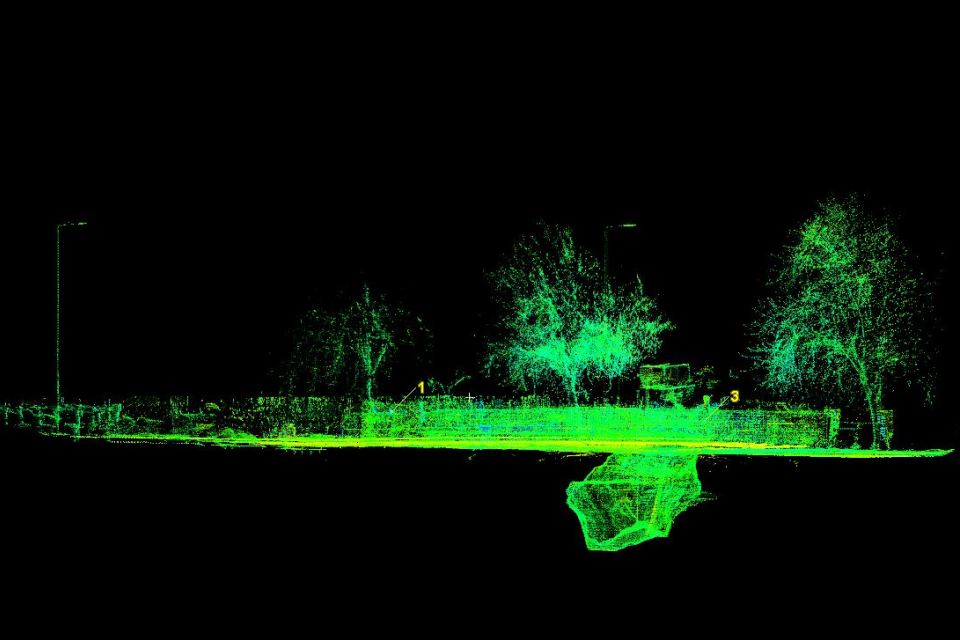
Laser scan showing the void beneath Kilbowie Road

The depth of the mine shaft is the equivalent to the height of 14 double decker buses stacked on top of one another.

Our team of experts designed a solution to safely:

  • fill the shaft with 140 tonnes of stone and inject 217 tonnes of pressurised grout
  • construct a reinforced concrete cap

This repair was further complicated by exposed utility services in the void that needed to be protected during the works. A fractured foul water sewer and storm water drain within the ground collapse also made the repair more complex, with water needing to be pumped over 150 metres around the void during the works.
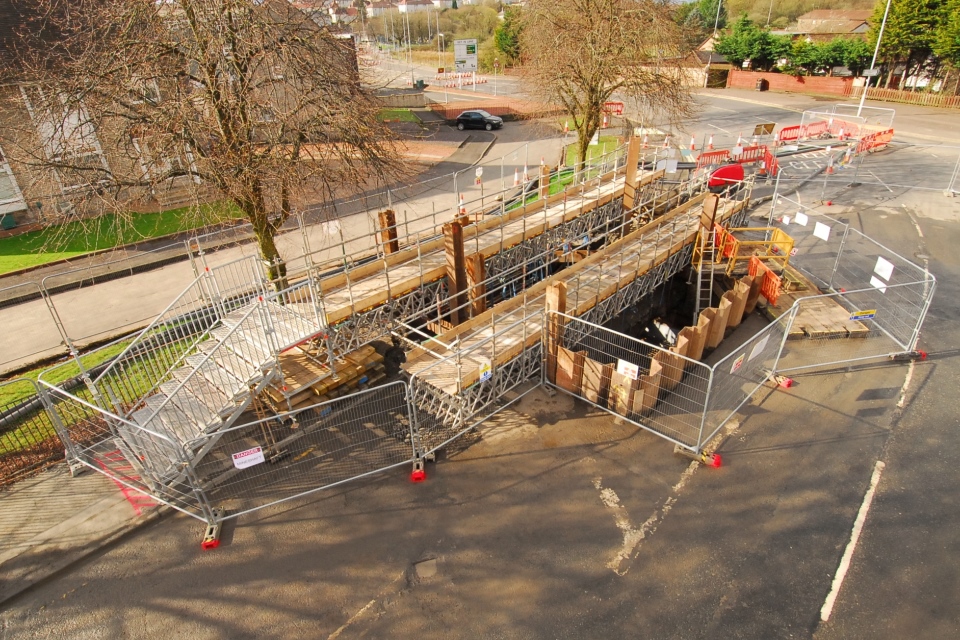
The Coal Authority's works at Kilbowie Road, Clydebank
The Coal Authority’s works at Kilbowie Road, Clydebank

Tim Marples, Head of Public Safety and Subsidence, said:

“Our team has now completed works to secure the mine shaft and we’ve handed over the site to West Dunbartonshire Council who are leading on the road reinstatement works.

“It’s been a complex repair project, but our team’s been operating 7 days a week to ensure it was completed as quickly as possible.

“We’d like to thank residents for their patience while our works have taken place.”

A West Dunbartonshire Council spokesperson said:

“Following the completion of the Coal Authority’s repairs, work will begin to fill the void above the shaft, reinstate services, commence the road reconstruction and resurface the road.

“This phase of the repairs was anticipated to take up to 16 weeks, however, we hope to have completed this work by the end of June.

“If residents have any specific queries we would encourage them to email roads@west-dunbarton.gov.uk so that we can help.”

News story: Laser technology used in works to secure mine shaft

image_pdfimage_print

Works are now complete to secure an unrecorded mine shaft, which caused a ground collapse at Kilbowie Road, Clydebank.

The collapse was caused by a mine shaft that was not detailed in historical mining records, but we believe that it was used to extract coal, limestone and iron ore over 100 years ago.

While only a 6 metre diameter hole was initially visible at the surface, investigations using laser scanning technology identified this led to a 200 cubic metre void on top of the unrecorded mine shaft, which went down a further 56 metres.

Laser scan showing the void beneath Kilbowie Road

The depth of the mine shaft is the equivalent to the height of 14 double decker buses stacked on top of one another.

Our team of experts designed a solution to safely:

  • fill the shaft with 140 tonnes of stone and inject 217 tonnes of pressurised grout
  • construct a reinforced concrete cap

This repair was further complicated by exposed utility services in the void that needed to be protected during the works. A fractured foul water sewer and storm water drain within the ground collapse also made the repair more complex, with water needing to be pumped over 150 metres around the void during the works.

The Coal Authority’s works at Kilbowie Road, Clydebank

Tim Marples, Head of Public Safety and Subsidence, said:

“Our team has now completed works to secure the mine shaft and we’ve handed over the site to West Dunbartonshire Council who are leading on the road reinstatement works.

“It’s been a complex repair project, but our team’s been operating 7 days a week to ensure it was completed as quickly as possible.

“We’d like to thank residents for their patience while our works have taken place.”

A West Dunbartonshire Council spokesperson said:

“Following the completion of the Coal Authority’s repairs, work will begin to fill the void above the shaft, reinstate services, commence the road reconstruction and resurface the road.

“This phase of the repairs was anticipated to take up to 16 weeks, however, we hope to have completed this work by the end of June.

“If residents have any specific queries we would encourage them to email roads@west-dunbarton.gov.uk so that we can help.”

Local rail improvements

image_pdfimage_print

I am all in favour of providing more seats and more train capacity locally for passengers. I have been pressing for better services.

I have recently been sent the plans for a two platform  station at Green Park, and told of the works to extend the platforms at Wokingham to take longer trains.

The new Green Park stop will be between Reading and Mortimer on the Basingstoke line, near Kirtons Farm Road. The idea is to run a half hourly train service in each direction when it is completed.

If constituents have views on either of these projects please let me know.

Press release: Foreign Secretary on first official visit to Greece

image_pdfimage_print

The Foreign Secretary Boris Johnson is visiting Athens on 6 and 7 April.

The Foreign Secretary is visiting Greece to underline the strength of the UK-Greece relationship and our cooperation on a wide range of areas including migration, organised crime and counter terrorism.

During his visit the Foreign Secretary Boris Johnson will meet with the Prime Minister Alexis Tsipras and Foreign Minister Nikos Kotzias.

Speaking from Athens, the Foreign Secretary Boris Johnson said:

Greece is an important partner for the UK. We work closely together on our joint security and defence objectives in the region and our shared goal of a Cyprus Settlement. As we prepare to leave the EU, I look forward to strengthening our historic ties.

Further information

News story: Foreign Office appoints new Non Executive Directors

image_pdfimage_print

Miranda Curtis has been appointed as lead non-executive director, and Sir Edward Lister has been appointed as a member non-executive director.

They take up their appointments with immediate effect.

Miranda Curtis’s expertise is in building multinational leadership teams, the negotiation and oversight of international joint ventures, and cross-border deal making.

Sir Edward Lister’s background is in facilitating large-scale urban regeneration schemes and coordinating major public & private sector partnerships.

Head of the UK Diplomatic Service, Sir Simon McDonald said:

I welcome Miranda and Sir Edward to the Foreign Office’s Board. They know how to manage large projects in both the commercial and public sectors and will give us invaluable support.

Further Information:

Miranda Curtis is Non-executive director of Marks and Spencer Plc and Deputy Chair of the Royal Shakespeare Company. She spent her executive career in international media and telecoms, with over 20 years at Liberty Global. She joined the board of Liberty in 2010.

Sir Edward is Chairman of the Homes and Communities Agency (HCA). Previous roles include Chief of Staff to the Mayor of London, Deputy Mayor for Policy and Planning at City Hall and Leader of Wandsworth Council. He was also the Chairman of the Old Oak Common Development Corporation.