

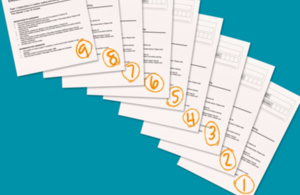
The vast majority of students taking GCSEs in England in 2019 will receive grades from 9 to 1. Students taking 5 lesser-taught GCSE subjects (Biblical Hebrew, Gujarati, Persian, Portuguese and Turkish) will receive letter grades in 2019 before they become numerical (9 to 1) in 2020.
9 things to know about the new GCSE grades
- GCSEs in England have been reformed and are graded with from 9 to 1, with 9 being the highest grade.
- GCSE content is more challenging.
- Fewer grade 9s are be awarded than A*s.
- The new grades are being brought in to signal that GCSEs have been reformed and to better differentiate between students of different abilities.
- In the first year each new GCSE subject has been introduced, broadly the same proportion of students get a grade 4 or above as would have got a grade C or above in the old system.
- These changes are only happening in England. Wales and Northern Ireland are not introducing the new 9 to 1 grading scale as part of their changes to GCSEs.
- English language, English literature and maths were the first to be graded from 9 to 1 in 2017.
- Another 20 subjects had 9 to 1 grading in 2018, with most others following in 2019. During this transition, students received a mixture of letter and number grades.
- You can see how the 9 to 1 grades compare with the A* to G scale in our GCSE grading postcard.
GCSE science
GCSEs for science have changed in England. Students taking separate science GCSEs now get a grade from 9 to 1 in each subject. Combined science draws content from all three subjects and students receive an award worth two GCSEs, consisting of two equal or adjacent grades.
5 things to know about combined science GCSEs
- Students taking separate science GCSEs get a grade from 9 to 1 for each subject, with 9 being the highest grade.
- Students studying combined science receive an award worth two GCSEs, consisting of two equal or adjacent grades from 9 to 1 (9-9, 9-8, 8-8, 8-7, 7-7…to 1-1).
- If the numbers are different, the highest number will always be reported on the left.
- Students do at least 8 practical activities (16 for combined science) covering specific apparatus and techniques.
- Exam questions about practical work make up at least 15% of the total marks for the qualification.
More information
We’ve got lots of information to help students, parents, teachers and businesses understand the changes. You can:
And if you’ve got any questions, drop us an email at public.enquiries@ofqual.gov.uk or give us a call on 0300 303 3344.
Last updated 6 August 2019 + show all updates
- Updated to reflect that we are in the third year of GCSE reforms.
- Article now shows the updated video.
- Added results day guides for students and parents.
- First published.