Foreign and Chinese companies equal under Made in China 2025

image_pdfimage_print

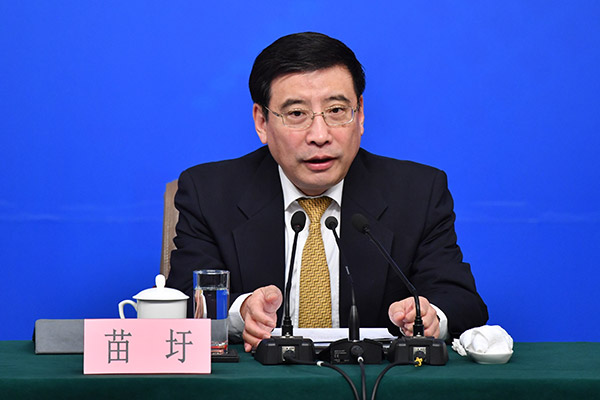
Miao Wei, minister of industry and information technology, answers questions at a press conference for the fifth session of the 12th NPC in Beijing, capital of China, March 11, 2017. [Photo/Xinha]

Foreign and Chinese enterprises will continue to be treated equally as the country steps up efforts to implement the Made in China 2025 initiative, Miao Wei, Minister of Industry and Information Technology, said.

The initiative, which was designed to promote high-end manufacturing in China, adheres to the government-led, market-oriented principles, Miao said.

“It is meant to allow the market to play a decisive role in allocating resources.”

Miao made the comments at a press conference during the annual session of National People’s Congress on Saturday.

According to Miao, the Made in China 2025 initiative is in line with common international practices.

The United States, Germany and other European countries also rolled out similar policies to upgrade their manufacturing industries.

“Foreign enterprises have played an active role in driving China’s economic growth in the past three decades. Foreign companies and domestic enterprises are and will be treated equally,” Miao said.

Long-term care insurance may become mandatory

image_pdfimage_print

As part of the national effort to defuse a demographic “time-bomb”, China is very likely to introduce compulsory long-term care insurance to cope with ever-increasing care needs, particularly for the elderly who have a difficult time living independently due to age, illness or disability, said a national political advisor.

Hu Xiaoyi, former vice-minister of human resources and social security and a member of the National Committee of the Chinese People’s Political Consultative Conference, made the remarks on the sidelines of the ongoing two sessions.

China has an increasingly aging population coupled with surging chronic diseases, and “it’s the right time to introduce such a new social insurance program as a pre-emptive approach”, said Hu, now head of the China Social Insurance Association.

China has 150 million people aged 65 and older, with at least 40 million of them partially and fully disabled.

To leave such elderly people fully dependent on their children for long-term care is, in Hu’s opinion, unrealistic.

“It has become a universal social problem facing all families and thus should be addressed with a package of resources including the individual family, the government and the entire society, or the social insurance,” he noted.

Currently, China has five social insurance programs – elderly care, health, unemployment, work injury and maternity. They are run by the government and premiums are paid by the individual and the employer on a compulsory basis.

Hu expected long-term care would be the sixth.

All families, whether or not in urgent need of care, should participate in the program to prepare for potential future challenges, he urged.

According to him, care under the program is more household-based and would sometimes require professional medical intervention.

Recipients should be categorized according to various levels of dependency, he added.

But he stressed that more testing and research are required to roll out the program nationwide.

“The trial run should start with disabled seniors,” he said.

Such trials also assist in setting standards and level of premiums, he added.

Hu suggested a family-based approach for premium collection rather than an individual basis.

Countries such as Germany, Japan and South Korea have pioneered setting up such social security programs, according to the World Health Organization.

Sun Jie, another CPPCC member, said the program had proved helpful in addressing the long-term care demands of the old who have disabilities.

Sun, also deputy director of the School of Insurance and Economics at the University of International Business and Economics in Beijing, added that some trials under way in China would provide experience for a future scale-up of the program nationwide.

Press release: ‘Brand Britannia’ dominates the field at world’s largest music, film and interactive media festival

image_pdfimage_print

Brit Award and Turner Prize winners, including Rag n’ Bone Man, will join over 70 leading UK tech and digital businesses showcasing ‘Brand UK’ at the world’s largest creative festival in Texas this weekend.

Over 1,500 UK delegates are traveling to Austin, Texas, as the UK is set to have the biggest international presence at the South by Southwest (SXSW) festival. Performers and businesses will look to break into lucrative US and international markets, supported by government and industry experts such as Mick Fleetwood of Fleetwood Mac.

The Department for International Trade is supporting UK businesses to attend including virtual reality technology firms from Northern Ireland, companies from London developing smart cities solutions and delegates from Birmingham, Manchester and Wales. They will be helped by DIT to build vital contacts with international investors, bringing in tens of millions of pounds to the UK economy.

International Trade Minister Greg Hands, who will visit the event this weekend, said:

Our huge presence here at South by Southwest, the biggest of any country outside the US, shows the strength of ‘Brand Britannia’ internationally. From what we watch and listen to, to the new technologies making our cities better places to live – UK companies and individuals are here demonstrating ground-breaking ideas that are leading the world.

Last year we helped boost new export opportunities for our home-grown businesses by around £10 million and with our biggest ever delegation, this year aims to be even bigger and better.

The festival, which last year welcomed 87,000 participants including former US President Barack Obama, is a huge opportunity for performers and businesses to attract investment into the UK’s £90 billion creative industries.

Through government support in 2015 over 20 inward investment projects to the UK, and over £10 million in new export business wins for UK companies, was generated from SXSW. One company, Trackd, an app which allows musicians to record and share music studio-style, secured a £1.25 million contract through DIT support at SXSW.

Also, successful artists such as Bastille, and The 1975 have used the festival to launch their US careers, selling millions of records in the country. DIT is the lead partner of the British Music Embassy, a venue in Austin where for the tenth year the department and UK music industry will showcase the best new British music artists. The British Music Embassy will host over 50 performances from artists such as Rag n’ Bone Man and Yorkshire-based punk newcomers Life, who are included in the BBC Introducing showcase.

Throughout the week long event, DIT will host performers, businesses and investors for three days at the Great Britain House – a national pavilion showcasing the very best the UK has to offer in the tech, creative and music industries.

Events include:

  • a Q&A session for British businesses with Mick Fleetwood: legendary drummer, band leader and founding member of world-renowned rock group, Fleetwood Mac
  • sessions on the impact of AI on artists with Arts Council England and nine creative delegates, from an interactive dance company to a cutting-edge virtual orchestra
  • workout sessions from global UK sports brand Sweaty Betty

One company attending SXSW with DIT support is Pavegen, based in London and Cambridge – demonstrating its revolutionary street paving which generates electricity from footsteps and captures data within the urban environment.

Laurence Kemball-Cook, founder and CEO of Pavegen said:

This year’s South by Southwest is crucial for us, helping us to build vital relationships with some of our most important international customers. With the support of the Department for International Trade we’re now closing some of our biggest deals yet, in the US and beyond.

Notes to editors

  • Founded in 1987 in Austin, Texas, SXSW is best known for its conference and festivals that celebrate the convergence of the interactive, film and music industries
  • SXSW 2016 featured more than 2,000 sessions including keynotes by President Barack Obama and First Lady Michelle Obama, plus dozens of visionaries at the forefront of their industries to more than 87,000 participants

Further information

UN aid chief urges global action as starvation, famine loom for 20 million across four countries

image_pdfimage_print

10 March 2017 – Just back from Kenya, Yemen, South Sudan and Somalia – countries that are facing or are at risk of famine – the top United Nations humanitarian official today urged the international community for comprehensive action to save people from simply “starving to death.”

“We stand at a critical point in history. Already at the beginning of the year we are facing the largest humanitarian crisis since the creation of the UN,” UN Emergency Relief Coordinator Stephen O’Brien told the Security Council today.

Without collective and coordinated global efforts, he warned, people risk starving to death and succumbing to disease, stunted children and lost futures, and mass displacements and reversed development gains.

“The appeal for action by the Secretary-General can thus not be understated. It was right to sound the alarm early, not wait for the pictures of emaciated dying children […] to mobilize a reaction and the funds,” Mr. O’Brien underscored, calling for accelerated global efforts to support UN humanitarian action on the ground.

Turning to the countries he visited, the senior UN official said that, about two-thirds of the population (more than 18 million people) in Yemen needed assistance, including more than seven million severely food insecure, and the fighting continued to worsen the crisis.

“I continue to reiterate the same message to all: only a political solution will ultimately end human suffering and bring stability to the region,” he said, noting that with access and funding, humanitarians will do more, but cautioned that relief-workers were “not the long-term solution to the growing crisis.”

In South Sudan, where a famine was recently declared, more than 7.5 million people are in need of assistance, including some 3.4 million displaced. The figure rose by 1.4 million since last year.

“The famine in the country is man-made. Parties to the conflict are parties to the famine – as are those not intervening to make the violence stop,” stressed Mr. O’Brien, calling on the South Sudanese authorities to translate their assurances of unconditional access into “action on the ground.”

Similarly, more than half the population of Somalia (6.2 million people) is need aid, 2.9 million of whom require immediate assistance. Extremely worrying is that more than one million children under the age of five are at the risk of acute malnourishment.

“The current indicators mirror the tragic picture of 2011, when Somalia last suffered a famine,” recalled the UN official, but expressed hope that a famine can be averted with strong national leadership and immediate and concerted support by the international community.

Concerning Kenya, he mentioned that more than 2.7 million people were food insecure, and that this number could reach four million by April.

“In collaboration with the Government [of Kenya], the UN will soon launch an appeal of $200 million to provide timely life-saving assistance and protection,” he informed.

Further in his briefing, Mr. O’Brien informed the Council of the outcomes of the Oslo Conference on the Lake Chad Basin where 14 donors pledged a total of $672 million, of which $458 million is for humanitarian action in 2017.

“This is very good news, and I commend those who made such generous pledges,” he said but noted that more was needed to fully fund the $1.5 billion required to provide the assistance needed across the region.

On the UN response in these locations, Mr. O’Brien highlighted that strategic, coordinated and prioritized plans are in place and dedicated teams on the ground are closely working with partners to ensure that immediate life-saving support reaches those in need.

“Now we need the international community and this Council to act,” he highlighted, urging prompt action to tackle the factors causing famine; committing sufficient and timely financial support; and ensuring that fighting stops.

In particular, he underscored the need to ensure that humanitarians have safe, full and unimpeded access and that parties to the conflict in the affected countries respect humanitarian law and called on those with influence over the parties to the conflict to “exert that influence now.”

“It is possible to avert this crisis, to avert these famines, to avert these looming human catastrophes,” he concluded. “It is all preventable.”

Security Council encourages Syrian parties to take part in UN-supported talks ‘without preconditions’

image_pdfimage_print

10 March 2017 – Looking forward to the early resumption of the United Nations-facilitated intra-Syrian negotiations, the Security Council today encouraged the Syrian parties to return to talks in good faith “and to engage constructively and without preconditions” on the agenda set out by UN Special Envoy Staffan de Mistura when they resume.

In a press statement that follows a briefing earlier this week from Mr. de Mistura, the Council welcomed the conclusion of a further round of intra-Syrian negotiations in Geneva on 3 March 2017. It further welcomed the Special Envoy’s announcement that the talks had yielded a clear agenda for future negotiations as indicated by resolution 2254 (2015), focusing on governance; constitutional issues; elections; and counter terrorism, security and confidence building measures.

The members of the Security Council reiterated their commitment to ensuring the inclusion of Syrian women in the political process through sustained consultation and dialogue and promoting their full and effective participation.

Recognizing that the continuation of political negotiations was made possible by the ceasefire developed through the Astana process, the Council called on the Syrian parties to fully implement the ceasefire, established pursuant to the arrangements of 29 December 2016, including ending ceasefire violations and ensuring humanitarian access.

The Council also encouraged the International Syria Support Group (ISSG) members to use their influence over the parties to help end violations, reduce violence, build confidence and ensure safe, sustained and unhindered humanitarian access in line with its resolution 2165 (2014).

The ISSG established respective taskforces on humanitarian aid delivery and a wider ceasefire. They have been meeting separately since early 2016 on a way forward in the crisis. Russia and the United States are the co-chairs of the taskforces and the ISSG, which also comprises the UN, the Arab League, the European Union and 16 other countries.

In his briefing to the Council, Mr. de Mistura had expressed his intention “to bring the invitees back to Geneva for a fifth round with a target date of 23 March.”