News story: New appointments to Supreme Court and Court of Appeal

The Queen has been pleased to approve the appointment of The Rt Hon the Baroness Hale of Richmond as President of the Supreme Court of the United Kingdom on the retirement of The Rt Hon Lord Neuberger of Abbotsbury in September 2017.

Justices of the Supreme Court

Three other appointments as Justices of the Supreme Court have been approved by The Queen:

  • The Rt Hon Lady Justice Black DBE on the retirement of The Rt Hon Lord Toulson in July 2016
  • The Rt Hon Lord Justice Lloyd Jones on the retirement of The Rt Hon the Lord Clarke of Stone-cum-Ebony in September 2017
  • The Rt Hon Lord Justice Briggs on the retirement of The Rt Hon the Lord Neuberger of Abbotsbury in September 2017

The appointments will take effect from a date to be agreed with the President of the Court.

Lord and Lady Justices of Appeal

The Queen has also approved the appointment of one Lady Justice, Mrs Justice Asplin and six Lord Justices of Appeal, Mr Justice Coulson, Mr Justice Holroyde, Mr Justice Peter Jackson, Mr Justice Leggatt, Mr Justice Newey and Mr Justice Singh.

These appointments will fill forthcoming vacancies in the Court of Appeal arising from autumn 2017.

These appointments are to be made in light of forthcoming retirements in the Court of Appeal and vacancies that arise as a consequence of a number of changes including the appointment of Sir Ian Burnett as Lord Chief Justice and Sir Adrian Fulford as Investigatory Powers Commissioner.

The appointment of Lord and Lady Justices of the Court of Appeal are made by Her Majesty The Queen on the advice of the Prime Minister and the Lord Chancellor following the recommendation of an independent selection panel.

Biographical notes

The Rt Hon the Baroness Lady Hale of Richmond

The Rt Hon the Baroness Lady Hale of Richmond was appointed Deputy President of The Supreme Court in June 2013 having been appointed a Lord of Appeal in Ordinary in January 2004 and a Justice of the Supreme Court when it opened in October 2009.

Lord Justice Lloyd Jones

Lord Justice Lloyd Jones was called to the Bar in 1975 (Middle Temple). From 1975 to 1991 he was a Fellow of Downing College, Cambridge. He was appointed as Queen’s Counsel in 1999. Lord Justice Lloyd Jones was appointed to the High Court in 2005, and was assigned to the Queen’s Bench Division. He served as a Presiding Judge on the Wales Circuit and Chair of the Lord Chancellor’s Standing Committee on the Welsh Language from 2008 to 2011. From August 2012 to August 2015 he was Chair of the Law Commission. He was appointed as a Lord Justice of Appeal in 2012.

Lady Justice Black

Lady Justice Black was called to the Bar (Inner Temple) in 1976. In 1994 she was appointed as Queen’s Counsel and became a Deputy High Court Judge in 1996. She was appointed to the High Court in 1999, assigned to the Family Division; she also sat in the Administrative Court. Lady Justice Black served as Family Division Liaison Judge on the Northern Circuit from 2000-2004. In 2004 she became the Chairman of the Judicial Studies Board’s Family Committee, until her appointment to the Judicial Appointments Commission in 2008. She was appointed a Lady Justice of Appeal in 2010. In 2013, she was appointed as Head of International Family Justice.

Lord Justice Briggs

Lord Justice Briggs was called to the Bar (Lincoln’s Inn) in 1978. He was appointed as Queen’s Counsel in 1994. In 2001 he was appointed as the Attorney General to the Duchy of Lancaster, a position he held until 2006. He was appointed to the High Court in 2006, assigned to the Chancery Division. Lord Justice Briggs was the Judge in charge of the Chancery Modernisation Review in 2013, and has been the Personal Support Unit liaison judge since 2013. He was appointed as a Lord Justice of Appeal in 2013. On 1 January 2016 he was appointed Deputy Head of Civil Justice.

Mrs Justice Asplin

Mrs Justice Asplin: Called to the Bar (Gray’s Inn) in 1984. She was appointed both a Master of the Bench and Queen’s Counsel in 2002. She was made a Deputy High Court Judge in 2007 and a Justice of the High Court (Chancery Division) in October 2012. She is responsible for issues and co-ordination in relation to litigants in person on behalf of the Judiciary and has written a Guide to the Chancery Applications Court for Litigants in Person.

Mr Justice Coulson

Mr Justice Coulson: Called to the bar (Gray’s Inn) in 1982 after graduating from the University of Keele. He became a well-respected junior at the Technology and Construction Bar from 1983 onwards. He was appointed Queen’s Counsel in 2001 and he became a Recorder the same year. In 2004, he was appointed a Senior Circuit Judge in the Technology and Construction Court. In 2008 he was appointed as a High Court Judge in the Queen’s Bench Division. He was a presiding Judge of the North Eastern Circuit between 2011 and 2014. He was appointed as the Judge in Charge of the Technology and Construction Court in 2016.

Mr Justice Holroyde

Mr Justice Holroyde: Called to the bar (Middle Temple) in 1977 and took silk in 1996. He was appointed as a Recorder in 1997 and as a High Court Judge in the Queen’s Bench Division in January 2009. He was a Presiding Judge on the Northern Circuit from 2012 until 2015.

Mr Justice Peter Jackson

Mr Justice Peter Jackson: Called to the bar (Inner Temple) in 1978 and took silk in 2000. He was appointed as a Recorder in 1998, a Deputy High Court Judge in 2003 and a High Court Judge in the Family Division in October 2010.

Mr Justice Leggatt

Mr Justice Leggatt: Called to the Bar (Middle Temple) in 1982. He practised as a barrister specialising in commercial law. He was appointed Queen’s Counsel in 1997. He became a Recorder of the Crown Court in 2002 and a Deputy High Court Judge in 2008. He was made a Justice of the High Court (Queen’s Bench Division) in October 2012.

Mr Justice Newey

Mr Justice Newey: Called to the Bar (Middle Temple) in 1982. He practised at the Chancery Bar between 1983 and his appointment as a High Court Judge at the beginning of 2010. Before taking silk in 2001, he was one of the Junior Counsel to the Crown (Chancery/A Panel) (from 1990) and Junior Counsel to the Charity Commissioners (from 1991). In 2003 he became an (Acting) Deemster of the Isle of Man, and in 2006 he was appointed as a Deputy High Court Judge. He also served as a DTI inspector, inquiring into the affairs of MG Rover and associated companies. He has been the Chancery Supervising Judge for the Midland, Wales and Western Circuits since 2014.

Mr Justice Singh

Mr Justice Singh: Called to the Bar (Gray’s Inn) in 1989 and was appointed Queen’s Counsel in 2002. His practice was mainly in the areas of public law, human rights and employment law. He was one of the Junior Counsel to the Crown, serving on the A Panel from 2000 to 2002. He was also the Additional Junior Counsel to the Inland Revenue from 1997 to 2002 and Chair of the Administrative Law Bar Association from 2006 to 2008. He was appointed as a Deputy High Court Judge in 2003 and a Recorder of the Crown Court from 2004. He was appointed as a High Court Judge in 2011. He was a Presiding Judge on the South Eastern Circuit from January 2013 until December 2016.
Results of the Q3 2017 ECB Survey of Professional Forecasters

PRESS RELEASE

21 July 2017

  • HICP inflation expectations have been revised downwards for 2017, 2018 and 2019. Longer-term HICP inflation expectations remain unchanged at 1.8%.
  • Expectations for HICP excluding food and energy have been revised upwards for 2017, but remained unchanged for forecast horizons further out.
  • Real GDP growth expectations have been revised upwards for 2017, 2018 and 2019.
  • Unemployment rate expectations have been revised downwards.

Respondents to the ECB Survey of Professional Forecasters (SPF) for the third quarter of 2017 reported average point forecasts for inflation of 1.5%, 1.4% and 1.6% in 2017, 2018 and 2019, respectively. That represents downward revisions of 0.1 percentage points at each of those three horizons. Average longer-term inflation expectations (which referred to 2022) remained unchanged at 1.8%.

Expectations for the annual inflation rate of HICP excluding food and energy were revised upwards for 2017, to 1.1%, but remained unchanged for all other forecast horizons (1.3% in 2018, 1.5% in 2019 and 1.7% in 2022).

SPF respondents revised their expectations for growth in euro area economic activity upwards for 2017 and 2018 by 0.2 percentage points to 1.9%, and 1.8%, respectively. Expectations for economic growth in 2019 were revised up by 0.1 percentage points to 1.6%. There were no changes to longer-term economic growth expectations (1.6%).

Unemployment rate expectations continued to show a declining trajectory. The average point forecasts were 9.2%, 8.8% and 8.4% for 2017, 2018 and 2019, respectively. Relative to the SPF for the second quarter of 2017, this represents downward revisions of 0.2, 0.3 and 0.3 percentage points for 2017, 2018 and 2019, respectively. The average point forecast for the longer-term unemployment rate (which referred to 2022) was revised downwards by 0.3 percentage points, to 8.1%.

Table: Results of the ECB Survey of Professional Forecasters for Q3 2017

(annual percentage changes, unless otherwise indicated)

Survey horizon

2017

2018

2019

Longer term (1)

HICP inflation


SPF Q3 2017

1.5

1.4

1.6

1.8

Previous SPF (Q2 2017)

1.6

1.5

1.7

1.8

HICP inflation excluding food and energy

SPF Q3 2017

1.1

1.3

1.5

1.7

Previous SPF (Q2 2017)

1.0

1.3

1.5

1.7

Real GDP growth


SPF Q3 2017

1.9

1.8

1.6

1.6

Previous SPF (Q2 2017)

1.7

1.6

1.5

1.6

Unemployment rate (2)


SPF Q3 2017

9.2

8.8

8.4

8.1

Previous SPF (Q2 2017)

9.4

9.1

8.7

8.4

1) Longer-term expectations refer to 2022 in the Q3 2017 SPF and to 2021 in the Q2 2017 SPF.

2) As a percentage of the labour force.

For media enquiries, please contact Stefan Ruhkamp, tel.: +49 69 1344 5057.

  • The ECB Survey of Professional Forecasters (SPF) is conducted on a quarterly basis and gathers expectations for the rates of inflation, real GDP growth and unemployment in the euro area for several horizons, together with a quantitative assessment of the uncertainty surrounding them. The participants in the survey are experts affiliated with financial or non-financial institutions based within the European Union. The survey results do not represent the views of the ECB’s decision-making bodies or of its staff. The next Eurosystem staff macroeconomic projections will be published on 7 September 2017.
  • Since 2015 the results of the SPF have been released on the ECB’s website. For surveys prior to the first quarter of 2015, see the ECB’s Monthly Bulletin (2002-14: Q1 – February, Q2 – May, Q3 – August, Q4 – November).
  • The SPF survey for the third quarter of 2017 was conducted between 3 and 7 July. The total number of responses was 56, broadly comparable with the average number of responses to surveys in the third quarter of a year (54).
  • The SPF report and data are available via the SPF webpage and via the ECB’s Statistical Data Warehouse.

Media contacts

Euro banknote counterfeiting remains low in first half of 2017

PRESS RELEASE

21 July 2017

  • 331,000 counterfeit euro banknotes were withdrawn from circulation in the first half of 2017
  • Around 85% of the counterfeits were €20 and €50 banknotes
  • All euro banknotes can be verified using the “feel, look and tilt” method
  • Euro banknotes continue to be a trusted and safe means of payment

Some 331,000 counterfeit euro banknotes were withdrawn from circulation in the first half of 2017, a decrease compared with the second half of 2016. The likelihood of receiving a counterfeit is thus very slight. The number of counterfeits remains very low compared with the number of genuine banknotes in circulation, which has risen steadily, at rates above GDP growth, since they were introduced. In 2016, for instance, the number and value of euro banknotes in circulation grew by around 7.0% and 3.9% respectively. There are now over 20 billion euro banknotes in circulation, with a total value of more than €1.1 trillion.

The half-yearly trend is shown below:

Period

2014/1

2014/2

2015/1

2015/2

2016/1

2016/2

2017/1

Number of counterfeits

331,000

507,000

454,000

445,000

331,000

353,000

331,000

Breakdown by denomination:

Denomination

€5

€10

€20

€50

€100

€200

€500

Percentage breakdown

1.0%

2.4%

36.9%

47.6%

9.0%

1.6%

1.5%

During the first half of 2017:

  • the €20 and €50 notes continued to be the most counterfeited banknotes. Together, they accounted for 85% of the counterfeits;
  • most of the counterfeits (96.7%) were found in euro area countries. Around 2.3% were found in EU Member States outside the euro area and 1.0% were found in other parts of the world.

Check your banknotes!

Ever since the first series of euro banknotes was issued, the Eurosystem – i.e. the ECB and the 19 national central banks of the euro area – has encouraged people to be vigilant when receiving banknotes. You can check your notes by using the simple “feel, look and tilt” method described in “The €uro” section of the ECB’s website and on the websites of the national central banks. If you receive a suspect banknote, compare it directly with one you know is genuine. If your suspicions are confirmed, please contact the police or – depending on national practice – your national central bank or your own bank. The Eurosystem supports the law enforcement agencies in their fight against currency counterfeiting.

The Eurosystem communicates in various ways to help people distinguish between genuine and counterfeit notes, as well as to help professional cash handlers ensure that banknote-handling and processing machines can reliably identify and withdraw counterfeits from circulation.

The Eurosystem has a duty to safeguard the integrity of the euro banknotes and continue improving banknote technology. The second series of banknotes – the Europa series – is even more secure and is helping to maintain public confidence in the currency.

The new €50 banknote, with its innovative security features, was launched on 4 April 2017. Banknote equipment manufacturers and other suppliers will continue to receive support from the Eurosystem in adapting their machines and authentication devices to the new banknote. If their equipment is still unable to accept this banknote, operators/owners should contact their suppliers or manufacturers without delay.

For media queries, please contact Eszter Miltényi-Torstensson, tel.: +49 69 1344 8034.

Media contacts

Terna: EIB lends EUR 130 million for “Italy-France” interconnector

Italy-France Interconnector

Italy-France Interconnector

Terna: EIB lends EUR 130 million for “Italy-France” interconnector

21/07/2017

EIB

[Rome, Italy]

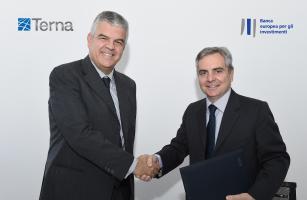
An agreement was signed today between Terna and the European Investment Bank (EIB) for a EUR 130 million loan in support of investments for the public component of the “Piedmont-Savoy” project, the new 320 kV direct current electricity interconnector that will link Italy and France. The loan has a term of 22 years and a fixed interest rate of 1.64%.

“We are very proud of the contribution that the European Investment Bank has chosen to provide to this strategically important project, which will make Europe’s entire power grid more efficient and safer and help to implement the single electricity market”, remarked Luigi Ferraris, Terna’s CEO. “The interconnector with France is an innovative project that is unique globally thanks to the engineering solutions adopted, combining sustainability and development, as provided for in Terna’s investment plan for the country.”   

“This operation confirms the EU bank’s engagement in the vital sector of energy networks and further consolidates its fruitful partnership with Terna: in recent years we supported with EUR 1 billion financings in total the Italian network operator’s key investment plans to upgrade and develop the electricity transmission network”, said EIB Vice-President Dario Scannapieco.

The high-voltage power interconnector between Piossasco (Italy) and Grande-Île (France) known as “Piedmont-Savoy” provides for an overall cross-border exchange capacity (combining public and private components) of 1 200 MW. The project will use technological solutions that are unprecedented globally and has been identified by the European Commission as a project of common interest (PCI) at Community level. With a length of 190 km, equally distributed between Italy and France, this will be the world’s longest direct current cable power line, fully integrated within the transmission infrastructure system and therefore ‘invisible’.

The project confirms Terna’s culture in terms of sustainability and respect for the land and is consistent with the strategy of growth designed to combine investment with the objectives of greater safety, minimal environmental impact and lower grid costs. The operation also comes under the EIB’s financing priorities in the fields of energy and environment.

When the work has been completed – the power line is expected to be operational by the end of 2019 – “Piedmont-Savoy” will be the fourth interconnector between Italy and France, serving to increase the exchange capacity between the two countries by some 40% and bolstering the integration and competitiveness of the electricity market, in line with EU strategy.