Press release: Scrap yard licence revoked for illegal activity

The Environment Agency took the action against Robert Wright (snr), the former Company Director of Robby’s Auto Dismantling Ltd in Stanley, County Durham, following a series of breaches of licence conditions after his son took over the business.

The decision means that Robby’s Auto Dismantling Ltd will no longer be authorised to accept and treat waste metals from 15 July 2017.

Environmental permits ensure the protection of the environment and local communities from the risk of pollution caused through the carrying out of waste activities.

Under the regulations, the permit must be in the name of the person who has overall control of the facility and the site must employ an industry qualified technically competent manager to provide waste management advice and guidance.

No application received

The permit for Robby’s Auto Dismantling Ltd was in the name of Robert Wright (snr), meaning he is legally responsible for ensuring the site is compliant. In 2006 he retired and his sons Ian and Robert Wright (jnr) took over. In January 2013 Ian Wright took sole control of the business.

Throughout this period, Environment Officers repeatedly advised Ian and Robert Wright (snr) of the legal requirement to transfer the permit to Ian. No application was ever received and officers were unable to take action against Ian Wright for a number of permit breaches on site because the permit was not in his name. Environment officers deemed these permit breaches to be a result of lack of technical competence.

In addition, the permit holder had failed to pay subsistence fees since 2013.
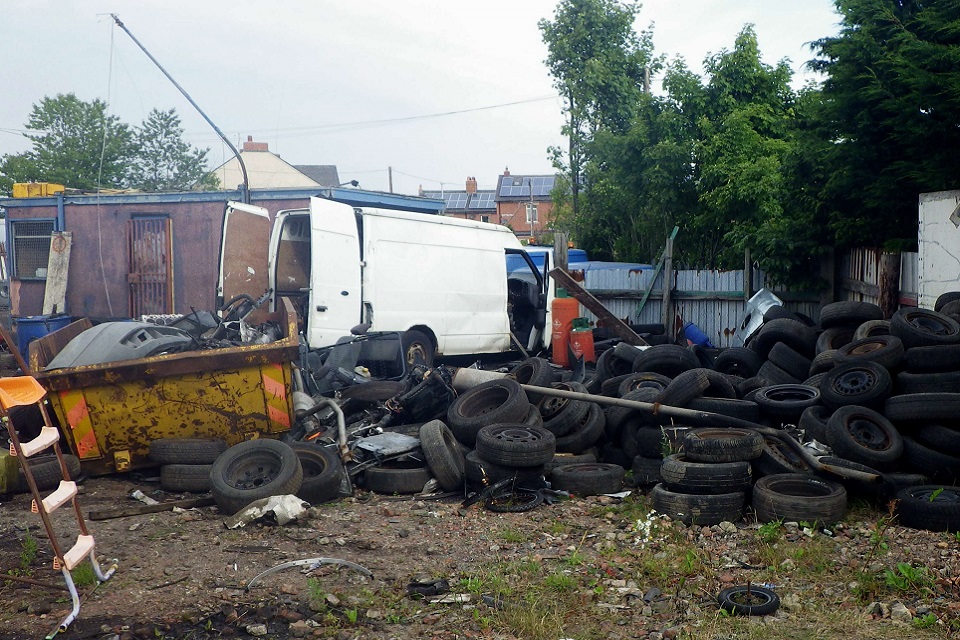
Image shows waste on land at the scrap yard

Permit revoked ‘to protect the environment’

Andrew Rothery from the Environment Agency said:

The Environment Agency has revoked the environmental permit for Robby’s Autos to protect the environment and ensure a level playing field for legitimate businesses. It is clear that the permit holder is not in a position to ensure compliance with permit conditions.

It is vital that waste companies comply with the law so that communities and the environment are not put at risk. We work with operators to help them meet their obligations, but where significant or repeated breaches occur, we will take appropriate action to protect the environment.

The revocation requires all waste is removed from the site and disposed of legally by 31 July 2017. Failure to do so may lead to legal action by the Environment Agency.

Anyone who experiences problems from this or any other waste site is urged to report the matter to the Environment Agency’s incident hotline on 0800 807060 or CrimeStoppers anonymously on 0800 555 111.

UK Chief Medical Officers issue advice for health professionals on physical exercise during pregnancy

The new recommendations aim to reduce issues such as obesity, diabetes and other health concerns during pregnancy. The latest evidence suggests pregnant women should carry out around 150 minutes of ‘moderate intensity’ activity every week.

This is described as ‘activity that makes you breathe faster’ while still being able to hold a conversation.

This new advice is being issued in the form of an infographic, aimed at providing midwives, nurses, GPs, obstetricians, gynaecologists, as well as the leisure sector, with the latest evidence on physical activity during pregnancy.

Chief Medical Officer for Wales, Dr Frank Atherton, said:

“There is strong evidence that shows that regular, moderate exercise during pregnancy can offer women significant benefits. This includes reducing high blood pressure problems, helping to control weight gain, improving sleep, reducing the risk of diabetes, and improving mood. That’s why we want to ensure pregnant women, and the health professionals who support them, are aware of the benefits of physical activity throughout pregnancy.

“Pregnant women who are not currently active, should build up their activity levels slowly, while women who already take part in regular exercise should stay active but listen to their body and adapt their exercise regime if necessary.  A general rule for all pregnant women is, if it feels pleasant, keep going; if it is uncomfortable, then stop and seek advice.”

Women who have not been active before pregnancy are recommended to follow a gradual progression of exercise—beginning with 10 minute bouts of moderate intensity exercise, gradually building up to 150 minutes. The activity should be spread throughout the week, and it is important to remember that ‘every activity counts’.

The new advice was constructed by the CMO Expert Committee for Physical Activity and Pregnancy, which included midwives, obstetricians, exercise physiologist, GPs, Public Health Consultants, Sports Medicine, exercise professionals, nursing and research scientists. The project was led by Professor Marian Knight and Dr Charlie Foster from the University of Oxford. The aim was to produce evidence-based messaging for health professionals to use with the public. The infographic was developed and tested with panels of health professionals and pregnant women before consultation with more than 250 UK based doctors and midwives.

Health professionals are encouraged to use this infographic to discuss the benefits of physical activity with all pregnant women, to help them maintain a healthy lifestyle, with approximately 1 in 20 women being recorded as obese during pregnancy.

The key points are:

  • Pregnant women who are already active should be encouraged to maintain their physical activity levels

  • Women may need to adapt their activity throughout their pregnancy. For example, replacing contact sports with a non-contact sport or an appropriate exercise class

  • Importantly, the evidence supporting this infographic found no evidence of harm for maternal or infant resulting from moderate intensity physical activity

  • Those who were not active before their pregnancy are advised to avoid intense exercise, such as running, jogging, racquet sports, and strenuous strength training. But some activities can be adapted

  • The final safety message is a common sense ‘don’t bump the bump’, referring to all activities which place pregnant women at an increased risk of injury through physical contact

  • The study recommends pregnant women avoid activities where there is an increased risk of falling, trauma or high impact injuries. These include skiing, water skiing, surfing, off-road cycling, gymnastics, horse riding and contact sports such as ice hockey, boxing, football or basketball. They are also discouraged from exercise that requires lying flat on their back after the first trimester

  • If you experience breathlessness before or following minimal exertion, headaches, dizziness, chest pain, muscle weakness affecting balance and calf pain or swelling, seek medical advice. Women may also be advised to reduce/stop physical activity following pregnancy complications such as vaginal bleeding, regular painful contractions or amniotic fluid leakage.

Press release: New measures to allow ratification of Istanbul Convention

The government will introduce new measures to protect women and girls from crimes committed overseas as part of its Domestic Abuse Bill.

The new legislation would be the final step to enable ratification of the Council of Europe Convention on preventing and combating violence against women, known as the Istanbul Convention.

Measures to be included in legislation will extend ‘extra-territorial jurisdiction’ so that certain offences committed by British citizens can be prosecuted in UK courts regardless of where they take place in the world.

Home Secretary, Amber Rudd said:

Domestic abuse has a devastating and life-long impact on victims, their children, family and friends and this government is determined to eradicate it.

These measures will help us bring justice to women who experience these abhorrent crimes anywhere in the world and shows perpetrators there is nowhere to hide.

This government has always been clear that we will ratify the Istanbul Convention and a Domestic Abuse Bill will allow us to deliver on that, demonstrating how we are driving international action to end violence against women.

Lord Chancellor and Justice Secretary David Lidington said:

We must do all we can to prevent Domestic Abuse and provide the very best support to victims.

That is why we are determined that those who commit these deplorable crimes feel the full force of the law.

This Government is committed to delivering a system that protects victims and increases convictions.

Despite record numbers of prosecutions and convictions, there are still two million victims of domestic abuse every year in England and Wales.

Though the UK already complies with most aspects of the Istanbul Convention in the United Kingdom, legislation is required for extra-territorial jurisdiction to cover offences committed by British citizens overseas. This will be included in a Domestic Abuse Bill.

The Prime Minister announced her intention to introduce a draft Domestic Abuse Bill earlier this year to ensure that victims have the confidence to come forward safe in the knowledge that the state and justice system will do everything it can to both support them and their children, and pursue their abuser. The Queen’s Speech set out how a draft Bill will establish a Domestic Violence and Abuse Commissioner, define domestic abuse in law, and ensure that if abusive behaviour involves a child, the court can hand down a sentence that reflects the devastating life-long impact that abuse can have on them.

This government has introduced new laws and tools to protect victims of violence against women and girls including the criminalisation of forced marriage; two new stalking laws; the national roll-out of Domestic Violence Protection Orders and the Domestic Violence Disclosure Scheme; and a new offence of domestic abuse covering controlling and coercive behaviour. To support our commitment to tackling VAWG, we have pledged increased funding of £100 million until 2020.

In most respects we are already compliant with, or go further than, the convention requires, but there remains one outstanding issue in relation to extra-territorial jurisdiction (ETJ) which must be addressed. Article 44 requires that all signatories take the necessary legislative measures to establish ETJ over any offence established in accordance with the convention.

There are still a number of these offences, including rape of an over 18 and sexual assault where ETJ does not yet apply. For this, further amendments to domestic law are necessary to comply and will require primary legislation to be introduced in England and Wales, as well as in Scotland and Northern Ireland. We will seek to do this for England and Wales through a Domestic Abuse Bill.

Press release: UK energy statistics: statistical press release – June 2017

Energy Trends and Energy Prices publications are published today 29 June 2017 by the Department for Business, Energy and Industrial Strategy. The publications cover new data for the first quarter of 2017.

Energy Trends covers statistics on energy production and consumption, in total and by fuel, and provides an analysis of the year on year changes. Energy Prices covers prices to domestic and industrial consumers, prices of oil products and comparisons of international fuel prices.