Press Releases: Under Secretary Shannon’s Meeting With Ambassador Kislyak


Media Note

Office of the Spokesperson

Washington, DC

July 3, 2017


Under Secretary for Political Affairs Thomas Shannon met today with Russian Ambassador Sergey Kislyak to follow up on recent conversations between Secretary of State Rex Tillerson and Russian Foreign Minister Lavrov, and to address the upcoming meeting between Presidents Trump and Putin. Under Secretary Shannon and Ambassador Kislyak also discussed scheduling a new meeting between Under Secretary Shannon and Russian Deputy Foreign Minister Ryabkov, as well as ongoing efforts to address issues of mutual concern in our bilateral relationship.


Press Releases: Belarus National Day


Press Statement

Rex W. Tillerson

Secretary of State

Washington, DC

July 3, 2017


On behalf of the American people, best wishes to the people of Belarus celebrating Independence Day.

The United States remains committed to working with the government and people of Belarus to support the country’s sovereignty and independence, increasing respect for democratic institutions and fundamental freedoms, and promoting a thriving economy. Through continued diplomatic and people-to-people engagement, the United States and Belarus will work to advance the common interests of our two countries. ‎

As we mark this important day, I wish the Belarusian people a peaceful and prosperous year to come.


China starts emergency flood response in Guangxi

China issued a grade-IV emergency response on Monday for rain and floods that have left 16 people dead and 10 missing in south China’s Guangxi Zhuang Autonomous Region.

Soldiers clear away mud after a flood at Riverside Park in Liucheng County of Liuzhou City, south China’s Guangxi Zhuang Autonomous Region, July 3, 2017. Works of epidemic prevention and mud-cleaning are underway as floods subsided in central China’s Hunan Province and south China’s Guangxi Zhuang Autonomous Region. (Xinhua/Deng Keyi)

Heavy rain started in parts of Guangxi on Saturday, forcing the relocation of 92,000 residents, according to the regional civil affairs department.

The disaster has caused around 2.9 billion yuan (430 million U.S. dollars) in direct economic losses.

The Ministry of Civil Affairs (MCA) and the China National Commission for Disaster Reduction have sent teams to assist relief work on the scene.

A grade-IV response, the lowest in China’s emergency response system, requires a 24-hour alerts, daily damage reports, and funds and relief delivered within 48 hours.

Guangxi disaster response and civil affairs authorities have delivered relief supplies and fund of 3.6 million yuan to affected areas.

Thousands battle floods along Yangtze River

Thousands of soldiers, armed police, civil servants and members of the public are battling floods in several provinces along the Yangtze River.

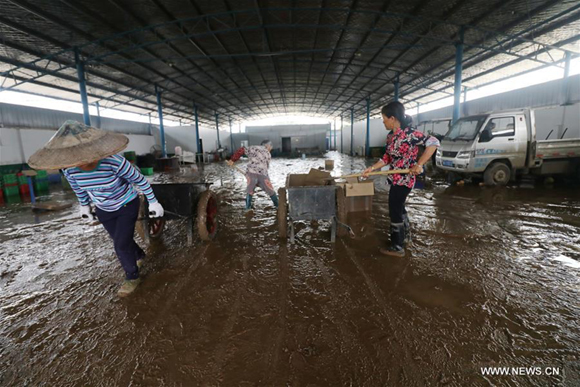
Staff members clear away mud after a flood at a vegetable base in Lianyuan City, central China's Hunan Province, July 3, 2017. Works of epidemic prevention and mud-cleaning are underway as floods subsided in central China's Hunan Province and south China's Guangxi Zhuang Autonomous Region. (Xinhua/Zhang Yang)

Staff members clear away mud after a flood at a vegetable base in Lianyuan City, central China’s Hunan Province, July 3, 2017. Works of epidemic prevention and mud-cleaning are underway as floods subsided in central China’s Hunan Province and south China’s Guangxi Zhuang Autonomous Region. (Xinhua/Zhang Yang) 

In Hunan Province, the water level at the Changsha monitoring station in the Xiangjiang River, a major Yangtze tributary, reached a record high of 39.51 meters early Monday, higher than the previous record of 39.18 meters set by a massive flood in 1998.

Floods have inundated houses, uprooted trees, damaged cars and sabotaged roads in Changsha, capital of Hunan.

The public, even elementary school students who are on summer vacation, volunteered to help fill sandbags to prevent the water from overflowing. Fourth grader Yang Shan, who lives in downtown Changsha, distributed ropes and filled sandbags for soldiers to carry to the riverbank.

Intermittent rain is forecast to last in Changsha until Wednesday, and the city is under heavy pressure to battle flooding.

In neighboring Hubei Province, the Three Gorges Dam on the upper Yangtze has reduced water discharge by 70 percent in the last three days.

Its flow was 27,000 cubic meters per second before July 1, but has now been reduced to 8,000 cubic meters per second, according to the Yangtze River Flood Prevention Headquarters.

The reduction stopped 3 billion cubic meters of water and lowered the water level by up to 1.5 meters, the headquarters said.

“We hope the reduction of outflow will give soldiers and the people enough time to evacuate and stack up sand bags to battle the flood,” said Wu Zhaohui, an official with the water resources bureau in Hubei Province.

In Hubei alone, 16,000 people are on high alert for flooding.

In eastern Jiangxi Province, 28,100 people are battling against the floods, as water levels in the Jiangxi section of the Yangtze and Poyang Lake, China’s largest fresh water lake, have risen above warning levels.

Heavy downpours also hit Sichuan Province on the upper reaches of the Yangtze. Chengdu Shuangliu International Airport in the provincial capital of Chengdu was forced to close down for over an hour on Monday afternoon.

Nearly 8,000 passengers were affected and 40 outbound flights were delayed.

Besides provinces along the Yangtze, other southern areas of China have also been plagued by heavy rain.

Rain-triggered floods have killed 16 people and left 10 missing in Guangxi Zhuang Autonomous Region, with 91,600 local residents relocated so far, according to the regional civil affairs department.

According to the Ministry of Finance, a total of 1.88 billion yuan (276.8 million U.S. dollars) was allocated to 20 provinces and regions Monday to aid disaster relief.

“New Treatment Fund is delivering for the people of Wales” – Vaughan Gething

The New Treatment Fund makes £80 million available over the life of this government, £16m annually, to speed up access to the very latest medicines recommended by the National Institute for Health and Care Excellence (NICE) and the All Wales Medicines Strategy Group (AWMSG).

Under the new system, all health boards in Wales are required to make a NICE or AWMSG recommended medicine available no later than two months from the date the final guidance is published, shortening the maximum amount of time before which a health board must make a treatment available by a third.

As of 9 June, there were 17 applicable medicines available under the New Treatment Fund. 

Six health boards have made all 17 medicines available. One health board, Cardiff & Vale University Health Board, made 15 of the 17 recommended medicines available within the two months, however all 17 medicines are now available.

Welcoming the progress made so far, Vaughan Gething said: 

“I’m pleased that our new treatment fund is working, delivering swift access to innovative new medicines to support people with life-threatening conditions in Wales.

“In January, when I launched the New Treatment Fund, I said a concerted, joint effort was needed between the pharmaceutical industry, NHS Wales and Welsh Government to deliver a sustainable and responsive approach to the introduction of new medicines.

“This was illustrated effectively just last month when the new breast cancer treatment, Kadcyla™, was made available quickly because the manufacturer engaged with NHS Wales to secure an early agreement.   

“It’s good to see we are making good progress, but I expect to see this continue over the five-year period of the fund.

“In the first two months, health board compliance showed some variation in the availability of recommended medicines. I am glad to see that has now been rectified and positive progress has been made so people in Wales can benefit from this potentially life changing policy.”