The Prime Minister Shri Narendra Modi launched the Pradhan Mantri Awaas Yojana-Gramin (PMAY-G) on November 20, 2016. The new Rural Housing programme is designed to meet the needs and aspirations of households.
Jul42017
Jul42017
The Prime Minister Shri Narendra Modi launched the Pradhan Mantri Awaas Yojana-Gramin (PMAY-G) on November 20, 2016. The new Rural Housing programme is designed to meet the needs and aspirations of households.
Jul42017
Students from the Oatridge Campus of Scotland’s Rural College gathered to collect their awards at the annual prize giving.
Jul42017
|
|
|
Artists from Taiwan and the mainland stage a puppet show during the Ninth Straits Forum in Xiamen, Fujian province, in June. [Photo/ Xinhua] |
A growing number of the island’s residents are relocating, lured by new policies, financial incentives and a wider range of opportunities.
‘Since I opened my first store in Sichuan province in December, the mainland’s business potential has exceeded my expectations. I now have four stores,” said Ken Huang, an entrepreneur from Taiwan.
The 37-year-old owner of a handbag brand was among 8,000 people from the island who participated in a weeklong trade exhibition at the Ninth Straits Forum in Xiamen, Fujian province, last month. Most of the attendees were seeking opportunities to expand their businesses in the mainland and exploring the possibility of trading internationally.
Last month, communications and exchanges between people on both sides of the Taiwan Straits continued to rise, despite recent setbacks in political ties.
Although tourism and business activity are developing rapidly, high-level communications between the mainland and Taiwan have been at a low point for more than a year. The relationship between the two sides had been developing constructively based on the 1992 Consensus, a formula for relations between Taipei and Beijing rooted in the understanding that there is only one China, and opposed to “Taiwan independence”.
Things changed in May last year, when the Democratic Progressive Party in Taiwan denied the existence of the 1992 Consensus, consigning dialogue to the deep freeze. That means the Straits Forum – composed of 21 major trade fairs, symposiums and exhibitions – is now the biggest platform for people from both sides of the Straits to seek career opportunities and better lifestyles.
During a speech at the forum, Yu Zhengsheng, China’s top political adviser, announced a series of new policies to be rolled out in the coming months to benefit Taiwan residents in the mainland, and help them enjoy the same status as mainlanders in terms of financial and public services.
A growing presence
The new policies have been formulated as a response to the growing number of people from Taiwan settling in the mainland. According to a report conducted in April by 1111 Job Bank Co in Taiwan, about 700,000 Taiwan residents live and work outside the island, with about 350,000 of them working in the Chinese mainland. Meanwhile, research conducted in March by the Global Views Survey Research Center in Taiwan suggested that nearly 60 percent of Taiwan residents ages 20 to 29 would be willing to work, study or invest in the mainland.
Last year, the number of new businesses in the mainland owned by Taiwan residents rose 32 percent, and by February, nearly 4,000 sole proprietors from the island were operating in the mainland.
More than 20 new policies will be released in the coming months to help Taiwan residents find their feet in mainland cities.
Jul42017
|
|
|
7-year old Chen Yi boasts amazing physique. [Photo: xdkb.net] |
The internet is buzzing about pictures of a 7-year old who is sporting the physique of a world-class athlete.
Local internet site xdkb.net interviewed Chen Yi after he dominated a gymnastics meet in Zhejiang’s capital, Hangzhou, recently.
While Chen Yi won six gold medals and one silver, what have made the headlines are the pictures of him posing!
The boy’s mother, Zhang Hongyu, said that her son was born with innate athletic talent. She claims that when Chen Yi was just 2 years old, he could do a pull-up with just one arm. “He started walking when he was just 11-months old, and he learned to ride a bicycle before kindergarten,” Zhang recalled with a proud smile on her face.
Chen Yi was accepted into the local gymnastics school at the age of five. He now lives at school and only goes home during the weekends. Although his training is tough and intensive, his mother says he never considers giving up.
Asked how he was able to develop his physique, Zhang credits the training her son is going through. “There is nothing special about his diet,” says Zhang “Just like other normal kids, Chen Yi eats around a dozen dumplings for a meal. He also enjoys vegetables, such as cucumber and lettuce.”
Jul42017
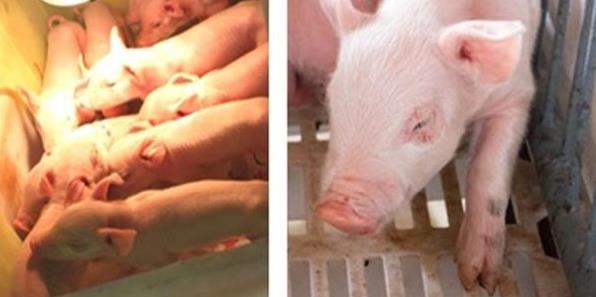
Test results now appear to show an attempt at robot-involved pig cloning at a university in Tianjin has been a success, reports the China News.
|
|
|
The world’s first case of robot-involved pig cloning hailed a success at Nankai University in Tianjin, July 3, 2017. [Photo: sina.com.cn] |
According to the report, 13 cloned pigs delivered by two separate females in April are unrelated to their “surrogate mothers,” but do have kinship with their DNA donors.
While surrogate cloning is not a new technique, this case involves the entire somatic cell nuclear transfer (SCNT) process being completed robotically, said the research group from Nankai University (NKU).
Somatic cell nuclear transfer (SCNT), involves taking an enucleated oocyte, or egg cell, and implanting a donor nucleus from the soma, or the body, of another cell. It’s the standard technique used in reproductive cloning.
But because the technique is very precise, the cloning process is considered one of the most complicated in micro-medicine.
Due to the manual failure rates, SCNT done by human hands has led to a bottleneck of the development of cloning technology, according to Nankai University researchers.
To overcome this, the research team from Nankai University has developed the robotic process which it says can significantly reduce the damage done to cells, which should significantly increase the ability of researchers to test new theories in the cloning process.