News story: Jetty completion marks major milestone in Carrier works

image_pdfimage_print

This is a major milestone in preparations at the naval base where £100m has been invested by the Ministry of Defence (MOD).

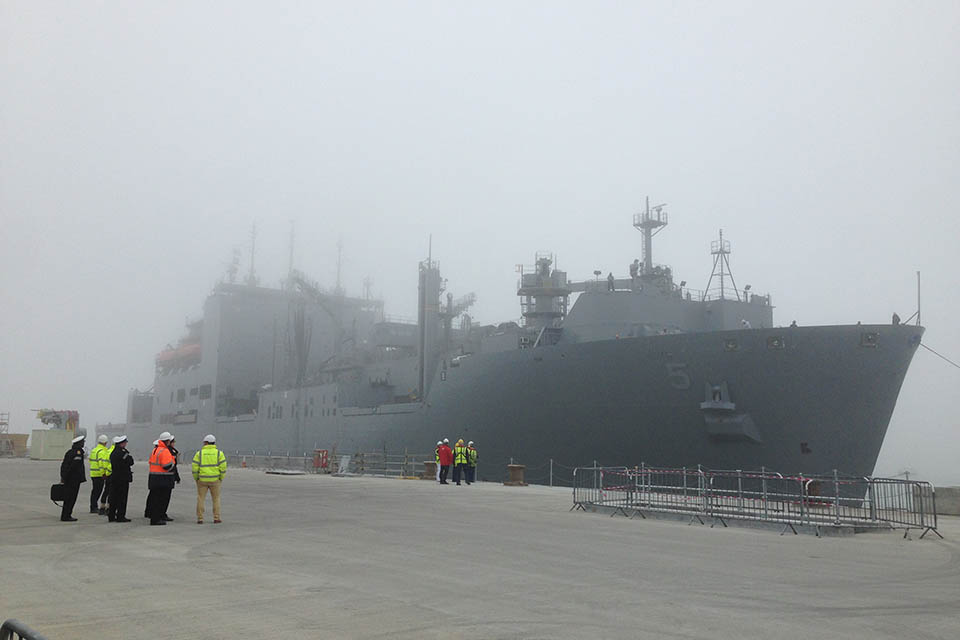
USNS Robert E Peary on the Jetty

The jetty, parts of which date back over 90 years, has been refurbished to prepare for the first of the Queen Elizabeth Class aircraft carriers. This is in addition to the dredging of the approach channel, inner harbour area and berth in order to make them deep and wide enough for the new ships, moving three million cubic metres of clay, sand and gravel from an area the size of 200 football pitches.

Bespoke navigational lights, a high-voltage electrical supply and specialist carrier-specific gangways, known as ‘brows’ are also being provided as part of the huge programme of works. The Defence Infrastructure Organisation (DIO) has worked with VolkerStevin and BAE Systems to deliver the package of infrastructure needed for the carriers.

DIO Project Manager Philip Wise said:

“I am delighted that the works to the jetty are completed. It is a crucial element of the £100m infrastructure package being delivered to support the arrival of the carriers into their homeport of Portsmouth. We are looking forward to seeing the first of the ships berthing against the new and improved jetty later this year.”

With the core jetty works complete and new specialist equipment delivered, the Naval Base’s preparations for the arrival of the Queen Elizabeth Class (QEC) Carriers are centred on a programme of Familiarisation, Integration and Testing, otherwise known as FIT.

This has been designed by BAE Systems on behalf of the Portsmouth Naval Base Commander and Naval Base staff to prepare equipment, personnel and processes for the arrival of the Queen Elizabeth Class Aircraft Carriers. They provide a valuable means to practice and refine standard operating procedures designed for the QEC and to role-play emergency scenarios.

David Mitchard, Managing Director, BAE Systems Maritime Services said:

“In readiness for the arrival of HMS Queen Elizabeth our team at BAE Systems in Portsmouth has put in place a rigorous testing programme for the new infrastructure at the Naval Base. We have a long expertise in maritime support and servicing and are committed to delivering the most innovative and cost-effective solutions to the Royal Navy for these remarkable ships.”

Today (10th March) saw the start of Phase 3 of the FIT trials, using the visit to the Naval Base of the 40,000 Tonne United States Naval Ship Robert E. Peary for live testing of people, processes and equipment.

Royal Navy Captain Iain Greenlees, the QEC Infrastructure Director said:  

“This jetty lies at the very heart of the preparations for the arrival of HMS Queen Elizabeth and the wider development of the Base for this century.  It is tangible evidence of how close we are to the dawn of the QEC era and I am proud of the way the Royal Navy, DIO and Volkerstevin have been able to work together on this challenging project to get us ready for today.”
News story: Jetty completion marks major milestone in Carrier works

image_pdfimage_print

This is a major milestone in preparations at the naval base where £100m has been invested by the Ministry of Defence (MOD).

USNS Robert E Peary on the Jetty

The jetty, parts of which date back over 90 years, has been refurbished to prepare for the first of the Queen Elizabeth Class aircraft carriers. This is in addition to the dredging of the approach channel, inner harbour area and berth in order to make them deep and wide enough for the new ships, moving three million cubic metres of clay, sand and gravel from an area the size of 200 football pitches.

Bespoke navigational lights, a high-voltage electrical supply and specialist carrier-specific gangways, known as ‘brows’ are also being provided as part of the huge programme of works. The Defence Infrastructure Organisation (DIO) has worked with VolkerStevin and BAE Systems to deliver the package of infrastructure needed for the carriers.

DIO Project Manager Philip Wise said:

“I am delighted that the works to the jetty are completed. It is a crucial element of the £100m infrastructure package being delivered to support the arrival of the carriers into their homeport of Portsmouth. We are looking forward to seeing the first of the ships berthing against the new and improved jetty later this year.”

With the core jetty works complete and new specialist equipment delivered, the Naval Base’s preparations for the arrival of the Queen Elizabeth Class (QEC) Carriers are centred on a programme of Familiarisation, Integration and Testing, otherwise known as FIT.

This has been designed by BAE Systems on behalf of the Portsmouth Naval Base Commander and Naval Base staff to prepare equipment, personnel and processes for the arrival of the Queen Elizabeth Class Aircraft Carriers. They provide a valuable means to practice and refine standard operating procedures designed for the QEC and to role-play emergency scenarios.

David Mitchard, Managing Director, BAE Systems Maritime Services said:

“In readiness for the arrival of HMS Queen Elizabeth our team at BAE Systems in Portsmouth has put in place a rigorous testing programme for the new infrastructure at the Naval Base. We have a long expertise in maritime support and servicing and are committed to delivering the most innovative and cost-effective solutions to the Royal Navy for these remarkable ships.”

Today (10th March) saw the start of Phase 3 of the FIT trials, using the visit to the Naval Base of the 40,000 Tonne United States Naval Ship Robert E. Peary for live testing of people, processes and equipment.

Royal Navy Captain Iain Greenlees, the QEC Infrastructure Director said:  

“This jetty lies at the very heart of the preparations for the arrival of HMS Queen Elizabeth and the wider development of the Base for this century.  It is tangible evidence of how close we are to the dawn of the QEC era and I am proud of the way the Royal Navy, DIO and Volkerstevin have been able to work together on this challenging project to get us ready for today.”

News story: Jetty completion marks major milestone in Carrier works

image_pdfimage_print

This is a major milestone in preparations at the naval base where £100m has been invested by the Ministry of Defence (MOD).

USNS Robert E Peary on the Jetty

The jetty, parts of which date back over 90 years, has been refurbished to prepare for the first of the Queen Elizabeth Class aircraft carriers. This is in addition to the dredging of the approach channel, inner harbour area and berth in order to make them deep and wide enough for the new ships, moving three million cubic metres of clay, sand and gravel from an area the size of 200 football pitches.

Bespoke navigational lights, a high-voltage electrical supply and specialist carrier-specific gangways, known as ‘brows’ are also being provided as part of the huge programme of works. The Defence Infrastructure Organisation (DIO) has worked with VolkerStevin and BAE Systems to deliver the package of infrastructure needed for the carriers.

DIO Project Manager Philip Wise said:

“I am delighted that the works to the jetty are completed. It is a crucial element of the £100m infrastructure package being delivered to support the arrival of the carriers into their homeport of Portsmouth. We are looking forward to seeing the first of the ships berthing against the new and improved jetty later this year.”

With the core jetty works complete and new specialist equipment delivered, the Naval Base’s preparations for the arrival of the Queen Elizabeth Class (QEC) Carriers are centred on a programme of Familiarisation, Integration and Testing, otherwise known as FIT.

This has been designed by BAE Systems on behalf of the Portsmouth Naval Base Commander and Naval Base staff to prepare equipment, personnel and processes for the arrival of the Queen Elizabeth Class Aircraft Carriers. They provide a valuable means to practice and refine standard operating procedures designed for the QEC and to role-play emergency scenarios.

David Mitchard, Managing Director, BAE Systems Maritime Services said:

“In readiness for the arrival of HMS Queen Elizabeth our team at BAE Systems in Portsmouth has put in place a rigorous testing programme for the new infrastructure at the Naval Base. We have a long expertise in maritime support and servicing and are committed to delivering the most innovative and cost-effective solutions to the Royal Navy for these remarkable ships.”

Today (10th March) saw the start of Phase 3 of the FIT trials, using the visit to the Naval Base of the 40,000 Tonne United States Naval Ship Robert E. Peary for live testing of people, processes and equipment.

Royal Navy Captain Iain Greenlees, the QEC Infrastructure Director said:  

“This jetty lies at the very heart of the preparations for the arrival of HMS Queen Elizabeth and the wider development of the Base for this century.  It is tangible evidence of how close we are to the dawn of the QEC era and I am proud of the way the Royal Navy, DIO and Volkerstevin have been able to work together on this challenging project to get us ready for today.”

UN agency spotlights role of Governments in preventing child exploitation in tourism

image_pdfimage_print

10 March 2017 – The United Nations-backed meeting on tourism has spotlighted the leading role of Governments in preventing all forms of child exploitation in the leisure travel industry.

“There is a bright and black side to tourism […] We cannot allow the tourism infrastructure to be used for this and shouldn’t have any issues in exposing such situations,” said UN World Tourism Organization (WTO) Secretary-General Taleb Rifai in a press release.

Mr. Rifai was addressing the 32nd meeting of the UNWTO World Tourism Network on Child Protection held yesterday in Berlin, Germany.

The meeting was attended by the Ministers of Tourism of Ghana and Sudan and was an opportunity to share best practices from a number of countries, including India, Kenya, Maldives, Myanmar, and Uruguay.

The meeting highlighted cross-government coordination and commitment as well as cross-sectoral cooperation as key factors to advance child protection in tourism.

The World Tourism Network on Child Protection, formerly the Task Force for the Protection of Children in Tourism, is an open-ended network featuring the multi-stakeholder participation of a range of tourism stakeholders, from governments, international organisations and non-governmental organizations (NGOs) to tourism industry groups and media associations.

Since 2007, its mandate has been to prevent all forms of youth exploitation in the tourism sector, such as sexual exploitation, child labour and child trafficking.

The activities of the World Tourism Network on Child Protection are co-ordinated by the UNWTO Secretariat.

As fresh violence in Yemen sends thousands their homes, UN agency urges international support

image_pdfimage_print

10 March 2017 – With tens of thousands of civilians forced to flee their homes following a spike in fighting across western and central Yemen, the United Nations refugee agency today appealed for more international support, as well as unrestricted access within the country so that it can reach those now facing “abysmal conditions.”

According to the Office of the UN High Commissioner for Refugees (UNHCR), more than 62,000 Yemenis have been displaced over the last six weeks.

“A number of those displaced, including many children, have been reported as suffering from malnutrition, while others are distressed and in need of psycho-social assistance,” William Spindler, a spokesperson for the UN agency, told journalists at a media briefing at the UN Office at Geneva (UNOG) today.

“Many of those displaced are in urgent need of food, shelter and medicine and lack adequate water and sanitation facilities. A number of women also reported psychological distress and malnutrition.”

Facing danger from both the sky and the land

A 28-year-old mother of three who fled her home in Al Mokha (western Yemen) with her husband and children, and another family, crammed into a vehicle for a 150-kilometre, eight hour journey.

This is what she said:

We faced danger from both the sky and the land. We hid at home for most of the time, but when we were nearly killed and our house damaged by the fighting, we just had to leave.

We couldn’t take anything with us – no food, clothes or any belongings because there was hardly any space for the people.

When we arrived in Hudaydah we had nothing, but the community have been so generous. Even though they are also suffering, they gave us a place to stay and helped us out.

Life is too hard. We don’t have enough food and water and we are sick. Many people and their children have infections, and fear has made our bodies and minds weak.

UN response

Together with its partners, UNHCR has stepped up their efforts to help those newly displaced. The response, however, has been hampered by ongoing fighting and restricted access such as in Taiz governorate, which has the highest number of recent displaced.

“Whilst [our] assistance has previously reached Taiz, intensified hostilities at present are hampering access,” Mr. Spindler added, noting similar problems in Dhamar governorate, bordering capital Sana’a.

“[We] continue to advocate for unfettered access and [are] trying to mobilize a response with all national actors on the ground,” he stressed.

At the same time, local host communities are also stretched to capacity and are buckling under the strain of hosting additional, newly displaced populations.

Not including the tens of thousands newly displaced, the governorates of Taiz, Hudaydah and Ibb between them host 25 per cent of Yemen’s total displaced population – more than half a million individuals.

Budget shortfall by 93 per cent

UNHCR too is struggling to cope with the crisis and calling for international support to help its efforts.

Its 2017 budget for Yemen, so far, is only seven per cent funded, leaving it with resources only sufficient to deal with urgent emergency needs and restricted to new waves of displacement.

“We are no longer able to support regular distributions including to internally displaced Yemenis living in collective centres and informal settlements,” said Mr. Spindler.

Before the latest surge, Yemen already had more than two million internally displaced people and one million who provisionally returned to their places of origin but still needing humanitarian assistance.