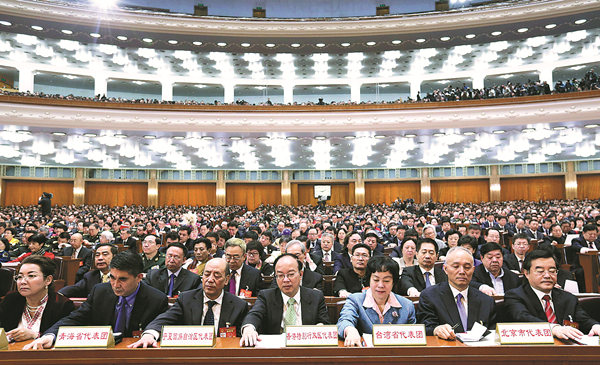
Top legislature adopts key documents, ends session

image_pdfimage_print

NPC deputies cast their votes at the closing of their annual plenary session in the Great Hall of the People on Wednesday. [Liu Zhen / China News Service]

China’s top legislature concluded its 11-day annual plenary session on Wednesday after adopting a number of key documents, paving the way for the country’s development in the coming year.

Of the 2,838 deputies to the National People’s Congress who attended the closing ceremony, the overwhelming majority voted in favor of these documents, including the Government Work Report, the work report of the NPC Standing Committee, the work reports of the top court and top procuratorate and the General Provisions of the Civil Law.

Other documents approved by the lawmakers included the 2017 national economic and social development plan and the 2017 central and local budgets.

The decision on the quota and election of deputies to the 13th NPC, and the methods for electing deputies to the 13th NPC from the Hong Kong and Macao special administrative regions, were also passed with high support.

During this year’s legislative session, national lawmakers filed 514 motions: 492 on legislation, 16 on NPC supervision and six on other issues, according to the NPC.

In his closing remarks, Zhang Dejiang, chairman of the NPC Standing Committee, hailed the achievements made under the leadership of the Communist Party of China Central Committee with Xi Jinping as the core since the 18th National Congress of the CPC in 2012.

Zhang called for maintaining a high degree of consistency with the CPC Central Committee in thoughts, politics and actions, upholding the authority of the CPC Central Committee and its centralized and unified leadership, and faithfully implementing the Party’s policies and the CPC Central Committee’s decisions.

The people’s congress system, a fundamental institutional arrangement that integrates the principles of upholding the Party’s leadership, people as the master of the country, and the rule of law, demonstrates the characteristics and advantages of China’s socialist democracy, according to an editorial published by Xinhua on Tuesday.

PHOTO FEATURE: UN Women’s Commission tackles parity and empowerment in changing workplace

image_pdfimage_print

15 March 2017 – Against the backdrop of rapid transformations in the world of work, the annual session of the United Nations Commission on the Status of Women – or in UN parlance CSW – will this year examine the impact such changes will have on women and girls, including in the areas of equal pay, unpaid care work, the informal economy and in technology.

The single largest forum for UN Member States and other international actors dealing with the promotion of gender equality, CSW focuses on women’s rights and empowerment as it builds consensus for actionable policy recommendations.

According to UN Women, the priority theme of this year’s largest inter-governmental meeting is “Women’s economic empowerment in the changing world of work.” It is also reviewing the challenges and achievements for women and girls in implementing the Millennium Development Goals (MDGs).

Challenges abound

This session comes at a critical moment as the 2030 Agenda for Sustainable Development gains momentum and the world of work rapidly transforms – bringing both challenges and opportunities for women’s economic empowerment and economic justice.

The innovation, globalization and human mobility shaping today’s workplaces are deeply impacting gender-based discrimination and income inequality.

At this pace, economic equality among men and women cannot be achieved for another 170 years, according to World Economic Forum’s latest Gender Gap Report. 

Research also shows that if women played an identical role in labour markets to that of men, as much as $28 trillion, or 26 per cent, could be added to the global annual GDP by 2025.

At the present pace of change, it will take 70 years to close the gender wage gap. 

From the gender pay gap to unpaid work, the challenges of the informal economy and the opportunities created by care and green economies, and new technologies, the 61th session of CSW will discuss key issues the sphere of work that significantly impact women and girl.

Speech: “We need a more forceful and unified UN approach to human trafficking and modern slavery and forced labour”

image_pdfimage_print

I’d like to begin by thanking all four of our excellent briefers. And by paying particular tribute to our civil society briefer Ilwad Elman for bringing home to us the devastating impact of trafficking and slavery in conflict. She gave voice to the 46 million men, women and children caught up in this tragedy across the world.

I’m glad that so many Ministers are here today to hear that testimony – and I’m grateful to them and to all Council members for their statements. The fullest response from each and every member of the United Nations is needed and I look forward to hearing the views of countries from outside the Security Council shortly.

Because, as we have heard so clearly, modern slavery is a global problem; one that extends far beyond the fifteen countries sat at this table. It exists in nearly all societies, including my own. It does not respect borders or jurisdictions. It does not recognise the dignity or worth of the human person. It just sees opportunities to exploit, lives to destroy.

If we could hear the millions who are being coerced and exploited today, their unwavering message to us would be that we have simply not done enough. That we have shut our eyes and dulled our senses to a crime we hoped had been consigned to history.

And that’s why the United Kingdom called this open debate today. It’s why my Prime Minister Theresa May first raised this issue at UNGA last year and plans to do so again later this year. And it’s why we are taking such strong action in our own country and across the world, so that together we can eradicate it.

We know the root causes. Poverty, conflict and instability lie at the heart of so many victims’ suffering. When a state’s authority is eroded, when its responsibility to its people is unfulfilled, organised criminal networks thrive, partnering with armed groups and terrorists to prey on the vulnerable, to prey on those who have already suffered far too much.

We know what follows. Sexual exploitation and sexual slavery. Forced labour and child labour. Human rights in tatters. Conflict exploited, conflict sustained.

This should be a familiar tale to this Council. We heard it ourselves in north-eastern Nigeria only last week. We saw it in the hands in the air when we asked the women there whether they’d lost a child to Boko Haram. We saw it in their tears as they spoke of abducted daughters, of mass rapes, of grandchildren being born only to be enslaved.

And in response, we need a more forceful and unified UN approach to human trafficking and modern slavery and forced labour. We look forward to the Secretary-General’s report in November on exactly that. And we encourage him to focus on making existing structures work effectively, including the Inter-Agency Coordination Group Against Trafficking in Persons.

We also need to combine our efforts across the mandates entrusted in us. We in this Council have a responsibility, no a duty, to maintain international peace and security, to end the instability in which modern slavery thrives. And as UN members, we have frameworks for action; the 2030 Agenda commitment to end trafficking, modern slavery and forced labour, and the General Assembly’s Global Plan of Action to Combat Trafficking in Persons.

But we also need to take responsibility as individual Member States. This means doing more to disrupt and disband serious organised criminal networks engaged in people trafficking. It means all of us ratifying the 1956 Convention and the ILO Forced Labour Convention Protocol. And it means taking real steps to strengthen our own national systems to identify, investigate and prosecute those committing these abhorrent crimes.

If we take these steps, at home and here in the UN, we will have begun to turn the page. But for us truly to consign this terrible tragedy to the history books, we will need sustained commitment that endures long after this session is over. Modern slavery must become a recurring theme for this Council, and one for other parts of the UN to return to – including at this year’s UNGA – so that we can accelerate our efforts to end this abhorrent practice once and for all.

Thank you.

Press release: New grant for council homelessness services

image_pdfimage_print

The government is transforming the way councils fund homelessness services, giving them greater flexibility to prioritise homelessness prevention, Communities Minister Marcus Jones has confirmed.

The new ‘flexible homelessness support grant’ is a radical replacement of the tightly controlled funding currently given to source and manage temporary accommodation for homeless individuals and their families.

Under the existing ‘temporary accommodation management fee’, funding can only be used for expensive intervention when a household is already homeless, rather than on preventing this happening in the first place.

The new grant will empower councils with the freedom to support the full range of homelessness services. This could include employing a homelessness prevention or tenancy support officer to work closely with people who are at risk of losing their homes.

Communities Minister Marcus Jones said:

This government is determined to help the most vulnerable in society, which is why we’re investing £550 million to 2020 to tackle homelessness and rough sleeping.

We’ve brought in a raft of measures over the last few months, from funding homelessness projects in 225 local authorities to changing the law by backing Bob Blackman’s Homelessness Reduction Bill to support for more people at risk of losing their homes.

We’re now going further and giving councils greater flexibility, so they can move away from costly intervention when a household is already homeless, to preventing this happening in the first place.

Councils across England will receive £402 million over the next 2 years. No local authority will receive less annual funding under the grant than we estimate they would have received under the Department for Work and Pensions fee. First year allocations will also include an additional amount to authorities with high temporary accommodation commitments.

Compared to the old system, we estimate that London councils will receive around £20 million more next year and that other high pressure areas, including Leeds, Birmingham, Reading, Peterborough and Portsmouth, will also gain significant additional funding.

In recognition of the particular pressures which London councils face, we are also setting aside £25 million of the funding across the 2 years while we work with the Greater London Authority and London boroughs to look at how we might help councils collaborate in the procurement of accommodation for homeless families in London.

The new grant forms part of the wide range of measures the government is taking to prevent people from becoming homeless.

This includes:

  • protecting and maintaining the funding for councils to provide homelessness prevention services at £315 million over the 4 years to 2019-20; £20 million to support innovative approaches in local areas to tackle and prevent homelessness

  • a £20 million rough sleeping prevention fund to help individuals at risk or new to the streets get back on their feet

  • a £10 million Social Impact Bond programme to help long-term rough sleepers

  • £61 million for councils to implement the measures in the Homelessness Reduction Bill, which will change the law to provide vital support for more people at risk of losing their homes

The former Chancellor announced at Autumn Statement 2015 that the Department for Work and Pensions’ temporary accommodation management fee would be replaced by a Department for Communities and Local Government grant from April 2017.

The new flexible homelessness support grant will come in from 1 April 2017. It is based on a completely new funding model so resources are directed to the areas with the greatest need and which allows councils to plan their homelessness services with certainty.

The funding allocated for the 2 years from 2017 to 2018 is £186 million and £191 million. A further £25 million has been set aside for London boroughs to work together to provide accommodation for homeless families in the capital.

See the allocations for the new grant.