Welsh food & drink exports up by almost 20%

This compares to a 9.5% increase for the UK as a whole over the same period. 

Provisional data for the year ending December 2016 shows the value of food and drinks exports from Wales rose to £337.3million, a 19.8% rise on the same period in the previous year. 

While the EU still remains the largest importer of Welsh food and drink, accounting for 72.4% of exports, there have been major increases in exports to the Middle East and North Africa. 

The top Welsh food and drink export for the year was meat and meat preparations, accounting for almost 22% of all food and drink exports. 

The latest data follows a push by the Welsh Government to raise Wales’ global profile. This includes support for Welsh food and drink producers to take part in a number of trade visits during 2016 and 2017 to key markets including Ireland, Spain, Netherlands, Belgium, Italy, Denmark, Norway, Canada and the United Arab Emirates, with further visits planned for the remainder of the year to Germany, the USA and France.

It also follows the recent TasteWales event, organised by the Welsh Government, which brought together Welsh food and drink producers, global buyers and food industry professionals in the largest ever showcase of Welsh food and drink. 

Welcoming the figures, the Cabinet Secretary for Environment and Rural Affairs, Lesley Griffiths said:

“We are extremely proud of our high-quality food and drink and recognise the enormous value it brings to our economy. These figures are further testament to the reputation our food and drink is gaining around the world. 

“I am delighted we are continuing to support the sector to expand its reach to new markets. Following our successful TasteWales event some of our producers are pursuing interest from buyers from all over the world. 

“There are undoubtedly challenging times ahead. The EU remains our biggest export destination by quite a stretch. It is further proof of the threat a hard Brexit poses to our economy, which is why we continue to push the UK Government to priorities full and unfettered access to the single market and to avoid any new barriers which impede Welsh food and drink businesses from operating effectively. 

“However, the increase in exports to markets outside of the EU is encouraging and with the quality of products we can boast in Wales I am confident we can continue to make excellent progress in new markets.”

Press release: Tesco/Booker merger referred for in-depth investigation

The Competition and Markets Authority (CMA) opened its phase 1 investigation into the merger in May. At the end of June, the companies requested a ‘fast track’ referral to the next stage of the investigation.

The CMA believes that in more than 350 local areas where there is currently an overlap between Tesco shops and Booker-supplied ‘symbol’ stores, shoppers could face worse terms when buying their groceries.

There are concerns that, after the merger, there is potential for Booker to reduce the wholesale services or terms it offers the ‘symbol’ stores it currently supplies, in order to drive customers to their local Tesco.

Other concerns were raised and considered in the CMA’s phase 1 investigation but the CMA has not found it necessary to conclude on all of these concerns given the ‘fast track’ referral.

The investigation will now pass to a new set of decision makers – an inquiry group chosen from the CMA’s independent panel members.

This group will assess whether the deal could reduce competition by conducting further research and analysis as well as seeking views and evidence from all those potentially affected by the merger.

The statutory timetable for the in-depth phase 2 investigation is 24 weeks, which means the final report will be published before Christmas – following an earlier provisional findings report.

The CMA’s referral decision will be published shortly on the case page along with all other information relating to the investigation.

Notes for editors

  1. A ‘symbol’ store is an independent grocery retailer, operating under the Premier, Londis, Budgens or Family Shopper brands, supplied by the grocery wholesaler Booker.

  2. Tesco operates more than 3,000 stores across the UK. Booker supplies services to over 5,000 ‘symbol’ stores.

  3. The CMA is the UK’s primary competition and consumer authority. It is an independent non-ministerial government department with responsibility for carrying out investigations into mergers, markets and the regulated industries and enforcing competition and consumer law. For CMA updates, follow us on Twitter @CMAgovuk, Facebook, Flickr and LinkedIn.

  4. Under the Enterprise Act 2002 (the Act) the CMA has a duty to make a reference to phase 2 if the CMA believes that it is or may be the case that a relevant merger situation has been created, or arrangements are in progress or in contemplation which, if carried into effect, will result in the creation of a relevant merger situation; and the creation of that situation has resulted, or may be expected to result, in a substantial lessening of competition within any market or markets in the United Kingdom for goods or services.

  5. For a case to be fast-tracked to phase 2, the CMA must have evidence in its possession that it believes objectively justifies a belief that the test for reference is met and the notifying parties must have requested and given consent for use of the procedure. In addition to considering whether the case meets those criteria, the CMA will in deciding whether to utilise the fast track process have regard to its administrative resources and the efficient conduct of the case.

  6. Under the Act a relevant merger situation is created if 2 or more enterprises have ceased to be distinct enterprises; and the value of the turnover in the United Kingdom of the enterprise being taken over exceeds £70 million (‘the turnover test’) or as a result of the transaction, in relation to the supply of goods or services of any description, a 25% share of supply in the United Kingdom (or a substantial part thereof) is created or enhanced (‘the share of supply test’).

  7. All the CMA’s functions in phase 2 merger inquiries are performed by inquiry groups chosen from the CMA’s independent panel members. The appointed inquiry group is the decision-maker on phase 2 inquiries. The CMA’s panel members come from a variety of backgrounds, including economics, law, accountancy and/or business. The membership of an inquiry group usually reflects a mix of expertise and experience (including industry experience).

  8. Media enquiries to the CMA should be directed to press@cma.gsi.gov.uk or 020 3738 6798.

Trading opportunities

On Monday I asked the Prime Minister to update us on the work the UK is now doing to have a better set of trading arrangements after we leave the EU.

She confirmed that the UK is working on transferring the current EU trade agreements with other countries to the UK as well as to the rest of the EU on exit. The two most important are with South Korea and Switzerland, with another 50 with other smaller trading partners. There is every prospect of this happening smoothly. So far no country who has signed one of these Agreements has said they wish to cancel it with the UK or with the rest of the EU as a result of our exit. Why would they? It makes no sense to put up barriers where you have successfully negotiated them down. The new EU/Canada deal will start coming into effect over the next year. That too can novate to the UK and be the basis for an enlarged Agreement in due course.

She also confirmed that the UK is working on a new Agreement with the USA and with Australia, where the EU does not have one. There will be other countries too where the UK can make progress in preparing a deal prior to exit to speed up signature after exit. The Prime Minister went on to say that the UK was also working on proposals to help the WTO speed more free trade worldwide.

Some remain negative about trade prospects outside the EU, afraid that the EU will impose new and difficult barriers on us. The good news is no EU member state has said it wants to impose tariff barriers on its exports to us, and therefore on our exports to them. Nor has any member state said it wants to stop its people and businesses getting access to the money, investment and financial advice that London provides.

Some on the continent have said they want to repatriate dealings in the Euro to the continent. This is a silly statement. All the time they want the Euro to be a serious global currency like the dollar, widely used around the world, they have to allow non EU centres to make a market in it. How would the EU stop people buying and selling Euros or Euro denominated bonds outside their area? And why would the world then take their currency seriously?

We will doubtless face another year or more of posturing. All the time interests in the UK try to force the UK to weaken its position over the future relationship there will be voices on the continent demanding we do so. They cannot believe their luck that so many in the UK establishment are still out to weaken the UK’s clear, optimistic and positive proposals on movement of people, future trade and collaboration.

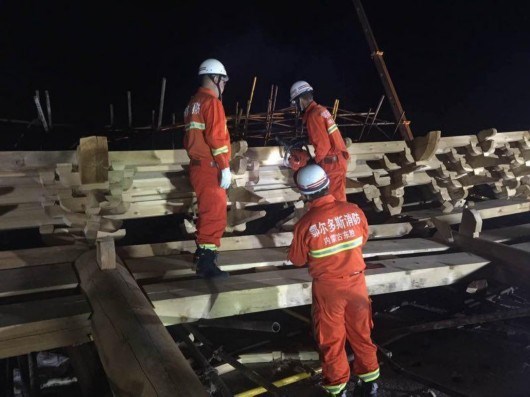
8 killed, 2 injured in N. China construction site collapse

Rescuers work at the scene after a construction site collapse in Inner Mongolia. [Photo/Shanghai Daily]

Eight people were killed and two others injured after a collapse at a construction site in northern China’s Inner Mongolia Autonomous Region Tuesday.

The accident, which happened at 5:20 p.m. in Ejin Horo Banner, Ordos city, initially left eight severely injured and two slightly injured.

They were all sent to a local hospital, but the eight severely injured died Wednesday morning, according to the emergency rescue headquarters.

An investigation is underway.

GVCs give developing countries opportunities – report

China’s University of International Business and Economics released the Global Value Chain Development Report 2017 in Beijing on Monday, identifying GVCs as providing new opportunities for developing countries.

“The Global Value Chain Development Report 2017: Measuring and Analyzing the Impact of GVCs on Economic Development” is released by the University of International Business and Economics in Beijing, July 10, 2017. [Photo/China.org.cn] 

“Global Value Chain Development Report 2017: Measuring and Analyzing the Impact of GVCs on Economic Development” is co-published by the World Bank Group, World Trade Organization (WTO), Organization for Economic Cooperation and Development (OECD), the Japan’s Institute of Developing Economies (IDE-JETRO) and the Research Center of Global Value Chains of the University of International Business and Economics (UIBE), providing comprehensive analysis of the global economy. Social Sciences Academic Press (China) will translate and publish a Chinese edition.

Global value chains (GVCs), breaking up production processes so that different steps can be carried out in different countries, have transformed world trade. The report says GVCs create new opportunities for developing countries, increasing their participation in global markets and enabling them to diversify exports.

Without them, a developing country would have to be able to produce a complete product in order to expand into a new line of business. While GVCs have helped many developing countries advance, the benefits are not even.

Witnessing the potential benefits, stakeholders in developing countries typically want to see their country more involved in value chains and moving to higher value-added activities over time. However, only a few developing economies, most notably China, are deeply involved in this approach.

The report released on Monday examines ways in which developing countries can deepen their involvement in GVCs and move up the value chain.

It suggests the key to expanding the concept lies in cutting trade costs. Although they have declined over the past decades, non-tariff trade costs related to infrastructure, transportation, and uncertainty remain a barrier to wider GVC participation. In some complex value chains, such as motor vehicles, computers or machinery, non-tariff trade costs are more than four times higher than tariffs.

Participating in deep trade and investment agreements can advance this agenda, and these will be most powerful if they encompass several neighboring countries. Preferential trade agreements are increasing in number and deepening in content, surging from 50 in 1990 to 279 in 2015. However, further growth depends on preservation of an open trading system.

Small firms and the informal sector also need to be included. Poor infrastructure, corruption, and red tape tend to hamstring smaller companies more than larger ones as the latter can often finance their own infrastructure and finds ways to operate in a complex environment. Much of job creation in the world is through small and medium-size firms and their involvement in GVCs is crucial for maximizing the positive impact from trade.

The report also says China provides some interesting lessons. It is known for having started its process of economic reform by establishing four special economic zones fitting the model of export processing zones, with favorable infrastructure and customs clearance.

What is less known is that, within a short time, China had expanded these benefits to more than other 30 cities nationwide. Competition then enabled quite a few to emerge as locations with low trade costs and deepened participation in GVCs.

Research into trade added value shows private domestic firms are biggest contributors. Foreign firms are often processing exporters from China, but the successful expansion of value chains to domestic firms within the country resulted in most of the added value coming from the domestic private sector, the report states.

It also finds that proximity to the world’s three major production hubs — the United States, Asia, and Europe — is highly important. It also matters who a country’s trading partners are, how far the country is from high-income markets, and the degree to which partners are integrated within regional global value chains.

“How economies are linked, specialize, and grow (or not) is captured in the way global value chains (GVCs) are put together,” Michael Spence, Nobel Laureate in Economics, wrote in a foreword to the report. “This report is a huge contribution to our deepening understanding of what the global economy really means and how it is changing.”

Professor Zhao Zhongxiu, vice president of the University of International Business and Economics, hosted the launch event in Beijing on Monday, declaring the report was a very significant flagship achievement for the university’s GVC research center.

Liu Shijin, former vice president of Development Research Center of the State Council and vice-chairman of China Development Research Foundation, said in his address that, in the new international situation, China should speed up the fundamental transformation in its economic growth mode, elevate comprehensively its industrial competitiveness, and accelerate the advance to the medium and even high end of global value chains.