Top legislator thanks journalists covering annual session

image_pdfimage_print

Chinese top legislator Zhang Dejiang has voiced his thanks to the journalists covering the annual session of the national legislature.

“The annual session is an important window for the world to observe China,” said Zhang, chairman of the National People’s Congress (NPC) Standing Committee, at the session’s media center on Tuesday.

The stories of this year’s parliamentary session have been well told and are worth praising, he said.

Zhang toured the news center set up by Xinhua News Agency in the Great Hall of the People, shaking hands with Xinhua staff and watching them report on the event through traditional and new-media platforms.

Zhang also talked with journalists from other state media outlets including the People’s Daily, China Central Television and China Daily.

The annual session of the NPC concluded Wednesday.

Math textbooks from Shanghai head to Britain

image_pdfimage_print

The latest agreement sealed between Shanghai Century Publishing (Group) Co. Ltd and HarperCollins Publishers at the London Book Fair (March 14 – 16, 2017) will introduce Shanghai’s instructional approach to math into the classrooms of British primary schools.

The export of Shanghai’s mathematics textbooks is an attempt by the British government to empower young students with consolidated mathematics skills.

In July last year, the British government announced the financing of mathematics teaching with an investment of 41 million pounds, including learning from Shanghai’s educational models.

The 36 volumes of textbooks in English from Shanghai are scheduled to make their debut in September this year in some British primary schools.

By enabling students to get a good understanding of math, the textbooks will be complete with teaching approaches, an anonymous officer from HarperCollins Publishers said.

The exchange of mathematics teachers from both China and Britain started in 2014, when 73 teachers from 45 British primary schools visited their counterparts in Shanghai.

Several months on, between 2014 and 2015, 61 teachers from Shanghai visited Britain, giving presentations in 48 British primary schools on how they teach math in their home country.

The students were impressed by their flexible and individual-centered teaching methods that progressed step by step to lead the students eventually to master the skills of calculation.

Nick Gibb, the British Minister for Schools said that the teaching approaches to math used in East Asia will expand to an increasing number of young people desiring to receive a professional and quality education.

There have been nearly 30 exchange programs among schools between Shanghai and Britain. The Shanghai International Friendly Urban Youth Summer Campus has for seven consecutive years received students from Liverpool. By 2015, institutes of higher education in Shanghai had housed 1,086 British students.

Nowadays, Shanghai’s pedagogic approaches have extended far beyond the exchange between the city and Britain as countries like the United States, Finland, Malaysia and Columbia, and organizations including the UN Children’s Fund and the World Bank have all initiated Shanghai-bound learning trips.

Projects to improve traffic on Yangtze

image_pdfimage_print

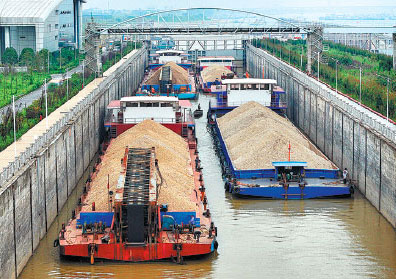
A navigation lock in operation in Xiangjiang River in Changsha, Hunan province. [Photo/Xinhua] 

China will dredge sections of the Yangtze River this year to deepen it and increase the amount of freight traffic that can use the waterway, a national legislator said recently.

“Projects will be carried out on the upper, middle and lower reaches of the Yangtze River,” said Tang Guanjun, deputy to the National People’s Congress and also director of the Changhang River Administration of Navigational Affairs in Hubei province.

“We aim at forming a water network connecting more places,” he said.

“The water level is of prime importance to freight transportation on the river. For every 10 centimeter rise in the water level, a 3,000 metric ton ship can carry an extra 176 tons of cargo,” he said.

“The ‘golden water gateway’ is essential to boosting the development of the Yangtze River Economic Belt. The river’s mainstream is the busiest river in the world regarding freight traffic,” Tang said.

In 2016, freight traffic on the mainstream of the Yangtze River was 2.31 billion metric tons, while railways across the country carried 3.33 billion tons. The river handled 15.2 million containers last year.

“Water transportation is much cheaper than rail and road transportation,” he said.

New projects will be carried out under strict environmental rules, Tang said.

“We will build a green navigation channel, including using environmental materials and technology to avoid water pollution, and use an ecological design to allow fish to migrate and plants to grow,” he said.

The projects will be carried out on the mainstream and its tributaries.

After the project is completed, the river will be navigable for bigger ships, allowing them to be able to load and unload cargo along the middle and upper reaches of the Yangtze River.

Bottlenecks affect freight transportation traveling to the middle and upper reaches of the river.

The increase of freight traffic along the river is an important part of the Yangtze River Economic Belt, one of China’s three major national strategies.

The economic belt covers 11 provinces and cities, such as Jiangsu, Zhejiang, Anhui, Sichuan and Shanghai, with a total area of 2.05 million square kilometers. The belt also spans the country’s eastern, middle and western regions, and its population and GDP account for more than 40 percent of the national totals.

Time to see the UK’s strengths – steady pound since 2012

image_pdfimage_print

Amidst all the hyperbole over short term movements in sterling it is worthwhile looking at the longer trend. Today sterling is around the same level against the Euro as it was at the beginning of 2012. It is almost a fifth higher against the yen, and around one fifth down against the dollar. Over this time period the dollar has been strong against all major currencies, running with higher interest rates and expectations of higher rates than elsewhere in the advanced world. The yen has been particularly weak thanks to negative rates and the creation so many extra yen by the authorities.

One of the odd features of the protracted and often repetitious UK debate about Brexit is the wish of so many to look for weaknesses and problems on the UK side, and to fail to analyse the weaknesses and difficulties on the EU side in the forthcoming talks. On Tuesday I pointed out to the PM during the exchanges on her statement about the EU summit that the questions to be asked need to be asked of the 27.

I began by asking how can a group of civilised democracies that are meant to believe in decent values not reassure British citizens living on the continent legally that they can stay there after exit?  I do not for one moment think the Spaniards will want to evict UK pensioners living in their own villas on the Costa Brava, for example. Nor do I see how they could do so legally. However, why is it asking too much of the EU and the Spanish government not to confirm that of course they are welcome to stay. After all, the UK government has been very clear that we would like all EU citizens legally in the UK to stay as long as they wish, but do need similar confirmation for our citizens on the continent.

I also asked for confirmation that it is clearly in the interests of business and governments on the continent to carry on trading tariff free, with no more barriers than they currently face, once the UK has left. The UK will willingly offer continental countries tariff free access to our market as long as we have the same to theirs. The choice rests with them, as the UK would recommend tariff free but can live with WTO most favoured nation terms.

Whilst we are about it, we should ask the rest of the EU how they intend to implement their Treaty obligation to have good relations with neighbouring states and to promote trade with them. As the EU is always keen to ensure we follow the letter as well as the spirit of the Treaty I assume the same applies on this important issue.

The UK voted to take back control of our laws, our money and our borders. We are doing so based on the referendum of the UK voters, and now also on the back of a Commons vote with a majority of 372 to leave. Under the Treaty we do not owe them any money apart from our regular contributions.