Second year Arboriculture students got to test their skills that they had picked up throughout the year at the Barony Campus of SRUC – and picnic benches were produced as a result.
Mar152017
Second year Arboriculture students got to test their skills that they had picked up throughout the year at the Barony Campus of SRUC – and picnic benches were produced as a result.
Mar152017
Scientists from SRUC are warning that this spring there is a high risk of damage to spring cereals from Leatherjacket grubs.
Mar152017
|
|
|
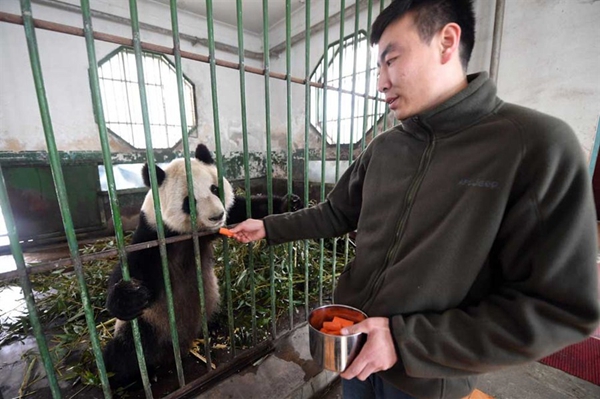
Keeper Liu Jiang feeds Shu Lan at a zoo in the northwestern city of Lanzhou. The 23-year-old giant panda, who is 70 in human terms, is to be returned to her hometown in Sichuan Province. [Photo/Xinhua] |
A 23-year-old panda living in a zoo in the northwestern city of Lanzhou is to return to its hometown in southwest China’s Sichuan Province due to its age, zoo authorities said yesterday.
Shu Lan was born in Chengdu, Sichuan’s capital, and moved to Lanzhou in 1996.
In 1999, she went back to Sichuan to live in Chengdu and two giant panda centers in the city of Ya’an for research and breeding.
The panda returned to Lanzhou in April last year, but her health aroused public concern after photographs of her with an injured back and foaming at the mouth went viral.
The China Conservation and Research Center for the Giant Panda sent three experts to Lanzhou earlier this month to evaluate her health and the living conditions at Lanzhou Zoo.
They found that Shu Lan’s health was normal and determined that the foaming at the mouth was caused mainly by chewing and playing with her tongue. But they also pointed out that her weight had dropped from 103 kilograms to 92kg since she had returned to the city, though that was still in the normal range.
However, they also concluded that Shu Lan was showing symptoms of aging.
Giant pandas live mainly in the mountains of northern Sichuan as well as the southern parts of Gansu and Shaanxi provinces.
According to the latest nationwide survey, there are 132 giant pandas in the wild in southern Gansu.
But Lanzhou, in the middle of the province, has a different environment and climate compared with wild panda habitats.
Heating, air conditioning and a humidifier have been installed in Shu Lan’s living area in the zoo. But the panda habitat was built in 1976 and is now deemed too antiquated for her.
The bamboo she was fed was not fresh enough as it was transported from central China’s Henan Province. In addition, the zoo lacks experience in taking care of old pandas.
Experts suggested sending Shu Lan to the China Conservation and Research Center for the Giant Panda in Sichuan to help maintain her health.
That suggestion has been approved by the zoo, though a specific schedule has not yet been released.
The decision was confirmed by Zhang Jianlong, head of the State Forestry Administration.
“We will try our best to improve the condition of the zoo,” said Lei Qinghai, its director, adding that the city is planning to move the zoo to a new site for future development.
A national survey released in February 2015 showed that by the end of 2013, China had 1,864 wild pandas and 375 others living in captivity.
Mar142017
Peter Dowd MP, Labour’s Shadow
Chief Secretary to the Treasury, speaking at the close of the
Budget debates tonight, said:
Mr Speaker, last week the
Chancellor painted a rosy picture of the
nation’s finances.
He claimed the Conservative Party’s stewardship had been nothing short of
miraculous.
A relaxed Chancellor attempted jokes throughout his
speech.
The Prime Minister shoulders shook
with amusement.
Many members opposite chuckled
away.
Some of the more experienced Members
opposite were watching cautiously, as the nose dive gained velocity.
The Chancellor got it wrong – big
time.
Within hours he was attacked by many of his own
backbenchers.
He
was left
hung out to dry by the Prime Minister.
Unsurprisingly,
he has faced
universal criticism over his plans to raise national
insurance to 11 per cent for millions of people who are self-employed.
As Sir Michael Caine, playing the
character of Charlie Crooker in the iconic Italian Job movie said to
his bumbling side kick.
“You’re only supposed to
blow the doors off!”
Well, the debris from the
explosion is still in descending.
A manifesto pledge broken – pure
and simple.
And since last Wednesday No.10 and
No. 11 have been in a briefing war with
each trying to blame the other for the fine mess.
Ostensibly, No.10 suggests the
Chancellor sneaked the NI rise into the Budget.
Apparently, other shocked Cabinet
colleagues have indicated that he failed to mention, that it would break their
manifesto pledge.
It’s worrying, Mr Speaker, that
Cabinet Ministers don’t know what manifesto commitments they made or perhaps
they don’t care?
Then again the Government has an
insouciant attitude towards its manifesto commitments.
First, the Government committed to getting rid of the deficit
by 2015 – a promise broken.
Second, they said it would be
pushed back to 2019/20 –
another broken promise.
Third, they vowed the debt would
start to come down after 2015 – another broken promise.
The Government will have virtually
doubled the debt and doubled the time they’ll have taken to get it down.
And this is what they call success
and fiscal credibility?
They seem to think that they can
simply press the reset button when it comes to meeting their own fiscal rules
and no one will notice.
The flip side of John Maynard
Keynes’ approach, namely when I change my mind the facts change with it.
When the Government’s misses a
deadline it’s modus operandi is to set a new one and brazenly move on.
The immutable Tory law of
economics – make it up as you go along.
What happened to the long term
economic plan?
Well, it didn’t last very long? Mr
Speaker
The Prime Minister and the
Chancellor have their finger prints all over every single financial decision
that has been made during the last seven years.
It’s no surprise that
they have come under criticism from many in their own party including the
former Member for Witney.
Or the former Chancellor, Lord
Lamont, who called the NI debacle a “rookie error”.
Otherwise known, in the real
world, as gross incompetence.
But regrettably it’s other people
who will pay the price for that incompetence.
Mr Speaker, turning to Brexit,
I’ll mention it even if the Chancellor doesn’t, it’s the tenth anniversary
since the production of
“Freeing Britain to Compete: Equipping the UK for
Globalisation”
This
publication was a wide ranging policy document authored by the right
honourable Member for Wokingham and friends.
It was endorsed by the then Shadow
Cabinet which included the current incumbents at numbers 10 and 11 Downing
Street.
The publication was hard to track
down as it has been removed from the Conservative Party website and for good
reason.
But I found a copy.
Its contents were toxic and all
the more so in the wake of the subsequent global financial crisis and remain
so.
But in the light of Brexit, and
the resurgence of the honourable member for Wokingham’s influence, it will soon
be getting a second run out.
Mr Speaker, it is worth appraising
the House of a few of the nuggets contained in its pages.
It includes policies such as the
abolition of inheritance tax.
Charging foreign lorries to use
British roads.
The potential
abolition of the BBC licence fee, which it refers to as a poll tax.
The watering down of money
laundering regulations.
The deregulation of mortgage
finance.
Because it’s the:
“lending institutions rather than
the client taking the risk.”
Try
telling that to someone whose house has been repossessed.
It
goes on:
“we need to make it more difficult
for ministers to regulate, and we need to give the critics of regulation more
opportunity to make their case against specific new proposals.”
Remember this document, dated
August 2007, was rubber stamped by the current Prime Minister and
Chancellor at the same time Northern Rock was about to go under.
It continues:
“the Government (the Labour
Government) claims that this regulation is all necessary. They seem to believe
that without it banks could steal our money.”
That
is not quite the case but the
taxpayer, at its peak, had liabilities for the banking crisis of £1.2 trillion.
But, Mr
Speaker, many people did believe the banks were stealing their money.
It refers to wanting:
“reliably low inflation,
taking no risks by turning fiscal rules into flexible friends.”
As for Europe, in search
of jobs and prosperity, it says:
“An incoming Conservative
Government should go to Brussels with proposals to deregulate the whole EU…”
No wonder they wanted to bury the
evidence.
It’s the autobiography of the hard
line Brexiteers.
It’s the Tory blue print for a
post Brexit deregulated Britain.
It’s a race to the bottom.
These policies are a telling
narrative of the views of the fundamentalist wing of the Conservative Party.
The Prime Minister is a hostage to
the far right of the Tory Party.
She is on the hook.
The stage directions are coming
from Wokingham, Haltemprice and Howden, North Somerset and Chingford and Wood
Green with occasional guest appearances by the Foreign Secretary.
The forlorn, melancholic
Chancellor is briefed against because he may just have a less hard-line outlook
as far as Brexit is concerned.
These are the dusted off policies
of the hard Brexiteers who will stop at
nothing until Britain becomes a low wage, low tax, low regulation economy.
They want to turn our country into
the bargain basement of the western world.
They have the Prime
Minister in tow.
Parliamentary scrutiny is a
hindrance.
Meanwhile, the Prime Minister has
put Kamikaze pilots in the cockpit.
The Chancellor knows this too well and that is why
reportedly he is putting aside £60 billion, equivalent to a year’s worth of
borrowing on the national debt to cope with the trauma.
It’s not Brexit proofing the
economy but rather proofing the economy from the toxic ideology of the hard Brexiteers.
Mr Speaker, ultimately, it comes
down to choices and values.
The Government’s choices in this
Budget are informed by their values and they are not the same as the vast
majority of people in this country.
The
Government propose to increase Insurance Premium Tax
from 10 per cent to 12 per cent, a regressive measure which will be a further
hit on household finances and act as a deterrent to families wanting to obtain
proper insurance cover.
It
was a surprise to see this measure in the Autumn Statement, coming as it did
from a government which constantly uses the high cost of insurance premiums as
an excuse for curbs on victims’ right to claim compensation for their losses,
with particularly damaging effects for those injured in accidents at work.
We
will oppose this rise.
And while the Government drives up
insurance price for millions of families, it has chosen to forego £73 billion
of revenue to give corporations and the wealthy few tax handouts between
now and 2021.
A choice we would not make.
Their choice is informed by the
value they put on elites and corporations, many of whom readily avoid paying
their fair share of tax.
They
plan to loosen the rules on the Business Investment Relief, increasing the
scope for non-doms to avoid tax when they bring funds into the UK.
This
is straightforwardly a giveaway to non-doms, which we will oppose.
There
is little evidence that this relief has had a significant impact on inward
investment since it was first introduced in 2012.
And there is little genuine reason
to believe that expanding the relief now will do anything but give non-doms
even more advantages over millions of UK taxpayers.
These and other tax cuts for
elites and corporations come off the backs of public sector employees who have
foregone pay rises for years.
Or those in the private sector
whose wages and salaries remain in the doldrums and will for another decade or
more.
Or the self-employed who are
increasingly driving our economy who will see an increase to 11 per cent in
National Insurance contributions.
We would make a different choice.
We reject the kick in the teeth to self-employed people.
Not only does it hit many on low
to middle income but will it raise anywhere near the
£2 billion the Treasury
projects?
It may also deter many people from
setting up their own businesses, from innovating and excelling.
It’s a moratorium on aspiration.
We would choose not to give tax
breaks to those who do not need them.
Mr Speaker, in this Budget the
Government claims it’s giving lower and middle earners, the NHS, social care
agencies, the self-employed, schools, businesses, pubs, the strivers, the
entrepreneurs the thumbs up.
Mr Speaker, in practice, this
Budget is not giving a thumbs up to all those people.
On the contrary, it’s two other
digits being put up to those people.
That’s another choice that Labour
would not make.
Mar142017
Every year, the close season prevents fishing for coarse fish, like barbel and chub, for 3 months to give the fish a chance to breed.
Judy Proctor, Head of Fisheries at the Environment Agency, said:
Our job is to protect fish stocks and improve fisheries. This includes rescuing fish in distress, improving habitat and restocking rivers with 450,000 fish a year. However, one of the best things we can do is simply to leave the fish alone during the spring allowing them the opportunity to breed so that we have healthy stocks in the future.
During the close season, the Environment Agency’s specialist enforcement teams rigorously police illegal fishing. In the first few weeks of last year’s close season, officers carried out more than 380 targeted patrols and found more than 70 people fishing on waters off-limits.
In addition to Environment Agency enforcement teams, the Angling Trust’s Voluntary Bailiff Service, which is funded by fishing licence money, will be taking part in Operation Clampdown. The volunteers will be looking out for illegal fishing on local rivers and reporting any suspicious activity to the Environment Agency and police.
Judy Proctor:
The majority of anglers, who fish legally, rightly demand that we take action to catch offenders. Our enforcement officers, supported by Angling Trust voluntary bailiffs, will be targeting illegal fishing again this year and anyone caught can expect to face prosecution and receive a significant fine. We urge anyone to report illegal fishing as quickly as possible by calling our incident hotline on 0800 80 70 60.
Coarse fishing is still allowed on most still waters and canals, depending on fishery owner agreement, though a valid fishing licence is still required. You can check which still waters and canals still have a close season in operation by checking the byelaws which apply in your area at https://www.gov.uk/government/collections/local-fishing-byelaws
Anyone who wants to go fishing needs to buy a fishing licence. A full annual licence costs £30 (short term and some concessionary licences are also available) and are available online at www.gov.uk/get-a-fishing-licence.