The European Parliament

image_pdfimage_print

The European Parliament reminds us they can veto or approve any EU/UK deal on the future relationship.Some of them also say they want to offer EU citizen rights to individual UK citizens who want it. This appears to be a generous offer, as of course the UK will  no longer be paying in or accepting the judgements of the Parliament, Council and Court.

It is difficult to reconcile this with their wish as well to ensure insofar as they can influence it that we will not be better off out. Fortunately whether we are better off or not will be mainly up to us, based on the approach we follow when we are free to make our own decisions.

I trust the European army will not be making conscripts of European citizens.

Self employed status

image_pdfimage_print

I am glad the PM has agreed to delay NI proposals and has confirmed that the Chancellor will listen to concerns. They will receive a report on the wider issue of self employed status and will also consider the differences in benefits between the self employed and other employees.

I am still consulting my constituents on the issue and will welcome their views on these wider issues as well as on Mr Hammond’s tax increase proposal.I will then put suggestions to the Chancellor.

Foreign and Chinese companies equal under Made in China 2025

image_pdfimage_print

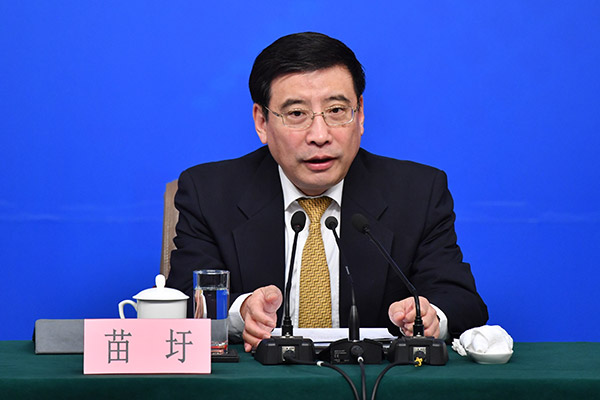
Miao Wei, minister of industry and information technology, answers questions at a press conference for the fifth session of the 12th NPC in Beijing, capital of China, March 11, 2017. [Photo/Xinha]

Foreign and Chinese enterprises will continue to be treated equally as the country steps up efforts to implement the Made in China 2025 initiative, Miao Wei, Minister of Industry and Information Technology, said.

The initiative, which was designed to promote high-end manufacturing in China, adheres to the government-led, market-oriented principles, Miao said.

“It is meant to allow the market to play a decisive role in allocating resources.”

Miao made the comments at a press conference during the annual session of National People’s Congress on Saturday.

According to Miao, the Made in China 2025 initiative is in line with common international practices.

The United States, Germany and other European countries also rolled out similar policies to upgrade their manufacturing industries.

“Foreign enterprises have played an active role in driving China’s economic growth in the past three decades. Foreign companies and domestic enterprises are and will be treated equally,” Miao said.

Foreign and Chinese companies equal under Made in China 2025

image_pdfimage_print

Miao Wei, minister of industry and information technology, answers questions at a press conference for the fifth session of the 12th NPC in Beijing, capital of China, March 11, 2017. [Photo/Xinha]

Foreign and Chinese enterprises will continue to be treated equally as the country steps up efforts to implement the Made in China 2025 initiative, Miao Wei, Minister of Industry and Information Technology, said.

The initiative, which was designed to promote high-end manufacturing in China, adheres to the government-led, market-oriented principles, Miao said.

“It is meant to allow the market to play a decisive role in allocating resources.”

Miao made the comments at a press conference during the annual session of National People’s Congress on Saturday.

According to Miao, the Made in China 2025 initiative is in line with common international practices.

The United States, Germany and other European countries also rolled out similar policies to upgrade their manufacturing industries.

“Foreign enterprises have played an active role in driving China’s economic growth in the past three decades. Foreign companies and domestic enterprises are and will be treated equally,” Miao said.

Long-term care insurance may become mandatory

image_pdfimage_print

As part of the national effort to defuse a demographic “time-bomb”, China is very likely to introduce compulsory long-term care insurance to cope with ever-increasing care needs, particularly for the elderly who have a difficult time living independently due to age, illness or disability, said a national political advisor.

Hu Xiaoyi, former vice-minister of human resources and social security and a member of the National Committee of the Chinese People’s Political Consultative Conference, made the remarks on the sidelines of the ongoing two sessions.

China has an increasingly aging population coupled with surging chronic diseases, and “it’s the right time to introduce such a new social insurance program as a pre-emptive approach”, said Hu, now head of the China Social Insurance Association.

China has 150 million people aged 65 and older, with at least 40 million of them partially and fully disabled.

To leave such elderly people fully dependent on their children for long-term care is, in Hu’s opinion, unrealistic.

“It has become a universal social problem facing all families and thus should be addressed with a package of resources including the individual family, the government and the entire society, or the social insurance,” he noted.

Currently, China has five social insurance programs – elderly care, health, unemployment, work injury and maternity. They are run by the government and premiums are paid by the individual and the employer on a compulsory basis.

Hu expected long-term care would be the sixth.

All families, whether or not in urgent need of care, should participate in the program to prepare for potential future challenges, he urged.

According to him, care under the program is more household-based and would sometimes require professional medical intervention.

Recipients should be categorized according to various levels of dependency, he added.

But he stressed that more testing and research are required to roll out the program nationwide.

“The trial run should start with disabled seniors,” he said.

Such trials also assist in setting standards and level of premiums, he added.

Hu suggested a family-based approach for premium collection rather than an individual basis.

Countries such as Germany, Japan and South Korea have pioneered setting up such social security programs, according to the World Health Organization.

Sun Jie, another CPPCC member, said the program had proved helpful in addressing the long-term care demands of the old who have disabilities.

Sun, also deputy director of the School of Insurance and Economics at the University of International Business and Economics in Beijing, added that some trials under way in China would provide experience for a future scale-up of the program nationwide.