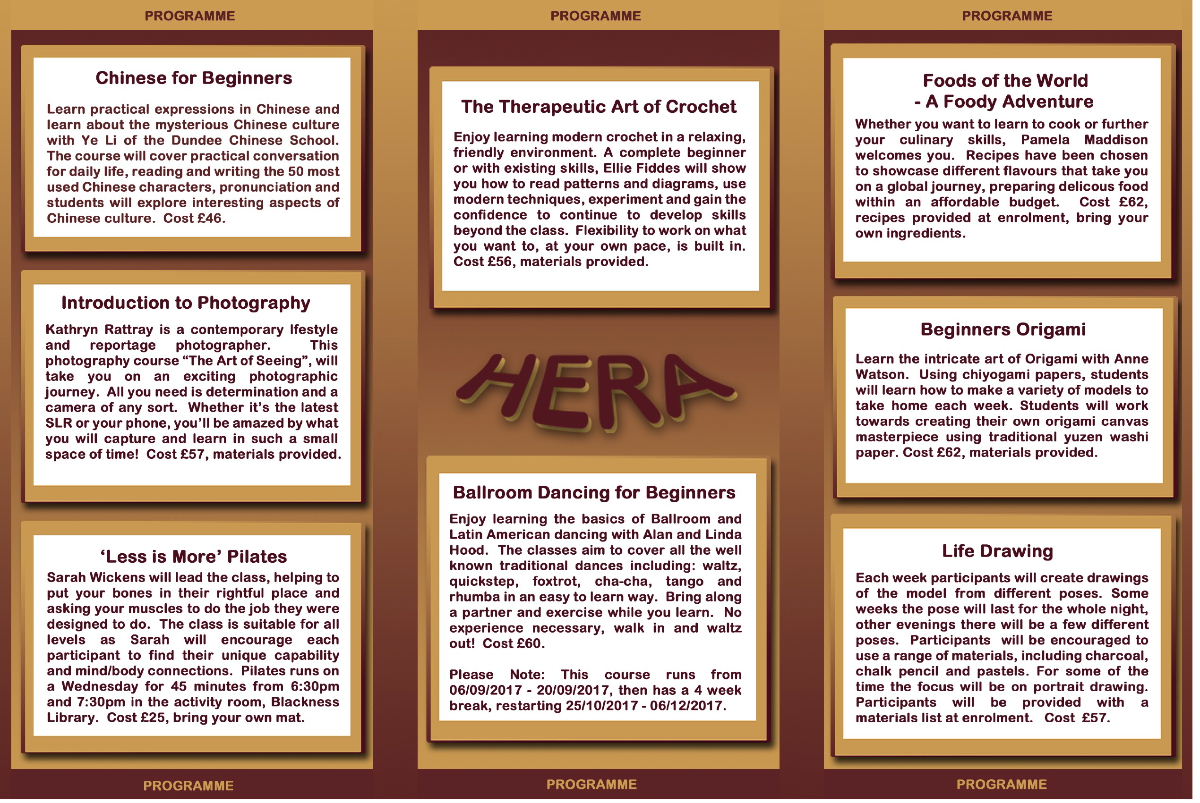
Harris Education and Recreation Association has an excellent Autumn programme of evening classes starting in September – details below or click here for a more readable version.

Enrolment night is at the school on 31st August from 6pm to 7.30pm :
Aug222017
Aug222017
Today’s Daily Telegraph (22 Aug) contains both inaccurate and misleading statements in relation to new GCSEs. The assessment of new GCSEs has been designed to support 9 to 1 grading and we have not ‘warned’ about their use as suggested. The Ofqual report cited is not a commentary on the new grades and the selected excerpts within the story are taken completely out of context.
Dr Michelle Meadows, Executive Director, Strategy, Risk and Research said: “New GCSEs have been designed from first principles to deliver better differentiation on the new 9 to 1 grading scale. The new GCSE exams and mark schemes have been created to support the increase in the number of grades, with better spread of grade boundaries and reliable assessment.”
Aug222017
The Bee Friendly scheme, thought to be the first of its kind anywhere in the world, is aimed at communities and community groups, schools, public bodies, businesses, universities and colleges, places of worship and aims to reduce and reverse the decline in numbers of pollinator species like bees and butterflies.
The Cabinet Secretary visited St Peter’s Community Gardens in Cardiff, to present them with a Bee Friendly certificate to acknowledge the important work that they are doing to help pollinators. 22 Bee Friendly Certificates have been handed out since the scheme was launched last year.
Wales was the first country in the UK to have an Action Plan for Pollinators, stating our ambition to reduce and reverse the decline in pollinators. This is helping us to achieve our aim of becoming the first Pollinator-Friendly nation in the world.
Lesley Griffiths said,
“We want the natural environment to be managed so that it continues to provide us with the environmental, economic, and social benefits now and in the future. By encouraging more community groups like St Peter’s to join the Bee Friendly scheme we can protect pollinators and create thriving environments for local communities to enjoy.
“I am delighted Cardiff University is now Bee Friendly and I have been really impressed with the work it has done as part of its Pharma Bees project. This is a really unique project and shows how important our pollinators are to all walks of life.
“I hope others follow the lead of Cardiff University and St Peter’s Community Gardens to help make Cardiff the first Bee Friendly capital city in the world!”
In 2016 Cardiff University School of Pharmacy provided St Peters with its first bee hive and the funds to enable community volunteers to be trained as beekeepers. The hive will provide the pharmabees team with an excellent source of honey for testing from a wonderful variety of wildflowers, vegetables and fruit trees planted at the gardens.
Aug222017
In many courts, traditionally victims and witnesses are asked to wait in sparse, unfriendly surroundings. So HM Courts & Tribunals Service (HMCTS) has invested £80,000 in victim and witness waiting rooms in five courts across the country – making a number of changes including the addition of children’s toys.
Research conducted with court users has shown that small changes such as these can make the court experience less intimidating for some of the 156,000 victims and witnesses who give evidence each year – particularly children and the vulnerable.
The model victim and witness waiting rooms have been established at Nottingham Justice Centre, Manchester Magistrates’ Court, Newcastle Crown Court and Aldershot Justice Centre, with work ongoing at Liverpool Crown Court. They will provide a template for courts nationwide.
HMCTS worked closely with stakeholders including the Victim’s Commissioner, the Witness Service and court users to identify areas across the estate to develop and analyse the best way to support victims and witnesses through the court process. This work informed how the rooms were developed, and they will now be used as models for further estate changes.
Victims’ Commissioner for England and Wales, Baroness Newlove:
I welcome HMCTS’ initiative to enhance the victim and witness room facilities across the court estate. I am looking forward to seeing the pilot rooms and very much hope that they will set the standard for victims’ facilities in all court rooms across the country. The court process can be a traumatic experience for victims and any attempt to make this environment less impersonal and more comfortable is most definitely a positive step.
I am looking forward to seeing how the remodelled rooms can provide a change for victims and hope they will assist victims and witnesses to have a better experience of the court process.
Gillian Guy, chief executive of Citizens Advice, said:
Giving evidence in court can be a difficult and stressful experience so it is crucial that witnesses are supported to perform their invaluable role.
It’s our role as the Witness Service to provide information and support to help people feel as comfortable and confident as possible when giving evidence. We know all too well that even small changes to make waiting areas more comfortable can make big differences to a witness’s experience – providing a welcoming space for child witnesses is particularly important.
This is on top of a range of measures the Government has put in place to help reduce the anxiety of attending court, including giving evidence behind a screen and the use of a registered intermediary. In criminal courts the government is driving the increased use of video links – meaning more vulnerable victims can give evidence away from the court room and without having to meet their attacker face to face.
HMCTS is also assessing criminal courts to ensure they are properly equipped for victims and witnesses, and monitoring individuals’ experiences of the court system. This will provide a yardstick for key improvements across the estate. A range of work will be carried out in the coming months to improve the information available to victims and witnesses before coming to court – making the often painful process clearer and easier to understand.
The £1bn investment will ensure that HMCTS are providing targeted care to those who need it – by reducing unnecessary stress for victims and the most vulnerable, and lessening the emotional turmoil experienced through crime. That £1bn is made up of £855 million to modernise and digitise the courts, and £240 million to deliver a fully connected criminal courtroom.
More modern and robust technology will be put in place in courts, such as Wi-Fi, modern telephony and screens for sharing evidence. This transformation of the estate will create a user-focused and modern justice system which supports the most vulnerable.
Aug222017
Mr Martin Bowles PSM has advised me that he wishes to leave his position as Secretary of the Department of Health on September 1, 2017.
In a public service career of almost four decades, Mr Bowles has built a well deserved reputation as a highly respected leader and driver of innovation.
Mr Bowles joined the Australian Public Service in 2006 as Deputy Secretary of the Department of Defence after a lengthy career in the Queensland and NSW public services. He transferred to the Department of Climate Change and Energy Efficiency in 2010 and was awarded the Public Service Medal in 2012, after delivering highly successful energy efficiency policies and remediating the Home Insulation Program.
He was appointed Secretary of the Department of Immigration and Citizenship in 2012, where he oversaw the early stages of the significant transformation of the Department into the Department of Immigration and Border Protection.
Since coming to the role of Secretary of the Department of Health in 2014, Mr Bowles has played an integral role in changes across the sector including the significant recent reforms to government funding for public hospitals in Australia, which will lead to greater efficiency, safety and quality in our hospital system.
I thank Mr Bowles for his professionalism, dedication and significant contribution to the public service and wish him all the very best for the future.
Mark Cormack, Deputy Secretary, will be acting Secretary pending the appointment of Mr Bowles’ successor.