Press release: Environment Agency trials use of body cameras

Environment Agency enforcement officers in the North East are wearing body worn cameras as part of a six-month trial.

It is the first of its kind within the organisation and is aimed at assessing if cameras can help reduce incidents of anti-social behaviour, assaults and threats against staff, particularly those working with regulated and illegal waste sites.

If successful, body worn cameras, which are now the norm among many enforcement agencies, could be rolled out to Environment Agency teams across the country. They could be used in a variety of ways, including at visits to poor performing sites, illegal waste sites, during fisheries and navigation patrols and even during incident response.

Since the trial started in April, waste enforcement and fisheries officers have been wearing the devices during their routine activities and activate them if they encounter a hostile situation or site.
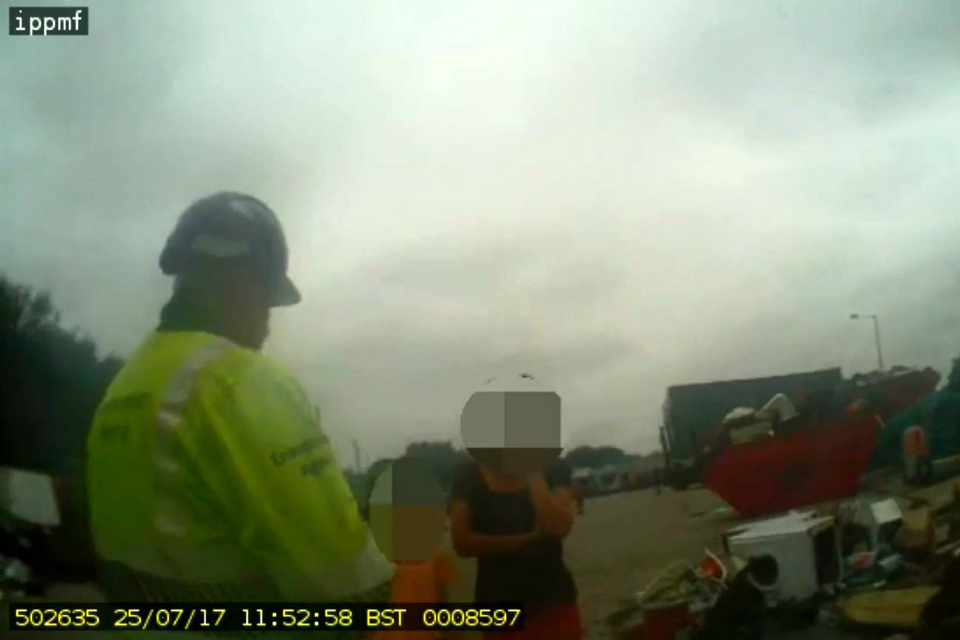
Image shows footage from one of the cameras during a visit to an illegal waste site
Footage from one of the cameras during a visit to an illegal waste site

Pilot scheme

The pilot scheme comes after Environment Agency employee, Paul Whitehill, an ex-police officer, was threatened with violence when he and a fellow colleague attended an illegal waste site on a routine visit. He said:

I worked with body cameras in the police and saw how effective they can be so suggested we run a trial.

Already officers have reported that wearing the cameras has prevented threatening situations from escalating.

Environment Agency waste enforcement officers regularly encounter aggressive behaviour across the country. Since 2001, the Environment Agency has successfully prosecuted 59 cases of obstruction, hostility or threatening behaviour towards staff, 22 of which were in the North East.

‘Safety is paramount’

Rachael Caldwell from the Environment Agency’s Waste and Enforcement Department, said:

The safety of our staff is paramount. They are well trained in dealing with hostile situations and we take any threat against them very seriously. But our preference is to prevent hostility in the first place.

Studies also show that people are less likely to contest the evidence when they know their offence is captured on camera. This could help speed up justice and reduce legal costs.

Officers taking part in the pilot must follow guidelines on use of these cameras. They will not be permanently switched on and people will be informed if they are being filmed. If they are used the footage is automatically deleted after a month unless it is required for evidential purposes.

Rachael added:

Officers will only switch the cameras on if and when they enter a hostile situation. That could be a site where they have experienced aggressive behaviour in the past, or an unknown quantity where hostility may be anticipated, such as on a remote river bank.

The BBMF's Merlin Engines

Following the recent pause in flying our Merlin-powered aircraft for safety reasons, OC BBMF said: “Please see below the MOD’s latest release on the subject of BBMF Merlin engines. As I hope you all know, my aim is to keep these vital and unique artefacts of Britain’s proud history in the sky forever. To do that we sometimes have to take extra precautions, with our eye sharply on continuing safety, to ensure that we can keep them flying for future generations. I thank each and every one of you who has voiced their support and shown their understanding. We will get them back into the blue as soon we can.

Lest We Forget.”

The update from the MOD:

“Our
investigation has confirmed an issue with a pinion gear in a Merlin engine. With
the precise cause of the problem known, each pinion gear is now being inspected
to confirm it meets our exacting standards, with the BBMF and industry putting
all of our efforts into getting these beautiful aircraft safely back in the air
as soon as possible.”

Let’s block ads! (Why?)

RAF Typhoons hand over NATO Romania duties to Canada

RAF Typhoons hand over NATO Romania duties to Canada

FOUR ROYAL Air Force Typhoon FGR4 fighter aircraft departed
Romania on 28 August, ending the UK’s five-month leadership of NATO’s enhanced
air policing mission in the country. Since April the Typhoons – from 3(F)
Squadron, RAF Coningsby – had spent alternate weeks on high-readiness standby
to defend NATO’s airspace over the Black Sea, augmenting the Romanian Air
Force’s existing air defence capability. The Royal Canadian Air Force is now
preparing to assume responsibility for the NATO mission, while two of the RAF’s
Typhoons proceed to Estonia to join NATO training with the British Army.

20170829TYPHMI1

The Typhoons deployed to Mihail Kogalniceanu Air Base, near
the Black Sea port of Constanta, as part of the RAF’s 135 Expeditionary Air
Wing under the code-name Operation BILOXI. More than 300 regular and reserve
RAF personnel from 16 RAF units – supported by Royal Engineers soldiers – were
involved in the mission. Typhoons launched once in response to Russian air
activity over the Black Sea, and flew more than 280 sorties to support NATO
training with Romanian, Hungarian and Bulgarian armed forces. Towards the end
of 135 EAW’s tour of duty, eight of its personnel were awarded the Romanian Air
Force’s highest peacetime honour for their work in the country.

20170829TYPHMI2

135 EAW’s Commanding Officer, Wing Commander Andy Coe, said:
“As we hand over NATO duties to our colleagues in the Royal Canadian Air Force,
the men and women of 135 EAW can be proud of what we have achieved. In our five
months here, we were ambassadors for the RAF Whole Force, and for a truly
global Britain. We learned much from our Romanian friends, even as we passed on
our experience to them and to our other allies in the region. It’s been a
privilege to lead a team who have embraced NATO’s principles with complete
enthusiasm and dedication.”

The RCAF’s Air Task Force Romania, comprising 135
specialists from across the Canadian Armed Forces, is preparing for a vital
NATO certification on 31 August – the final stage in its preparation to lead
the enhanced air policing mission. Four RCAF CF-188 Hornet fighter aircraft
from 409 Tactical Fighter Squadron arrived in Romania on 20 August, and will be
patrolling the skies shortly after the NATO certification.

20170829TYPHMI3

Air Task Force Romania Commander Lieutenant Colonel Mark
Hickey said: “As we bid farewell to our British friends, my entire team’s focus
is now on supporting Canada’s allies here in Romania and across the wider
region. Canada will always stand up for the freedom and collective security of
our NATO allies; that’s why we are happy to assume leadership of this important
mission. My team will make Romania and Canada proud.”

© MOD Crown Copyright 2017

Let’s block ads! (Why?)

Xi stresses commitment to deepening reform

China will unswervingly deepen reform with greater commitment and courage, President Xi Jinping said Tuesday.

Xi, also general secretary of the Communist Party of China (CPC) Central Committee and chairman of the Central Military Commission, made the remarks at the 38th meeting of the Central Leading Group for Deepening Overall Reform, which he heads.

The group called for efforts to build development priority zones, as part of the economic development and ecological protection strategy.

These zones should play a basic role in land development and be carried out with precision. There must be a long-term mechanism for differentiated but coordinated development among zones of different functions, according to the meeting.

A long-term mechanism is needed to optimize fiscal spending on agriculture. Innovation is encouraged in the use and management of funds. The rural investment system should be reformed to make agriculture policy more efficient and cost effective.

The group stressed the need to improve the ecological environment damage compensation system that had been in trial operation. It called for a damage evaluation system and a mechanism for fund management.

Setting up supervisory commissions for village affairs is an exploratory way to improve democratic village management and is significant to eliminating unhealthy tendencies and corruption, according to the group.

As for reforms to improve the accountability of judicial system, the attendees underlined better ideological, political and work ethic education for judges and prosecutors, as well as stronger supervision over them.

Pilot judicial system reform in Shanghai should adhere to the Party’s leadership in judicial work, and satisfy people’s demands for judicial service.

Technology should play a bigger part as a reference to improve the quality, efficiency and credibility of the judicial system, the group continued.

The meeting acknowledged that results have been seen in poverty alleviation after measures to clarify responsibilities. The next stage should solve existing issues and improve mechanisms.

As part of a pilot program on provincial territorial planning, Ningxia Hui Autonomous Region has made progress in making and enforcing the regional zoning plan, the group said, calling for further perfection of the plan and its implementation.

Attendees acknowledged solid progress in reforms since the 18th National Congress of the CPC in 2012 and agreed to continue the work. “Reform will never stop,” the meeting agreed.