Guidance: Energy Company Obligation (ECO): Help to Heat scheme – flexible eligibility

image_pdfimage_print

Updated: List of local authority statements of intent updated.

Under the Energy Company Obligation (ECO) Help to Heat flexible eligibility, obligated energy suppliers will be able to use the ‘flexible eligibility’ mechanism for up to 10% of their ECO Affordable Warmth obligation by installing energy saving measures in premises that have been declared eligible by local authorities.

Participating local authorities will have to ensure these are households in private tenure living either in fuel poverty or living on a low income and who are particularly vulnerable to the effects of living in the cold. In addition some non-fuel poor homes will be allowed for solid wall insulation projects, as long as a proportion of the households in the project are in fuel poverty or living in the cold.

This guidance is aimed at local authorities and provides templates for the local authorities’ statement of intent and declarations, as well as guidance on the targeting of households.

The last document on this page is a list of links to ECO Flexible Eligibility Statements of Intent that have been published on Local Authority websites. Please note that this is not an exhaustive list of published Statements of Intent.

If there are any missing, please contact beisecoteam@beis.gov.uk with the link to the published SOI.

We will update the list periodically.

Libor rigging – schools, hospitals, local councils all potential victims – Shadow Chancellor demands compensation for public bodies

image_pdfimage_print

Libor rigging – schools, hospitals, local councils
all potential victims – Shadow Chancellor demands compensation for public
bodies

Local councils, NHS hospitals and schools engaged with PFI contracts,
derivatives linked to Libor and day-to-day borrowing could be large scale
victims of Libor rigging.

Yesterday, Shadow Chancellor, John McDonnell MP, called for the Chancellor to
establish a public inquiry into the scandal. He is today demanding an
independent assessment of the losses to public bodies and that where losses are
identified as a result of Libor rigging, they must be made good by the banks.

Revelations by the BBC’s Panorama programme concerning the involvement of the
Bank of England and senior officials from major banks in the rigging of the
Libor index raise urgent questions for the Bank of England and the Government:

– Did senior Bank of England officials, in allegedly applying pressure to banks
to lowball their reported borrowing rates, act with or without the knowledge of
Treasury officials and ministers?
– Was the Bank or Treasury aware of the potential costs to public authorities
as a result of lowballing?
– How many public bodies have losses arising from their purchase of
Libor-linked derivative products, and what are the scale of those losses?

John McDonnell MP said:

“This is now a matter of utmost concern that gets to the heart of failings
in our banking system. Did senior officials at the Bank of England, with or
without government encouragement, knowingly cause public bodies like NHS
hospitals, schools and local councils to suffer potentially major losses?

"My concern is that local councils, NHS hospitals, and schools could have
paid a huge cost for the Libor rigging scandal. We need to know exactly what
went on, what was the impact on public finances and who was responsible. Above
all else if local councils and other public bodies suffered losses then the
institutions responsible should pay them back for those losses.”

Dmitry Medvedev's talks with President of Italy Sergio Mattarella

image_pdfimage_print

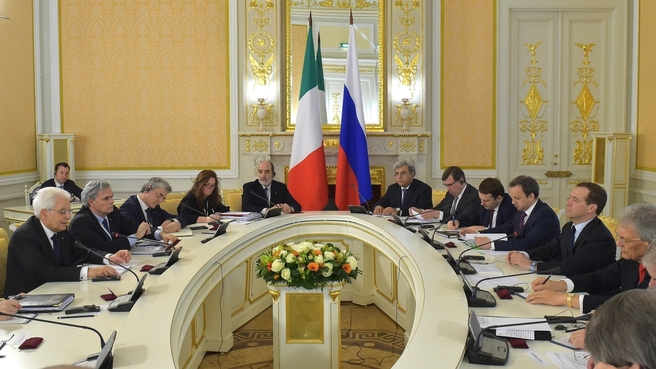
The two officials discussed investment cooperation and the two countries’ joint projects.

Excerpt from the transcript:

Talks with President of Italy Sergio Mattarella

Dmitry Medvedev: This is President Mattarella’s first official visit to Russia as head of the Italian Republic.

We attach special importance to relations with Italy. Russia and Italy have a good partnership despite the current difficulties in our relations with the European Union.

We are certainly ready to restore the former dynamics in relations with all European countries.

With Italy, we have long-term contacts in various fields: the economy – primarily energy, industry, trade and investment, as well as culture and education. I hope that your visit will help further strengthen these relations.

Our mutual trade has decreased from $54 billion to $20 billion over the past three years. There are objective reasons for this, namely, the change in prices for a number of goods, including energy carriers, but there are subjective reasons as well: Europe’s restrictive measures, which hardly contribute to the development of relations. Yet, we do understand that you have certain obligations and how they work.

Sergio Mattarella (via interpreter): The relationship between our countries is excellent. It is a relationship of friendship, a strong relationship, something so many politicians have worked on. These relations are developing in all sectors – politics, the economy and trade. We are successfully weathering this difficult period; on both sides, there is mutual interest in resolving the problems as effectively as possible and returning to the level of relations we can sustain.

Our economic relations can be described as strategic. There is huge potential for growth, and we attach great importance to this.

< …>

News story: Aviva deal boosts investment for UK breathalyser diagnosis firm

image_pdfimage_print

An award-winning Cambridge company that is developing a breathalyser as a tool to diagnose cancer and infectious and inflammatory diseases has secured investment from the venture capital arm of Aviva plc.

Aviva Ventures, which provides early-stage investment to high-growth businesses, will promote Owlstone Medical in the healthcare sector and build awareness of breath biopsy as a new standard in diagnostics.

Owlstone Medical has now raised £19.3 million ($23.5 million USD) to commercialise its Breath Biopsy® platform since a spin-out from Owlstone Inc last year.

Aviva invests in Owlstone Medical

Highly sensitive and selective

Owlstone Medical’s breathalyser can be programmed to detect volatile organic compound (VOC) biomarkers of disease in breath and other bodily fluids.

Highly sensitive and selective, these tests allow for early diagnosis so that treatments are more effective and more lives can be saved.

The company is currently developing tests for lung and colorectal cancer, 2 of the most common cancer killers worldwide. It also sells its research and development tools and services to academic, clinical and pharma partners who want to develop breath-based diagnostics for their own applications.

The Owlstone breathalyser can be programmed to detect biomarkers of disease in breath and other bodily fluids.

Billy Boyle, co-founder and CEO at Owlstone Medical, said:

Investment from Aviva as one of the major global insurance brands further validates our FAIMS technology and breath biopsy as a new approach to medical diagnostics.

We are very pleased that Aviva is supporting us in our mission to save 100,000 lives and $1.5 billion in healthcare costs.

How Innovate UK has supported

Total funding of £277,000 from Innovate UK since 2013 helped the company develop its core technology, a microchip field asymmetric ion mobility spectrometer (FAIMS) sensor.

We first supported a 2013 Biomedical Catalyst feasibility study into developing a diagnostic test for Crohn’s disease and ulcerative colitis.

That was followed by a funded SBRI contract in 2016 to match asthma patients to correct treatments. Wrong medication leads to 54,000 emergency hospital admissions for asthma sufferers every year in the UK – and some 1,200 deaths.

Invention of the Year

In December 2016, Owlstone Medical’s breathalyser technology was recognised as Invention of the Year in the Top 50 in Digital Health Awards in San Francisco.

Press release: £29 million boost for bioscience

image_pdfimage_print
  • Roslin Institute to benefit from £29 million of UK Government money
  • New funding is part of £319 million investment in UK bioscience
  • Announcement comes as Greg Clark meets businesses from across Scotland to discuss the Industrial Strategy

Business Secretary Greg Clark has today announced £29 million of funding for the Roslin Institute, part of the University of Edinburgh.

This investment is part of a total £319 million the UK government has today committed for UK bioscience funding over the next five years, delivering opportunities for highly-skilled jobs and cementing the UK as a world-leader in science and innovation as we build our Industrial Strategy.

The £29 million funding for the Roslin Institute will play a vital role in the government’s and Biotechnology and Biological Sciences Research Council’s (BBSRC) mission to further scientific knowledge, particularly around controlling infectious diseases, such as bird flu, and helping researchers develop solutions to modern healthcare challenges.

Business and Energy Secretary Greg Clark said:

Through our modern Industrial Strategy, we will build on Scotland’s exceptional strengths and use all the tools at our disposal to ensure every part of the country can reach its potential, ensuring that prosperity is spread across the UK.

Science, research and innovation are at the heart of the Industrial Strategy which is why we’re providing more than £4.7 billion of additional funding over the next five years, including the £319 million for bioscience research. The Roslin Institute is a great example of Scotland’s world class bioscience sector and exactly the sort of project our Industrial Strategy will support.

Welcoming the announcement of £29 million for the Roslin Institute, Professor Melanie Welham, Chief Executive from Biotechnology and Biological Sciences Research Council said:

Keeping the UK a global hub of vibrant research and innovation requires strategic investment in excellent research. I’m delighted that the Secretary of State, Greg Clark, is able to announce this significant investment in bioscience research. Alongside other disciplines, bioscience is vital for ensuring UK research and innovation remains competitive, addresses real world challenges and makes a difference to people’s lives.

Professor Sir Timothy O’Shea, Principal and Vice-Chancellor of the University of Edinburgh, said:

This investment will help to ensure Roslin’s continuing success over the next five years. The Institute plays a pivotal role in the University’s mission to tackle the many pressing issues in animal health and welfare, including those which have implications for human health and sustainability of animals in the food chain.

With only one week to go until the end of the Industrial Strategy green paper consultation, the Business Secretary and the Scottish Secretary, David Mundell, will hold a meeting this morning in Edinburgh with a number of Scottish businesses from a range of sectors. The reception will be an opportunity for the business, science and academic community to discuss how the government’s Plan for Britain and Industrial Strategy can benefit workers, entrepreneurs and businesses in the Scottish economy and across the U.K.

Secretary of State for Scotland David Mundell said:

The investment of £29 million of UK government funding for the Roslin Institute underpins our ambitious Industrial Strategy, as we ensure that innovative Scottish industries such as biosciences lead the way in research and development on a global scale.

As we prepare to negotiate our exit from the EU, the UK government are supporting Scottish businesses, from Harris Tweed to whisky, to compete in markets across the globe and create skilled, sustainable and secure jobs.

The Business Secretary started his two day tour by visiting Stornoway, where he met representatives of the Scottish Island Renewable Delivery forum to discuss renewable energy in the Outer Hebrides and also went to the Kenneth MacKenzie Harris Tweed mill, which plays a vital role in Scotland’s textile industry, exporting to 60 countries.

Whisky is one of Scotland’s great industries and world beating excellence, generating £3.95 billion for the UK economy in 2015 with nearly 100 million cases of whisky exported worldwide. To discuss the enduring success of the sector, the Business Secretary travelled to the Isle of Harris Whisky Distillery, which began distilling shortly after it was built in September 2015.

During his visit, the Business Secretary is due to meet Scottish Government Ministers Keith Brown and Paul Wheelhouse. They are expected to discuss how the UK and Scottish Governments can work together and how the Industrial Strategy will stimulate growth and boost prosperity across Scotland.

The engagement taking place follows the launch of the UK Government’s green paper, ‘Building our Industrial Strategy’, in January which outlined 10 pillars of focus to be discussed as part of a 12 week consultation period. The pillars cover a broad range of themes including skills, infrastructure, affordable energy and clean growth.

The strategy proposes plans for driving growth across the UK, with a framework to build on local strengths and reduce regional disparities in opportunities and prosperity.

The UK government has issued an open invitation to industries, businesses and local groups to visit the Industrial Strategy consultation and help set the priorities for a modern Industrial Strategy.

The consultation period has just over 1 week remaining, closing on April 17, after which the UK Government will consider responses before publishing a white paper later in the year.