Press Releases: State Department Terrorist Designation of Hizbul Mujahideen


Media Note

Office of the Spokesperson

Washington, DC

August 16, 2017


The Department of State has designated Hizbul Mujahideen—also known as Hizb-ul-Mujahideen, also known as HM—as a Foreign Terrorist Organization under section 219 of the Immigration and Nationality Act, and as a Specially Designated Global Terrorist (SDGT) under section 1(b) of Executive Order (E.O.) 13224. These designations seek to deny HM the resources it needs to carry out terrorist attacks. Among other consequences, all of HM’s property and interests in property subject to U.S. jurisdiction are blocked, and U.S. persons are generally prohibited from engaging in any transactions with the group.

Formed in 1989, HM is one of the largest and oldest militant groups operating in Kashmir. Hizbul Mujahideen is led by Specially Designated Global Terrorist Mohammad Yusuf Shah, also known as Syed Salahuddin. Hizbul Mujahideen has claimed responsibility for several attacks, including the April 2014, explosives attack in the state of Jammu and Kashmir, which injured 17 people.

Today’s action notifies the U.S. public and the international community that HM is a terrorist organization. Terrorism designations expose and isolate organizations and individuals, and deny them access to the U.S. financial system. Moreover, designations can assist the law enforcement activities of U.S. agencies and other governments.

A list of State Department-designated FTOs and SDGTs is available here: http://www.state.gov/j/ct/list/index.htm.

Fossilized dinosaur footprints discovered in SW China

More than 200 fossilized dinosaur footprints have been discovered in Maotai Township, the town famous for Kweichow Moutai alcohol.

It is believed to be the largest cluster of Sauropod footprints found in China. Sauropods were a group of huge, plant-eating, four-footed dinosaurs with long necks and tails dating from the early Jurassic period.

“The tracks were discovered by accident,” said Xing Lida, an expert at the China University of Geosciences.

In the summer of 2013, workers in Maotai Township in southwest China’s Guizhou Province found marks which looked like footprints on the surface of a huge rock when building a workshop.

This summer, when they saw media reports of dinosaur footprint fossils found elsewhere, the workers contacted researchers and a team of paleontologists came to the site.

Xing said the footprints were left by Sauropods more than 170 million to 180 million years ago.

Several clusters of Sauropod footprint fossils had been found previously in China, though some contained few fossils and others had been severely eroded by wind. The new discovery was well preserved.

“It can help with research on biological migration, behavior and evolution of these ancient creatures in the early Jurassic period,” said Xing.

Customs catch smugglers of endangered animals

Shanghai customs officials have caught several cases involving illegally bringing in or mailing endangered animals, plants or related products this year.

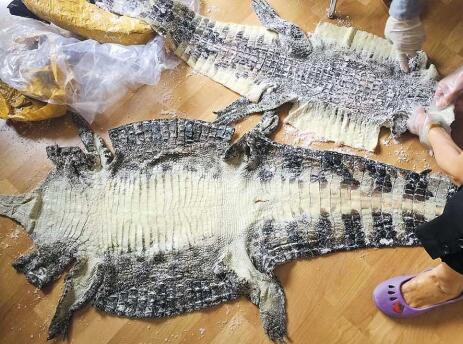
The unprocessed Siamese crocodile skins sent illegally in a mail package.[Photo/Shanghai Daily]

The unprocessed Siamese crocodile skins sent illegally in a mail package.[Photo/Shanghai Daily]

More than 60 dried sea horses and two Siamese crocodiles were found recently, the authority said yesterday.

Officials said a required certificate must be obtained to import or export endangered animals, plants and their related products to or from China.

This is according to Chinese regulations and the Convention on International Trade in Endangered Species of Wild Fauna and Flora (CITES).

The authority said the sea horses, weighing 0.34 kilograms, were found in a passenger’s luggage when it went through a machine examination at Pudong International Airport in July.

The passenger said the dried sea horses were bought for relatives as gifts, and he did not realize sea horses were an endangered animal.

The sea horses were sent to the inspection and quarantine authority.

Sea horses are not allowed to be imported to China. Listed on Appendix II of CITES and the IUCN Red List of Threatened Species. The species is not allowed to be fished or traded.

In June, the authority also found two animal skins in a mail package from Southeast Asia. The unprocessed skins were wrapped by salt and were later confirmed to be Siamese crocodiles. The Siamese crocodile is listed on the Appendix I of CITES, and banned from international trading.

Other imports of endangered species and related products attempted to have been smuggled into the country in recent years include ivory and pangolin scales.

The authority said it will penalize violators according to regulations.

No-mercury future for thermometers

About 7 million mercury thermometers in hospitals and clinics across China may be phased out by the end of this year, as an international treaty to protect human health and the environment from poisonous mercury took effect in China on Wednesday.

They will be replaced by mercury-free products, including electronic thermometers, which have been widely adopted in hospitals across China, according to the China Medical Devices Industry Association.

Yang Xiaofang, from the association’s legal department, said at a news conference on Wednesday that China will follow the World Health Organization’s proposal to reduce global demand for mercury thermometers and blood pressure gauges 70 percent by the end of this year.

There are currently more than 11 million mercury thermometers in use at medical institutions in China, according to the National Institute of Hospital Administration.

China will immediately ban the opening of new primary mercury mines, and will ban further mining at all existing primary mercury mines starting in 2032, according to a public notice released on Tuesday by 17 central government ministries and bureaus, including the Ministry of Environmental Protection.

China will also gradually ban the production, import and export of certain types of electrical switches, cosmetics and pesticides that contain mercury.

Production of thermometers and blood pressure gauges that contain mercury will be banned in China in 2026, the notice said.

The sales value of mercury thermometers accounts for more than 70 percent of the total value of thermometer sales in China, but many producers had already started the switch to mercury-free thermometers before China ratified the convention, Yang said.

Authorities should encourage the development of cheaper and more reliable alternatives to mercury thermometers and roll out policies for handling thermometers that are phased out or damaged, the National Institute of Hospital Administration said.

Medical equipment containing mercury, such as mercury thermometers, has already been banned in some European countries, such as Sweden. Mercury can vaporize at normal temperatures, causing serious damage to the human nervous system.

Arms exhibition highlights China’s weaponry innovation

Tanks are rumbling past and missiles roaring. These are not scenes from a war film, but highlights of a weaponry exhibition held in north China’s Inner Mongolia Autonomous Region on Wednesday.

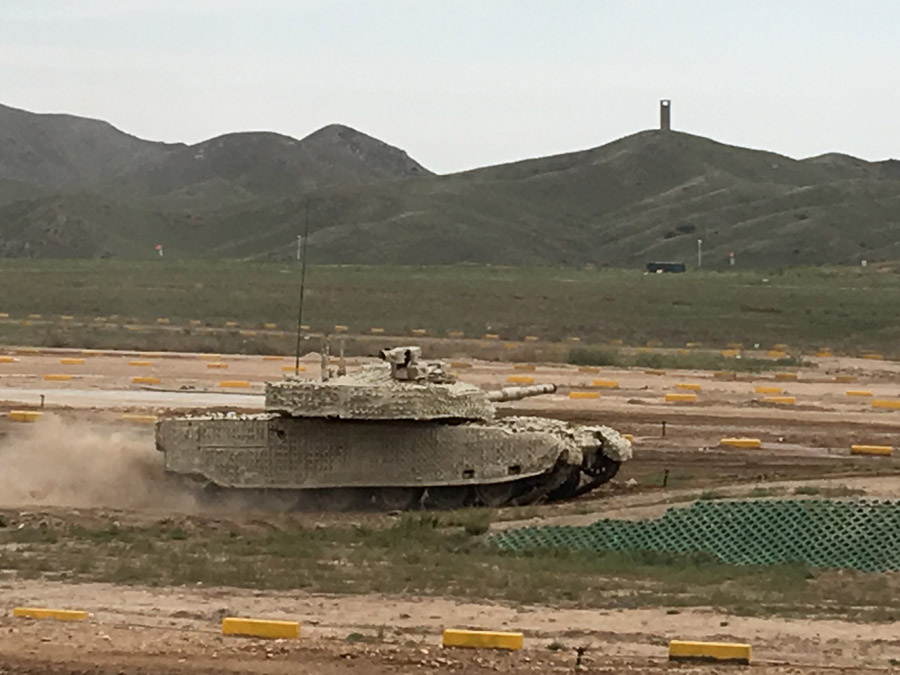
A domestically developed tank used by Chinese land forces is presented to hundreds of foreign military officers at a shooting range in the Inner Mongolia autonomous region on Aug 16, 2017. [Photo by Zhao Lei/chinadaily.com.cn]

A domestically developed tank used by Chinese land forces is presented to hundreds of foreign military officers at a shooting range in the Inner Mongolia autonomous region on Aug 16, 2017. [Photo by Zhao Lei/chinadaily.com.cn]

In the city of Baotou, where the country’s first domestically made tank rolled off the assembly line nearly 60 years ago, the 2017 Armour Day event was hosted by China North Industries Group Corporation (NORINCO), the largest manufacturer of armored vehicles for China’s armed forces and police departments.

Aiming at showcasing some of China’s latest innovations in weapons for land operations, the event attracted officials from the army and defense authorities, as well as foreign ambassadors and military officers from various countries.

A live fire demonstration was the highlight on Wednesday. Nearly half of the weapons on display were never shown before with live ammunition, NORINCO said at a press conference Tuesday.

The star of the day was the VT5. Debuted at Airshow China 2016 in Zhuhai, the newly-developed light tank finished its first dynamic demonstration Wednesday after a maneuverability and a live fire display.

Equipped with a domestically-made engine, auto gear box and a 105-mm tank gun, the lightweight tank is compatible with various types of terrain.

Wednesday’s exhibition also featured the live fire debut of the Red Arrow 10 and Red Arrow 12, China’s famous anti-tank and multi-purpose missiles.

The Red Arrow missiles can automatically locate and engage targets. In the live fire demonstration, the missiles hit and destroyed the targets without a single miss.

The VT4 and several other battle tanks and armored vehicles also took part in the event.

Seven major programs were in display, including an active protection system demonstration, a mine-resistance demonstration and a firing demonstration by a multitude of battle tanks and armored vehicles.

China is stepping up efforts to reform and modernize its army and national defense, with weaponry innovation weighing heavily on the cause.

“I think innovation is one of the major priorities in the field of weapon manufacturing,” said Zhu Zheng from NORINCO. “The innovative spirit of generations of scientists has driven the development of Chinese defense.”

China’s military manufacturers like NORINCO should continue to innovate to facilitate the country’s defense and military modernization, Zhu told Xinhua.