Commission proposes Baltic Sea fishing opportunities for 2018 with increased quotas for herring and salmon

In particular, the Commission proposes to increase catches for Central Herring, Sprat and the Main Basin Salmon stocks, and to maintain the number of catches for the important stock of Western Baltic Cod. For the remaining stocks the Commission proposes reducing catches. This year’s proposal also includes a ban on Baltic Eel fisheries, not traditionally a part of the annual allowable catch proposals but a necessary step due to alarming scientific evidence and historically low levels.

Karmenu Vella, Commissioner for Environment, Fisheries and Maritime Affairs, said: “We are proposing a balanced package that will ensure sustainable fisheries in the Baltic Sea. The good news is that important quotas for Baltic herring and salmon can be increased. Responsible management measures by Member States and the fishing industry are paying off. Now we must learn from these success stories and act urgently for those stocks that are still in a worrying state, like the European eel.”

The proposed total allowable catches (TAC) for herring, cod, sprat and salmon stocks are based on scientific advice from the International Council on the Exploration of the Seas and follow the Baltic multiannual management plan adopted last year by Member States and the European Parliament.

Efforts by stakeholders in recent years have already succeeded in rebuilding important stocks in the Baltic. Between 2012 and 2016, for example, the overall biomass of pelagic stocks increased by 50%. But further action remains necessary to ensure all stocks are exploited at sustainable levels.

European Ministers for Fisheries will now examine the Commission proposal, with the aim of adopting it during the Fisheries Council of 9-10 October.

Herring

The largest proposed increase (25%) for 2018 concerns the Central Herring stock. Responsible management of this stock has already borne fruit in recent years. This has allowed the fishing industry to reap the rewards and offer consumers a stable supply. Scientific advice for the Western Herring stock revealed a significant negative change in the state of the stock. The Commission is therefore proposing a corresponding reduction of 54% for the catch of 2018. For Herring in the Gulf of Bothnia the Commission is proposing a reduction of 50%, following the plan that was agreed by Member States and the European Parliament last year.

Cod

Western Baltic Cod is an important stock for many small-scale fishermen, and has been at very low levels in recent years. For 2017 allowable catches were reduced by 56% compared to 2016, and additional measures like closure periods and limiting recreational fishing were taken. Currently, the stock is still below the threshold of biologically safe limits. The Commission therefore considers it necessary to maintain existing measures to ensure that young cod can reproduce and help rebuild the stock. For Eastern Cod, scientists advice that catches are significantly reduced as the stock remains data-limited and scientists detect a slow growth. The Commission is therefore following a precautionary approach and proposes a reduction of 28%.

Salmon

The scientific advice for Main Basin Salmon, a stable stock, allows for an increase in catches by 11%. This reflects the responsible management of the fisheries by the industry. Thanks to this the number of returning spawners in the rivers of our Member States has reached record levels, with the Torne river now home to the world’s largest salmon population.

Eel

The European Eel stock has been at a historically low level since the late 1990s. It is today listed in Appendix II of the Convention on International Trade in Endangered Species (CITES). In 2007 the EU adopted measures to allow this stock to recover. However, ICES advice published in May 2017 indicates that these measures have not been sufficient and the stock is still in a critical state. The Commission therefore proposes to ban all marine eel fisheries in the EU waters of the Baltic Sea for 2018. This ban would apply to commercial and recreational fishing. This also means that all eels caught accidentally will have to be released immediately. In addition, the Commission is planning to evaluate the Regulation on the recovery of the European eel.

Table: Overview of TAC changes 2017-2018 (figures in tonnes except for salmon, which is in number of pieces)

Stock and
ICES fishing zone; subdivision

2017

2018

Commission proposal (in tonnes & % change from 2016 TAC)

Council agreement (in tonnes & % change from 2016 TAC)

Commission proposal
(in tonnes & % change from 2017 TAC)

Western Cod 22-24

1,588 (-88%)

5,597 (-56%)

5,597 (0%)

Eastern Cod 25-32

24,927 (-39%)

30,857 (-25%)

22,275 (-28%)

Western Herring 22-24

28,401 (+8%)

28,401 (+8%)

12,987 (-54%)

Bothnian Herring 30-31

140,998 (+17%)

140,998 (+17%)

70,617 (-50%)

Riga Herring 28.1

27,429 (-21%)

31,074 (-11%)

28,999 (-7%)

Central Herring 25-27, 28.2, 29, 32

191,129 (+8%)

191,129 (+8%)

238,229 (+25%)

Sprat 22-32

282,349 (+40%)

260,993 (+29%)

262,310 (+1%)

Plaice 22-32

7,862 (+95%)

7,862 (+95%)

6,272 (-20%)

Main Basin Salmon 22-31

105,696 (+10%)

95,928 (0%)

106,096 (+11%)

Gulf of Finland Salmon 32

9,403 (-28%)

10,485 (-20%)

10,003 (-5%)

European eel 22-32

Prohibition to fish for in the recreational and commercial fishery  

Background

The proposal is part of the European Union’s approach to adjust the levels of fishing to long-term sustainability targets, or maximum sustainable yield (MSY) by 2020 as agreed by Member States and the European Parliament in the Common Fisheries Policy. The Commission’s proposal is also in line with the policy intentions expressed in the Commission’s Communication on Fishing Opportunities for 2018.
In crisis-torn countries, children’s access to safe water and sanitation is a right, not a privilege – UNICEF

29 August 2017 – In countries beset by violence, displacement, conflict and instability, children’s most basic means of survival &#8211 water &#8211 must be a priority, the United Nations Children’s Fund (UNICEF) said today, warning that children living in fragile situations are four times more likely to lack access to drinking water.

&#8220Children’s access to safe water and sanitation, especially in conflicts and emergencies, is a right, not a privilege&#8221 said Sanjay Wijesekera, UNICEF’s global chief of water, sanitation and hygiene, who warned, as World Water Week gets underway, that more than 180 million people in crisis-torn countries have no access to drinking water.

UNICEF said that in Yemen, a country reeling from the impact of over two years of conflict, water supply networks that serve the country’s largest cities are at imminent risk of collapse due to war-inflicted damage and disrepair. Around 15 million people in the country have been cut off from regular access to water and sanitation.

As for Syria, where the conflict is well into its seventh year, around 15 million people are in need of safe water, including an estimated 6.4 million children. Water has frequently been used as a weapon of war: In 2016 alone, there were at least 30 deliberate water cuts &#8211 including in Aleppo, Damascus, Hama, Raqqa and Dara, with pumps destroyed and water sources contaminated.

In conflict-affected areas in northeast Nigeria, 75 per cent of water and sanitation infrastructure has been damaged or destroyed, leaving 3.6 million people without even basic water services. The UN agency adds that in South Sudan, where fighting has raged for over three years, almost half the water points across the country have been damaged or completely destroyed.

&#8220In far too many cases, water and sanitation systems have been attacked, damaged or left in disrepair to the point of collapse. When children have no safe water to drink, and when health systems are left in ruins, malnutrition and potentially fatal diseases like cholera will inevitably follow,&#8221 said Mr. Wijesekera.

In Yemen, for example, children make up more than 53 per cent of the over half a million cases of suspected cholera and acute watery diarrhoea reported so far. Somalia is suffering from the largest outbreak of cholera in the last five years, with nearly 77,000 cases of suspected cholera/acute watery diarrhoea. And in South Sudan, the cholera outbreak is the most severe the country has ever experienced, with more than 19,000 cases since June 2016, said UNICEF.

In famine-threatened north-east Nigeria, Somalia, South Sudan and Yemen, nearly 30 million people, including 14.6 million children, are in urgent need of safe water. More than five million children are estimated to be malnourished this year, with 1.4 million severely so.

Press release: Environment Agency trials use of body cameras

Environment Agency enforcement officers in the North East are wearing body worn cameras as part of a six-month trial.

It is the first of its kind within the organisation and is aimed at assessing if cameras can help reduce incidents of anti-social behaviour, assaults and threats against staff, particularly those working with regulated and illegal waste sites.

If successful, body worn cameras, which are now the norm among many enforcement agencies, could be rolled out to Environment Agency teams across the country. They could be used in a variety of ways, including at visits to poor performing sites, illegal waste sites, during fisheries and navigation patrols and even during incident response.

Since the trial started in April, waste enforcement and fisheries officers have been wearing the devices during their routine activities and activate them if they encounter a hostile situation or site.

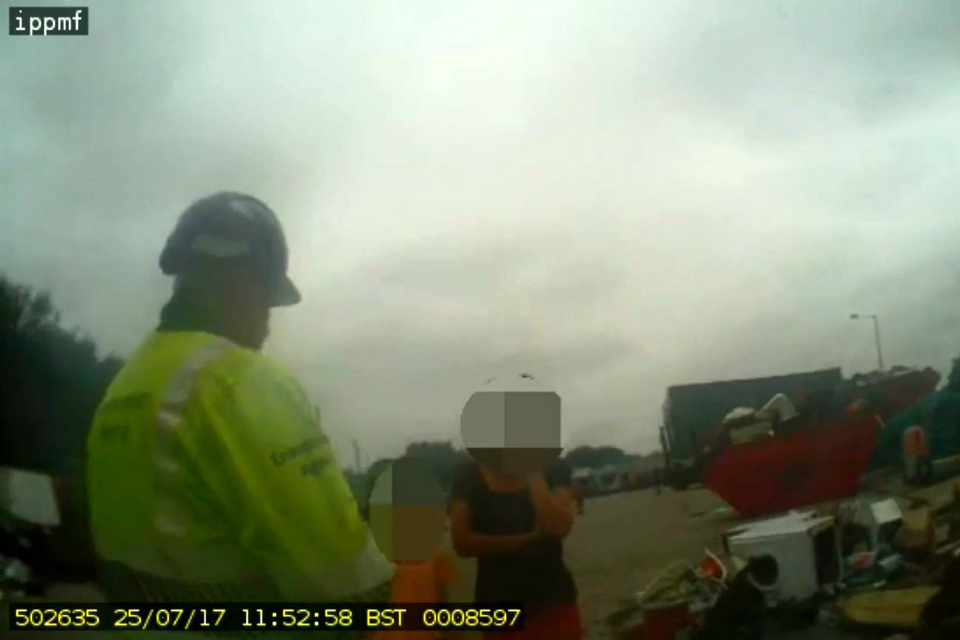
Image shows footage from one of the cameras during a visit to an illegal waste site
Footage from one of the cameras during a visit to an illegal waste site

Pilot scheme

The pilot scheme comes after Environment Agency employee, Paul Whitehill, an ex-police officer, was threatened with violence when he and a fellow colleague attended an illegal waste site on a routine visit. He said:

I worked with body cameras in the police and saw how effective they can be so suggested we run a trial.

Already officers have reported that wearing the cameras has prevented threatening situations from escalating.

Environment Agency waste enforcement officers regularly encounter aggressive behaviour across the country. Since 2001, the Environment Agency has successfully prosecuted 59 cases of obstruction, hostility or threatening behaviour towards staff, 22 of which were in the North East.

‘Safety is paramount’

Rachael Caldwell from the Environment Agency’s Waste and Enforcement Department, said:

The safety of our staff is paramount. They are well trained in dealing with hostile situations and we take any threat against them very seriously. But our preference is to prevent hostility in the first place.

Studies also show that people are less likely to contest the evidence when they know their offence is captured on camera. This could help speed up justice and reduce legal costs.

Officers taking part in the pilot must follow guidelines on use of these cameras. They will not be permanently switched on and people will be informed if they are being filmed. If they are used the footage is automatically deleted after a month unless it is required for evidential purposes.

Rachael added:

Officers will only switch the cameras on if and when they enter a hostile situation. That could be a site where they have experienced aggressive behaviour in the past, or an unknown quantity where hostility may be anticipated, such as on a remote river bank.

Press release: Environment Agency trials use of body cameras

Environment Agency enforcement officers in the North East are wearing body worn cameras as part of a six-month trial.

It is the first of its kind within the organisation and is aimed at assessing if cameras can help reduce incidents of anti-social behaviour, assaults and threats against staff, particularly those working with regulated and illegal waste sites.

If successful, body worn cameras, which are now the norm among many enforcement agencies, could be rolled out to Environment Agency teams across the country. They could be used in a variety of ways, including at visits to poor performing sites, illegal waste sites, during fisheries and navigation patrols and even during incident response.

Since the trial started in April, waste enforcement and fisheries officers have been wearing the devices during their routine activities and activate them if they encounter a hostile situation or site.

Image shows footage from one of the cameras during a visit to an illegal waste site
Footage from one of the cameras during a visit to an illegal waste site

Pilot scheme

The pilot scheme comes after Environment Agency employee, Paul Whitehill, an ex-police officer, was threatened with violence when he and a fellow colleague attended an illegal waste site on a routine visit. He said:

I worked with body cameras in the police and saw how effective they can be so suggested we run a trial.

Already officers have reported that wearing the cameras has prevented threatening situations from escalating.

Environment Agency waste enforcement officers regularly encounter aggressive behaviour across the country. Since 2001, the Environment Agency has successfully prosecuted 59 cases of obstruction, hostility or threatening behaviour towards staff, 22 of which were in the North East.

‘Safety is paramount’

Rachael Caldwell from the Environment Agency’s Waste and Enforcement Department, said:

The safety of our staff is paramount. They are well trained in dealing with hostile situations and we take any threat against them very seriously. But our preference is to prevent hostility in the first place.

Studies also show that people are less likely to contest the evidence when they know their offence is captured on camera. This could help speed up justice and reduce legal costs.

Officers taking part in the pilot must follow guidelines on use of these cameras. They will not be permanently switched on and people will be informed if they are being filmed. If they are used the footage is automatically deleted after a month unless it is required for evidential purposes.

Rachael added:

Officers will only switch the cameras on if and when they enter a hostile situation. That could be a site where they have experienced aggressive behaviour in the past, or an unknown quantity where hostility may be anticipated, such as on a remote river bank.