At close of 71st General Assembly, outgoing President stresses sustainability

11 September 2017 – The United Nations General Assembly today closed its 71st session with a focus on sustainable development, as outgoing president Peter Thomson handed over the gavel to his successor, Miroslav Lajčák.

In his final address, Mr. Thomson summarized the achievements of his one-year tenure, and urged the international community to raise awareness about the behavioural changes needed to create a more sustainable way of life and to combat climate change, as agreed to in the Sustainable Development Goals (SDG).

“We must embrace the power of innovation and technology to leverage SDG implementation and combat climate change at the speed and scale required,” he said. “We are witnessing exponential change in multiple areas of technology and we must manage the risks and seize the opportunities for the common good of humanity and the planet.”

Mr. Thomson also underlined the importance of partnerships and a change in how development is financed, as requirements for achieving the SDGs by the 2030 deadline.

“We have not come this far as a species only to be defeated by greed,” Mr. Thomson said, echoing what he told the press in his final press conference on Friday.

In that press briefing, Mr. Thomson said that he had written to all heads of government and to some 4,000 universities asking them to teach SDGs in school.

We have not come this far as a species only to be defeated by greed Peter Thomson

“We are stealing from our grandchildren’s future if we continue to take more from the planetary ecosystem than it can sustainably grant,” Mr. Thomson said in today’s statement.

Ahead of his address, Secretary-General António Guterres lauded the outgoing official for overseeing a “productive” session that included the adoption of a landmark declaration on refugees and migrants, the establishment of a technology bank for the least developed countries, and a momentum to save the oceans, among others.

“Thank you for helping to steer the Member States to a solid record of achievement over the past year. Day in and day out, you brought us together,” said the Secretary-General.

Paying homage to the 16th anniversary of the attacks on the World Trade Center and other targets in Pennsylvania and Washington, D.C., Mr. Guterres noted that this “spirit of unity has particular meaning today.”

“This was an assault on the United States. But so many of our Member States saw their citizens murdered that day,” he said. “I know you join me in expressing our sorrow and solidarity on this day.”

Following the remarks, the General Assembly stood for one minute of silent prayer or meditation, as is the custom, after which the incoming president, Mr. Lajčák, took the oath of office and received the symbolic gavel from Mr. Thomson.

Mr. Lajčák will open the 72nd session of the General Assembly tomorrow afternoon.
News story: Free at last as jammed fuel is lifted out

When the dome-shaped experimental reactor closed in 1977, most of the core fuel was removed.

But follow-up work came to a halt when some of the metallic casings in the zone surrounding the core were found to be swollen and jammed. Almost 1,000 – around two-thirds of the total – were left in place.

Made of stainless steel, the casings, known as breeder elements, contained natural uranium and were designed to produce more fuel for use in other reactors.

Now, after many years of work to design and test remotely operated equipment, a decommissioning team has started to recover the elements.

Decommissioning the 50-year-old reactor is one of the most technically challenging projects in the NDA estate and removing the breeder elements has been a top priority.

The removal work is expected to take less than 3 years, after which dismantling of the landmark reactor can begin.

David Peattie, NDA Chief Executive, said:

Dealing with this material is one of the highest priorities anywhere for the NDA, not just at Dounreay but across our UK sites. The safe and timely retrieval of the breeder material is crucial to both the site’s closure programme and the national defueling programme.

I am very pleased with this achievement which is a great example of how the Dounreay team and the NDA can work together to deliver results of national importance.

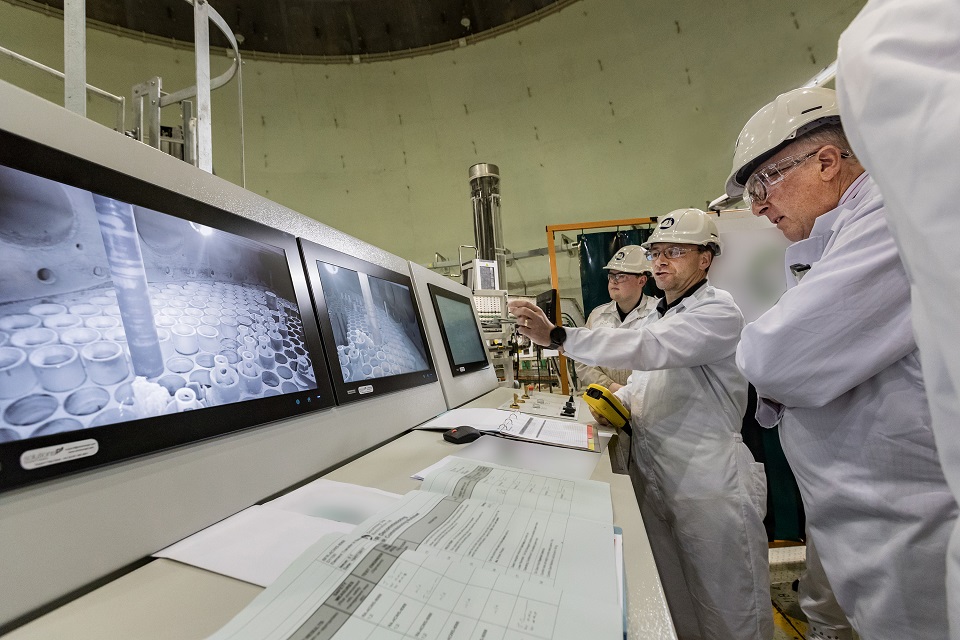
MP Jamie Stone looks on as team members monitor removal of the breeder material

During a visit to the reactor, Jamie Stone, MP for Caithness, Sutherland and Easter Ross, said:

Actually watching on screen the removal of an element from the reactor core was fascinating. Seeing the intricate techniques and skills, and the special locally designed equipment being used was absolutely inspirational.

In an age when sometimes you begin to wonder where British technology is going, it is hugely encouraging to see what is being done at Dounreay. I take my hat off to the workforce.

When the damaged elements were discovered, decommissioning effectively stopped for 20 years, until the decision was taken in 2000 to close down Dounreay and the creation of the NDA a few years later gave fresh momentum to the task.

The elements were immersed in some 57 tonnes of highly reactive liquid metal which had to be removed and destroyed before remotely operated cameras could inspect the condition of the material. This difficult, hazardous programme took more than 10 years.

Now, following extensive research and development trials inside the plant and at a test rig on the outskirts of Thurso, work has started to remove the remaining breeder material.

Watch the DFR breeder material removal process

Dounreay Fast Reactor

After removal, the elements are being transferred to a purpose-built facility, where they are being cut open to remove the uranium fuel, cleansed of any traces of liquid metal and packaged in containers for dispatch to Sellafield. About 40 tonnes of breeder recovered previously has already been sent there.

When all the breeder material has been removed, work can begin on taking the reactor apart.

Main support contractor: JGC Engineering & Technical Services Ltd

About the Dounreay Fast Reactor (DFR)

  • the DFR was built during the 1950s at a time when there was a world-wide shortage of uranium for electricity generation

  • It became the world’s first fast reactor to provide electricity to a national grid, providing enough power for a small town like Thurso (population approx 9,000)

  • DFR’s reactor core was surrounded by a blanket of natural uranium elements that, when exposed to the effects of the radiation, would ‘breed’ to create a new fuel, plutonium

  • UK experimentation with fast breeders came to an end in the 1980s

  • decommissioning DFR is one of the most significant challenges in the UK today. It was one of only two fast reactors ever built in the UK, both at Dounreay.

  • when the breeder material is all removed, the reactor and its circuits will be dismantled, followed by final decontamination of the structures

  • the dome and associated structures will be demolished

Dounreay Site Restoration Ltd (DSRL)

DSRL, a company owned by Cavendish Dounreay Partnership, is responsible for decommissioning the UK’s former centre of fast reactor research on behalf of the NDA.

News story: Free at last as jammed fuel is lifted out

Updated: Updated the link to the longer version of the video

When the dome-shaped experimental reactor closed in 1977, most of the core fuel was removed.

But follow-up work came to a halt when some of the metallic casings in the zone surrounding the core were found to be swollen and jammed. Almost 1,000 – around two-thirds of the total – were left in place.

Made of stainless steel, the casings, known as breeder elements, contained natural uranium and were designed to produce more fuel for use in other reactors.

Now, after many years of work to design and test remotely operated equipment, a decommissioning team has started to recover the elements.

Decommissioning the 50-year-old reactor is one of the most technically challenging projects in the NDA estate and removing the breeder elements has been a top priority.

The removal work is expected to take less than 3 years, after which dismantling of the landmark reactor can begin.

David Peattie, NDA Chief Executive, said:

Dealing with this material is one of the highest priorities anywhere for the NDA, not just at Dounreay but across our UK sites. The safe and timely retrieval of the breeder material is crucial to both the site’s closure programme and the national defueling programme.

I am very pleased with this achievement which is a great example of how the Dounreay team and the NDA can work together to deliver results of national importance.

MP Jamie Stone looks on as team members monitor removal of the breeder material

During a visit to the reactor, Jamie Stone, MP for Caithness, Sutherland and Easter Ross, said:

Actually watching on screen the removal of an element from the reactor core was fascinating. Seeing the intricate techniques and skills, and the special locally designed equipment being used was absolutely inspirational.

In an age when sometimes you begin to wonder where British technology is going, it is hugely encouraging to see what is being done at Dounreay. I take my hat off to the workforce.

When the damaged elements were discovered, decommissioning effectively stopped for 20 years, until the decision was taken in 2000 to close down Dounreay and the creation of the NDA a few years later gave fresh momentum to the task.

The elements were immersed in some 57 tonnes of highly reactive liquid metal which had to be removed and destroyed before remotely operated cameras could inspect the condition of the material. This difficult, hazardous programme took more than 10 years.

Now, following extensive research and development trials inside the plant and at a test rig on the outskirts of Thurso, work has started to remove the remaining breeder material.

Watch the DFR breeder material removal process

Dounreay Fast Reactor

After removal, the elements are being transferred to a purpose-built facility, where they are being cut open to remove the uranium fuel, cleansed of any traces of liquid metal and packaged in containers for dispatch to Sellafield. About 40 tonnes of breeder recovered previously has already been sent there.

When all the breeder material has been removed, work can begin on taking the reactor apart.

Main support contractor: JGC Engineering & Technical Services Ltd

About the Dounreay Fast Reactor (DFR)

  • the DFR was built during the 1950s at a time when there was a world-wide shortage of uranium for electricity generation

  • It became the world’s first fast reactor to provide electricity to a national grid, providing enough power for a small town like Thurso (population approx 9,000)

  • DFR’s reactor core was surrounded by a blanket of natural uranium elements that, when exposed to the effects of the radiation, would ‘breed’ to create a new fuel, plutonium

  • UK experimentation with fast breeders came to an end in the 1980s

  • decommissioning DFR is one of the most significant challenges in the UK today. It was one of only two fast reactors ever built in the UK, both at Dounreay.

  • when the breeder material is all removed, the reactor and its circuits will be dismantled, followed by final decontamination of the structures

  • the dome and associated structures will be demolished

Dounreay Site Restoration Ltd (DSRL)

DSRL, a company owned by Cavendish Dounreay Partnership, is responsible for decommissioning the UK’s former centre of fast reactor research on behalf of the NDA.

News story: Hurricane Irma: Foreign Secretary interview with media

Foreign Secretary Boris Johnson said:

We are continuing to deliver aid, including food and water, to where it is needed. There are now 700 UK troops and more than 50 police officers in Anguilla, British Virgin Islands, and Turks and Caicos islands. More than 40 tonnes of UK aid has arrived in the region with much more on the way.

In Anguilla there has been a request for building supplies, in particular plywood, to begin reconstruction and we have responded. We are also sending more police into both the BVI and into Anguilla, so that security has improved and a sense of confidence is rising. We have also taken steps in relation to St Maarten, which is a French and Dutch territory. There are a lot of Brits on holiday there and we have sent UK consular representatives.

Across the area the breakdown in communications, the inability to use mobile phones or access the internet, has people worried. So an effort is underway to re-establish wi-fi across the region as well as electricity supplies. We are doing everything possible to help Brits in need.

To assist with reporting, please see below for the latest information, facts and figures on the UK government’s response to Hurricane Irma.

  • The UK has a major response effort underway, with further resources being deployed to the Caribbean today.
  • There is now a UK military presence delivering disaster relief in the British Virgin Islands, Anguilla and Turks and Caicos islands.
  • The UK has deployed 700 troops and more than 50 police officers to support the islands. More will deploy in the next few days, including military doctors, dentists, nurses and other experts.
  • More than 40 metric tonnes of aid has now arrived and is being distributed across the region – including 2,608 shelter kits, which can provide shelter for over 13,000 people, and 2,304 solar lanterns, which can provide essential light and power for over 11,000 people.
  • Nine tonnes of food and water are being procured for onward delivery. Thousands more shelter kits and buckets are being prepared to dispatch from the UK.
  • RFA Mounts Bay, which patrols Caribbean waters for six months of the year during the hurricane season (June to November), carried out essential recovery work in the British Virgin Islands and Anguilla in the immediate aftermath of the storm, making it possible for further support to arrive. It has now reloaded with supplies and returned to Anguilla to assist further in rebuilding homes, key infrastructure and supporting the relief efforts.
  • HMS Ocean is currently docked in Gibraltar and will depart for the Caribbean in the next 24 hours. It is being loaded with 200 pallets of aid and 60 pallets of Emergency Relief Stores (ERS), as well as 5,000 hygiene kits, 10,000 buckets and 504,000 Aquatabs.
  • Expert engineers are helping to re-establish communications on the islands so cut off communities can be reached.
  • The UK is working closely with international partners in the region, including providing support to the French to transport helicopters to the region.
  • A further three flights are due to leave RAF Brize Norton carrying personnel and aid – in addition to five previous flights. Two UK scheduled commercial flights have also departed from Manchester for the region, carrying 8,340 aid buckets.
  • With our support, the Red Cross are also providing drinking water, family hygiene kits, blankets, tarpaulins and emergency backpacks.
  • A second Foreign Office rapid deployment team of expert staff was deployed to the region today.
  • Last week the Prime Minister announced a £32m relief fund to support the humanitarian effort and the UK was the first country to arrive on the scene. In addition to this, the UK government is doubling all public donations made to the British Red Cross appeal.
  • Our Ambassador to the US deployed teams of staff at airports in the affected areas of the USA. They are providing advice and support to British nationals in Florida and issuing emergency travel documents.
  • Our US Network has liaised closely with the US authorities to get British Nationals to safety.
  • The Foreign Office has set up a hotline for those concerned about friends and relatives affected by the hurricane: +44 20 7008 0000. At their request, we are taking all emergency calls for the British Virgin Islands and the Turks and Caicos Islands on this number.

Read more about the government’s response to Hurricane Irma.

News story: Hurricane Irma: Foreign Secretary interview with media

Foreign Secretary Boris Johnson said:

We are continuing to deliver aid, including food and water, to where it is needed. There are now 700 UK troops and more than 50 police officers in Anguilla, British Virgin Islands, and Turks and Caicos islands. More than 40 tonnes of UK aid has arrived in the region with much more on the way.

In Anguilla there has been a request for building supplies, in particular plywood, to begin reconstruction and we have responded. We are also sending more police into both the BVI and into Anguilla, so that security has improved and a sense of confidence is rising. We have also taken steps in relation to St Maarten, which is a French and Dutch territory. There are a lot of Brits on holiday there and we have sent UK consular representatives.

Across the area the breakdown in communications, the inability to use mobile phones or access the internet, has people worried. So an effort is underway to re-establish wi-fi across the region as well as electricity supplies. We are doing everything possible to help Brits in need.

To assist with reporting, please see below for the latest information, facts and figures on the UK government’s response to Hurricane Irma.

  • The UK has a major response effort underway, with further resources being deployed to the Caribbean today.
  • There is now a UK military presence delivering disaster relief in the British Virgin Islands, Anguilla and Turks and Caicos islands.
  • The UK has deployed 700 troops and more than 50 police officers to support the islands. More will deploy in the next few days, including military doctors, dentists, nurses and other experts.
  • More than 40 metric tonnes of aid has now arrived and is being distributed across the region – including 2,608 shelter kits, which can provide shelter for over 13,000 people, and 2,304 solar lanterns, which can provide essential light and power for over 11,000 people.
  • Nine tonnes of food and water are being procured for onward delivery. Thousands more shelter kits and buckets are being prepared to dispatch from the UK.
  • RFA Mounts Bay, which patrols Caribbean waters for six months of the year during the hurricane season (June to November), carried out essential recovery work in the British Virgin Islands and Anguilla in the immediate aftermath of the storm, making it possible for further support to arrive. It has now reloaded with supplies and returned to Anguilla to assist further in rebuilding homes, key infrastructure and supporting the relief efforts.
  • HMS Ocean is currently docked in Gibraltar and will depart for the Caribbean in the next 24 hours. It is being loaded with 200 pallets of aid and 60 pallets of Emergency Relief Stores (ERS), as well as 5,000 hygiene kits, 10,000 buckets and 504,000 Aquatabs.
  • Expert engineers are helping to re-establish communications on the islands so cut off communities can be reached.
  • The UK is working closely with international partners in the region, including providing support to the French to transport helicopters to the region.
  • A further three flights are due to leave RAF Brize Norton carrying personnel and aid – in addition to five previous flights. Two UK scheduled commercial flights have also departed from Manchester for the region, carrying 8,340 aid buckets.
  • With our support, the Red Cross are also providing drinking water, family hygiene kits, blankets, tarpaulins and emergency backpacks.
  • A second Foreign Office rapid deployment team of expert staff was deployed to the region today.
  • Last week the Prime Minister announced a £32m relief fund to support the humanitarian effort and the UK was the first country to arrive on the scene. In addition to this, the UK government is doubling all public donations made to the British Red Cross appeal.
  • Our Ambassador to the US deployed teams of staff at airports in the affected areas of the USA. They are providing advice and support to British nationals in Florida and issuing emergency travel documents.
  • Our US Network has liaised closely with the US authorities to get British Nationals to safety.
  • The Foreign Office has set up a hotline for those concerned about friends and relatives affected by the hurricane: +44 20 7008 0000. At their request, we are taking all emergency calls for the British Virgin Islands and the Turks and Caicos Islands on this number.

To donate to the British Red Cross Hurricane Irma appeal visit: www.redcross.org.uk/HurricaneIrma or call 0300 456 4999.

Read more about the government’s response to Hurricane Irma.