News story: MOD and Royal College of Art collaborate on cutting-edge new uniform

The Future Soldier Vision (FSV) is part of the MOD’s plan to give British soldiers’ high-quality, cutting-edge equipment.

The Royal College of Art’s (RCA) researchers and designers worked on the clothing to ensure prototypes were fitted to the body, easy to run in and comfortable to wear. The RCA supplied a number of sets of prototype combat clothing which were assessed at the Specialist Weapons School, Warminster, to examine future uniform concepts.

Minister for Defence Procurement Harriett Baldwin said:

From new materials to high-tech helmets, innovation is all about giving our personnel the kit they need by working with world famous partners like the Royal College of Art. You might not expect the MOD to work with an art and design university, but it is this kind of non-traditional partnership which will keep our Armed Forces equipped with cutting edge technology.

So far, kit being designed for FSV includes advanced combat clothing, with new materials like four-way stretch ‘phase-change material’ and silent hook-and-loop pockets. The enhanced body armour will be stronger, as well as having a new high-tech helmet with state-of-the- art, built-in communication systems.

FSV aims to give industry an example of an integrated soldier system that balances military need with cutting-edge technology. This includes technology that delivers distributed power and data, scalable and integrated protection, augmented surveillance and target acquisition, and a range of functional fabrics incorporated into the clothing.

Head of Programme for Textiles and Reader in Smart Textiles at the RCA Anne Toomey said:

The RCA was pleased to have this opportunity to demonstrate how our innovative design approaches can enhance value and impact across sectors through optimising existing materials performance and fabrication.

As the RCA grows its research activities to embrace new materials and fabrication technologies, we will be able to further extend this reach upstream. We plan to become the world’s first STEAM institution, operating a design-led approach to future innovation with materials through the development of our new Materials Science Research Centre.
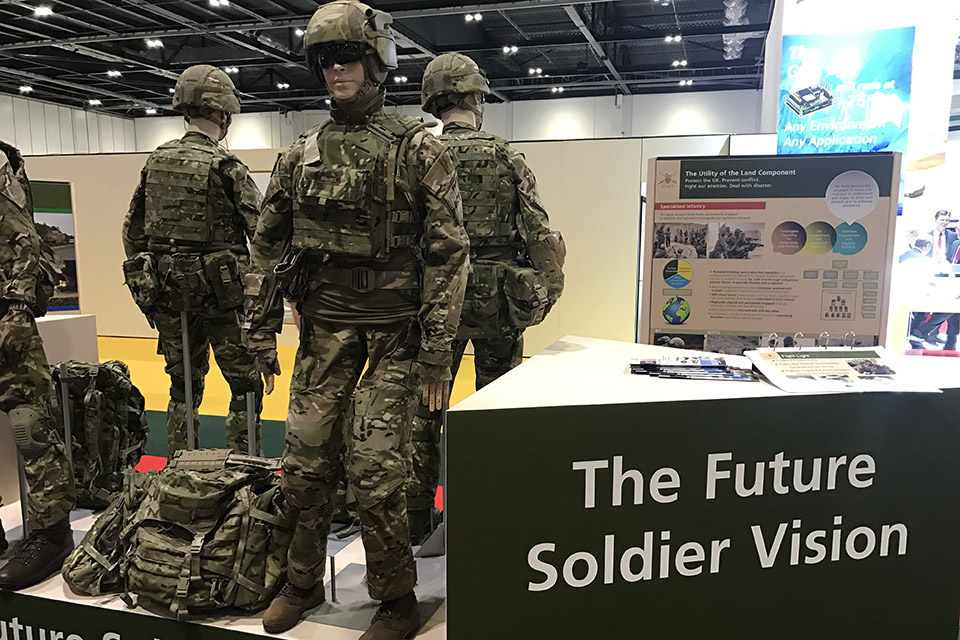
MOD and Royal College of Art Collaborate on cutting-edge new uniform. Crown Copyright.

Defence Science & Technology Laboratory has worked with a number of small and non-traditional suppliers, such as the RCA, to develop options for improved soldier system components.

News story: MOD and Royal College of Art collaborate on cutting-edge new uniform

The Future Soldier Vision (FSV) is part of the MOD’s plan to give British soldiers’ high-quality, cutting-edge equipment.

The Royal College of Art’s (RCA) researchers and designers worked on the clothing to ensure prototypes were fitted to the body, easy to run in and comfortable to wear. The RCA supplied a number of sets of prototype combat clothing which were assessed at the Specialist Weapons School, Warminster, to examine future uniform concepts.

Minister for Defence Procurement Harriett Baldwin said:

From new materials to high-tech helmets, innovation is all about giving our personnel the kit they need by working with world famous partners like the Royal College of Art. You might not expect the MOD to work with an art and design university, but it is this kind of non-traditional partnership which will keep our Armed Forces equipped with cutting edge technology.

So far, kit being designed for FSV includes advanced combat clothing, with new materials like four-way stretch ‘phase-change material’ and silent hook-and-loop pockets. The enhanced body armour will be stronger, as well as having a new high-tech helmet with state-of-the- art, built-in communication systems.

FSV aims to give industry an example of an integrated soldier system that balances military need with cutting-edge technology. This includes technology that delivers distributed power and data, scalable and integrated protection, augmented surveillance and target acquisition, and a range of functional fabrics incorporated into the clothing.

Head of Programme for Textiles and Reader in Smart Textiles at the RCA Anne Toomey said:

The RCA was pleased to have this opportunity to demonstrate how our innovative design approaches can enhance value and impact across sectors through optimising existing materials performance and fabrication.

As the RCA grows its research activities to embrace new materials and fabrication technologies, we will be able to further extend this reach upstream. We plan to become the world’s first STEAM institution, operating a design-led approach to future innovation with materials through the development of our new Materials Science Research Centre.

MOD and Royal College of Art Collaborate on cutting-edge new uniform. Crown Copyright.

Defence Science & Technology Laboratory has worked with a number of small and non-traditional suppliers, such as the RCA, to develop options for improved soldier system components.

Press release: Autonomy on the frontline: Last Mile challenge winners announced

The Ministry of Defence (MOD) set industry and academia a challenge to design pioneering technology to get vital supplies to soldiers on the front line and the winners have now been chosen.

Part of MOD’s Innovation Initiative, and led by MOD’s Defence Science and Technology Laboratory (Dstl) with the Defence and Security Accelerator (DASA), the contracts are worth around £3.5 million over 3 years.

Dstl, in partnership with industry and academia, delivers defence and security science and technology (S&T) research for MOD and other government departments and allied organisations, looking to find the best solutions to UK defence and security challenges of today and the future.

Supplying troops in challenging environments – often dubbed ‘the last mile’ – using unmanned technology may reduce risk and cost. As announced at last year’s Farnborough Airshow, Dstl is working with the US Department of Defense to accelerate and demonstrate the effective use of these new robotic and autonomous systems technologies, with UK troops testing prototypes by 2019.

Drawing on commercial technology and conceptual ideas, from online delivery systems to futuristic unmanned vehicles, more than 140 organisations from small and medium-sized enterprises to big defence companies submitted entries for the Last Mile challenge.

Winning ideas include autonomous hover-bikes, unmanned air and ground vehicles, novel means of autonomously loading and unloading, navigating and delivery ordering, management and control using ‘uber-like’ and other app-based technologies.

Twenty-five projects were chosen from organisations from the UK and worldwide with a total contract value for the 6-month first phase of almost £2 million to advance the technology towards a system solution for ‘tactical resupply in a box’. The subsequent year-long phase will then go on to produce demonstrator system prototypes of the concepts, including evaluation with the British Army in October 2018 as part of the Army’s Warfighter Experiment ‘Autonomous Warrior (Land)’ (AWE18), in addition to a potential demonstration in the US.

UK jobs will be created or secured from the project, with the majority of companies chosen being from Britain. The Innovation Initiative and £800 million Defence Innovation Fund aims to encourage imagination, ingenuity and entrepreneurship, to find twenty-first century solutions to rapidly emerging threats.

Dstl’s lead for the challenge, Peter Stockel, said:

The number and quality of the entries for this competition was outstanding and the competition was fierce. We chose the best from across the proposals to enable the system solutions we want for prototype demonstration and evaluation. This was a fully open competition, with many of those down-selected happening to come from the UK. This illustrates the strength of our national capability and the benefit of recent investments in this important and rapidly developing technology sector. However, it was great to also be able to pick some great propositions from around the world. The brief is to rapidly demonstrate system solutions which aim to reduce the logistic burden on our Armed Forces, provide new operational capability and reduce casualties; so we’re pleased with the response and keen to see the potential capability benefits being assessed by our military during AWE18.

Today’s report proves that British broadcasting has a diversity problem – Tom Watson

Tom
Watson MP, Labour’s Shadow Secretary of State for Culture, Media and Sport,
commenting on
Ofcom’s report into broadcasting diversity, said:


“Today’s
report proves that British broadcasting has a diversity problem.


“Women
and people from BAME backgrounds are underrepresented, particularly in senior
roles, but the most shocking fact is that just 3 per cent of the broadcasting
workforce has a disability, compared with 18 per cent of the population.


“Data
can be an important driver of change, but that data needs to be comprehensive.
The huge gaps in diversity data that Ofcom have found are unacceptable, but we
also need to collect data that paints a broader picture, and that means
collecting data on social class too.


“Our
television represents who we are as a nation and those who work on and off
screen should represent the whole country, not just part of it.”


Ends


Notes
to Editors


·         Ofcom’s report
out today can be found here:
https://www.ofcom.org.uk/about-ofcom/latest/features-and-news/diversity-uk-television-industry

·        
Labour released its Acting
Up
report over the summer which looked at access and diversity in the
performing arts. One of the key recommendations was an improvement in diversity
data collection and monitoring. The full report and executive summary is
available here:
http://www.tom-watson.com/actingup