The Boris article

I do not see the Boris article as a leadership bid or an offside comment. It is a clear statement of the possible gains from Brexit, by a senior member of the government speaking for the government.  It is a  reminder of how we can and should be better off by implementing the decision of the voters.  It was good to see the reminder that we want to be able to scrap VAT on items that should not attract it when we take back control of our taxes, and to be able to spend more on public services when we get our money back.

Site visit – Magdalen Green #dundeewestend

Yesterday, along with representatives of the Friends of Magdalen Green and a representative of the council’s environment management, I took part in a site visit at Magdalen Green to discuss a number of issues.

This was a very useful and productive discussion and it has been agreed to provide an information board near the bandstand and look at some other improvements for Magdalen Green in the coming months.

9 rescued from collapsed tunnel in SW China

Nine construction workers were rescued Saturday after having been trapped for two days in a collapsed railway tunnel in southwest China’s Yunnan Province, rescuers said.

Rescuers managed to dig a passageway to reach the workers at about 10:45 a.m. Saturday. The first worker was rescued at about 12:43 p.m. and eight minutes later, all had been rescued, rescue officials said.

All the workers are in stable condition.

The tunnel in the Xishuangbanna Dai Autonomous Prefecture they were working on collapsed at about 10:20 a.m. Thursday.

After digging a small opening through the rubble, rescuers managed to contact the workers with the help of a thin pipe and confirmed that all the workers were alive Friday. They even installed a mobile phone signal amplifier to help them keep in contact.

Later the workers were offered food three times.

More than 230 workers were involved in the rescue operation by excavating small tunnels or larger passageways in four directions.

The tunnel is part of a railway that connects Yuxi and Mohan in Yunnan.

Beijing’s landmark wholesale market closes for good

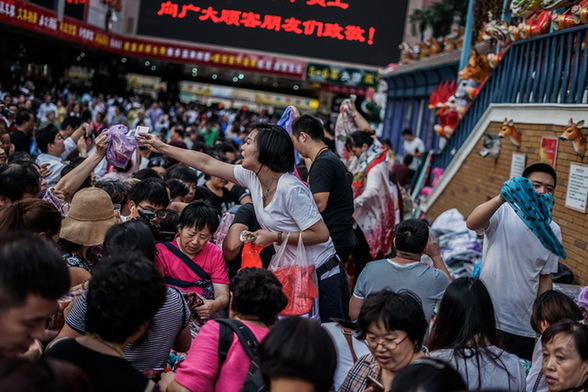
Tianyi Market, Beijing’s largest small commodities wholesale market, officially ended its 25-year life on Friday with thousands of shoppers enjoying their last chance of a cheap shopping spree.

Thousands of shoppers enjoy a last shopping spree at Beijing’s biggest wholesale market of Tianyi that closed for good on Sept. 15, 2017 after a 25-year operation. [Photo by Zheng Liang / China.org.cn] 

With one minute to go before closure, both shoppers and vendors stopped bargaining and took out their cameras or mobile phones to record the end of an era, with nostalgic farewell songs such as “Unforgettable Tonight” and “Auld Lang Syne” being played over the public address system.

“I have carried on business here for more than 10 years,” one vendor told China.org.cn, “I can’t just let it go in my heart.”

Tianyi Market opened on Nov. 18, 1992, and at its peak had more than 4,650 booths rented to 1,900 vendors selling over 130,000 kinds of commodities from all over the country. It was convenient for Beijing residents to buy all kinds of things for daily use and items for celebrating various festivals at cheap prices.

However, the Beijing government started a campaign to remove low-end businesses and wholesale markets, transferring them to neighboring cities, in order to reduce the population and relocate non-capital functions. It plans to remove all wholesale markets within the city’s Fourth Ring Road by 2020.

Tianyi Market has signed a contract cancellation agreement with the vendors and compensated them with four times the amount they initially paid in a guarantee deposit of 100,000 yuan (US$15,200).

However, for long-term vendors who likely paid one million yuan (US$152,000) in booth rent (guarantee deposit not included) for 10 years, for example, the compensation of 400,000 yuan (US$61,000) won’t necessarily help them much.

Liu Haitao, chairman of Tian Heng Group, which owns the real estate property containing Tianyi Market, said some vendors at first were not happy and didn’t understand the situation. However, his team negotiated with them and persuaded them to comply.

While some vendors have founded online platforms or returned to their hometowns to continue business, many others lost their living.

During the last days of Tianyi Market, tens of thousands of shoppers poured into the building for a last shopping spree, with security and customer flow controls tightened. Many goods were sold at very discounted prices.

After the market closed, the Tianyi building will be transformed into a venue to house technology companies and financial enterprises, Liu said. Tianyi Market may be reborn in Tianjin or neighboring Hebei Province, and many vendors have already pledged to follow it there and work with it again, a market representative said.

Previously, at the end of 2015, the branch of Tianyi Market at Di’anmen was closed after operating for 14 years.

Beijing has removed and improved 302 markets and 51 logistics centers in the period of 2015-2016. In 2017, the city plans to remove or renovate 120 markets and 38 logistics centers, according to an announcement by the Beijing Municipal Commission of Commerce. As of June, it had either removed or renovated 53 markets and three logistics centers.

Productivity

Productivity is an ugly sounding word from economics. Some are worried by it as they fear it means job losses, restructurings, making people work harder. Curiously enough it is a word which apparently unites the warring political parties. They all claim to want higher productivity. Some even understand that increased productivity is the key to higher real pay and better living standards. If business can produce more with less,  prices can be lower or specifications and quality higher, and we can afford to buy more or better.

Agreeing to support the general cause is as good as it gets. As we discovered again on Tuesday in the Finance Bill debate, productivity is also a word which divides, as different parties have different views of what you need to do to raise productivity, and where you might apply the policy.

I detected once again a distinct unease by Labour to discuss public sector productivity, for example. This is odd, given that Ministers- and indirectly MPs – have much more influence over how the public sector is financed and managed than we do over the private sector. I pointed out that during the long Labour years 1997-2010 there were no overall productivity gains in the main public services, at a time when private sector productivity was advancing moderately every year.It would be good to know from them why that was, and what they learned from the experience of presiding over a large sector with no clear gains.

The public sector has struggled with the digital revolution more than the private. The application of computer technology and robotics to business is transforming many areas of our lives. The UK public sector still does not have proper computerised records and controls in the NHS, tax has not yet gone fully digital and robotics are not much deployed.

The public sector has had access to substantial sums of capital to transform the way it does things, but has also had a disappointing record at implementing change through large computer programmes.