LCQ22: Maritime digitalisation and co-ordinated development of port cluster in Greater Bay Area

     â€‹Following is a question by the Hon Wu Yingpeng and a written reply by the Acting Secretary for Transport and Logistics, Mr Liu Chun-san, in the Legislative Council today (November 11):

Question:

     Our country's Outline of the 15th Five-Year Plan proposes to develop a world-class port cluster layout in the Guangdong-Hong Kong-Macao Greater Bay Area (GBA) and promote the integrated development of the port cluster. Hong Kong's First Five-Year Plan and the 2026 Policy Address also explicitly promote the digitalisation, smart transition and green transformation of the maritime industry. In this connection, will the Government inform this Council:

(1)(i) of the latest progress of the study on the roadmap for smart transition of the Kwai Tsing Container Terminals; (ii) the current actual coverage rates of autonomous electric vehicles and remotely-controlled cranes at the terminals; (iii) whether the authorities will provide financial subsidies on a matching basis or tax concession incentives for operators to upgrade automated rail-mounted gantry cranes and smart yard management systems; if not, the reasons for that;

(2)(i) of the number and proportion of local small and medium-sized logistics and shipping agency enterprises among the enterprises currently registered with the Port Community System; (ii) the respective numbers of applications received and approved for funding under the Future Innovative Logistics Acceleration Scheme; (iii) while promoting the interconnection of port logistics data, the specific measures in place to implement the requirements of the Protection of Critical Infrastructures (Computer Systems) Ordinance, so as to safeguard the commercial data security and privacy of shipping enterprises;

(3) of the progress of the Government's legal review in respect of the safety standards for the navigation of unmanned vessels in Hong Kong waters, the applicability of the international regulations for preventing collisions at sea, and the determination of legal liabilities of remote control operators, etc; when the authorities expect to launch unmanned vessel trial projects in designated waters or "water-to-water transhipment" channels, so as to promote the application of a smart and green logistics model;

(4) of the respective cumulative numbers of trips, cargo volumes in twenty-foot equivalent units, average cargo load factors and average times for customs clearance and transhipment waiting since the regular operation of the Chongqing-Shenzhen-Hong Kong and Chengdu-Shenzhen-Hong Kong scheduled rail-sea intermodal service in combination with the Shenzhen-Hong Kong Port Connect feeder service, as well as the Chongqing-Qinzhou-Hong Kong sea rail intermodal service; and

(5) of the current standing communication and collaboration mechanisms between the Government and other GBA cities in co-ordinating the division of labour among ports; the specific strategies to be adopted in future to achieve complementary advantages among the various ports in the GBA?

Reply:

President,

     The National 15th Five-Year Plan indicates clear support to Hong Kong in consolidating and enhancing its status as an international maritime centre (IMC). In the opening year of the National 15th Five-Year Plan, the Hong Kong Special Administrative Region (HKSAR) Government has formulated the First Five-Year Plan for Economic and Social Development of the Hong Kong Special Administrative Region (2026-2030) (Hong Kong's First Five-Year Plan) to proactively align with the national development strategy and propose the development strategy centered on stabilising container volume, increasing value, and strengthening synergy, with a shift of focus from volume-based to value-driven development, to accelerate the "volume to value" transformation of Hong Kong Port. It aims to consolidate and enhance Hong Kong's status as an IMC by promoting the development of a smart and green port, advancing high-quality collaborative development among ports, and strengthening high-value-added maritime services.

     In response to Member's question, having consulted the Security Bureau, a reply is as follows:

(1) The Kwai Tsing Container Terminals (KTCTs) comprise nine terminals with 24 berths, which are operated by five private port operators. Over the years, the KTCTs have been utilising computer systems for centralised resource allocation and operational management, connecting various hardware devices via wireless communication technology to form a highly efficient digital management infrastructure. In recent years, port operators have gradually upgraded the terminal's hardware facilities to enhance smart capabilities in line with their operational needs, including retrofitting more cranes for remote operation and introducing additional autonomous electric vehicles. Currently, port operators have introduced six autonomous electric vehicles, and 67 cranes (accounting for approximately 16 per cent of the total number of cranes at KTCTs) are now operated remotely.

     To further enhance the competitiveness of Hong Kong Port, the Government will focus on both quality and quantity, including continuously enhancing quality of our port through digitalisation, smart transition and green transformation. In this regard, the Government, in collaboration with the Hong Kong Maritime and Port Development Board and port operators, is formulating a roadmap for the smart transition of the KTCTs to accelerate the overall smart transition process of the terminals. In formulating the roadmap, the Government will take into account Hong Kong's unique position as a free port and international transshipment hub in full to ensure that the smart transition not only enhances terminal operational efficiency but also maintains operational flexibility. At the same time, the Government will consider factors such as the business development and operational needs of port operators, their investment capacity, and technical feasibility to ensure that the proposals put forward under the roadmap are practically feasible. The Government will take a proactive, pragmatic, and orderly approach to steer port operators in accelerating the smart transition of the terminals, thereby supporting the realisation of Hong Kong's vision for developing into a green and smart port.

(2)(i) The Port Community System (PCS) is a key digital infrastructure initiative led by the Government to drive the digital transformation of Hong Kong's maritime, port and logistics industries. Since its official rollout in January this year, over 9 000 enterprises, including terminal operators, shipping companies, logistics companies and traders, have registered with the system. Among them, about 6 000 enterprises are engaged in logistics and shipping agency services (accounting for more than 60 per cent of the total number of registered users).

(ii) To support the upgrading and transformation of the shipping and logistics industry and to make it easier for businesses to access logistics data platforms operated by the Government or public bodies-including the PCS-the Government launched in June this year the Future Innovative Logistics Acceleration Scheme (FILAS) where the first batch of three preapproved information technology onboarding solutions under the FILAS was announced on September 1 and funding applications from third-party logistics service providers for using the solutions have since been accepted. As of October this year, a total of seven applications were received under the FILAS and three of which have been approved, involving a total funding amount of HK$1.23 million.

(iii) The Protection of Critical Infrastructures (Computer Systems) Ordinance (Ordinance) requires operators of relevant critical infrastructure (the Operators) of various sectors, to effectively fulfill their statutory obligations under the Ordinance. The Ordinance ensures that the Operators establish dedicated management structures to implement necessary security protection measures, formulate computer-system security management plans, conduct regular computer-system security risk assessments and audits, develop emergency response plans and participate in drills to prevent cyberattacks and ensure a swift response to incidents, thereby enhancing the computer-system and data security of critical infrastructures.

     On the other hand, the PCS, as a key digital infrastructure owned by the Government and operated by the Logistics and Supply Chain MultiTech R&D Centre, aims to promote the interconnectivity of maritime, port and logistics data. Its operations fully comply with the requirements of the Government IT Security Policy and Guidelines of the Digital Policy Office. The system has established corresponding information technology security measures for data and system security and conducts regular security risk assessments and audits to safeguard the security and privacy of the commercial data of enterprises within the system.

(3) Following the release of the first non-mandatory International Code of Safety for Maritime Autonomous Surface Ships (MASS Code) by the International Maritime Organization in May 2026, the Government is actively reviewing Hong Kong's maritime legislations, and the need to upgrade port monitoring systems and supporting infrastructure, with reference to the MASS Code as well as relevant national standards or guidelines, to facilitate the application of autonomous vessels and ensure that their various modes of operation can operate safely and in compliance with the relevant regulatory requirements in Hong Kong waters. The Government is still studying the relevant rules and standards. At this stage, applications for trial operations will be accepted based on their complexity, with simpler ones to be handled first; and assessed for trial run by phase in suitable waters based on various factors, including the complexity of the application scenarios involved, the maturity of the technologies adopted, the operating mode and the risk level.

(4) The Government has been working closely with the logistics sector and port operators to further enhance the comprehensive "Rail-sea-land-river" Intermodal Transport System while stepping up promotional efforts in various inland provinces of Chinese Mainland, with a view to further expanding the catchment area for Hong Kong Port and attracting more transhipment cargos. Sea-rail intermodal transshipment aside, the Government is also working with the industry to explore ways of enhancing the competitiveness of other transshipment products, thereby consolidating Hong Kong's role as the regional transhipment hub and boosting the container throughput of Hong Kong Port. In 2025, laden container throughput between Hong Kong and Shenzhen Yantian, and between Hong Kong and Guangxi amounted to around 336 000 and 276 000 twenty-foot equivalent units respectively, increased by 13 per cent and 21 per cent respectively over a year earlier. The Chongqing-Shenzhen-Hong Kong scheduled freight train service, the Chengdu-Shenzhen-Hong Kong scheduled freight train service and the Chongqing-Qinzhou-Hong Kong sea-rail intermodal service are operated by port operators. The Government does not maintain relevant data on the relevant cargo volume involved.

(5) The Guangdong-Hong Kong-Macao Greater Bay Area (GBA) is home to three world-class major ports-Hong Kong, Shenzhen, and Guangzhou-each with its own competitive strengths. To develop the GBA into a world-class port cluster and enhance its overall international competitiveness, the three ports must maximise the synergies that yield mutual benefits for all parties.

     In the Hong Kong's First Five-Year Plan, the HKSAR Government sets out the objective of promoting high-quality collaborative development between Hong Kong and other ports within the GBA. The Government will work with Guangdong Province and relevant agencies through various co-operation platforms and co-ordination mechanisms to jointly advance and implement relevant initiatives. The Government will also maintain close contact with Guangdong Province and relevant bodies to continue fostering closer co-operation between Hong Kong and Chinese Mainland ports within the GBA, thereby consolidating and enhancing the comprehensive strength and competitiveness of the GBA port cluster and achieving high-quality collaborative development between Hong Kong and the Chinese Mainland city ports in the GBA.
LCQ11: Enhancing clearance capacity and level of convenience of boundary control points

     Following is a question by the Hon Chan Yung and a written reply by the Secretary for Security, Mr Tang Ping-keung, in the Legislative Council today (November 11):
 
Question:
 
     The Government of the Hong Kong Special Administrative Region and the Shenzhen Municipal Government have been progressively implementing the "East in East out, West in West out" planning strategy for cross-boundary goods traffic, with a view to facilitating the efficient and smooth flow of people, goods and vehicles within the Guangdong-Hong Kong-Macao Greater Bay Area. In this connection, will the Government inform this Council:
 
(1) of the respective numbers of eligible Hong Kong permanent residents who have enrolled for and used the Seamless e-Channel service at the Hong Kong Port of the Hong Kong-Zhuhai-Macao Bridge to date; the percentage of eligible Hong Kong permanent residents who have enrolled for the service; as the Administration has indicated that it will continue to review the effectiveness of the Seamless e-Channel service and system operations, and will explore the feasibility of extending the service to other immigration control points, of the current progress in this regard;
 
(2) whether the authorities have studied how to implement the "collaborative inspection and joint clearance" or "contactless clearance" mode through modification or redevelopment of other boundary control points (BCPs); if so, of the progress of the study, the BCPs initially assessed to be ready for implementation, and the timetable for follow-up studies;
 
(3) of the respective daily average and highest single-day passenger throughputs at the Lo Wu Control Point and the Lok Ma Chau Spur Line Control Point during long holidays in 2026 (including the Lunar New Year, Easter, the Birthday of the Buddha and the National Day Golden Week); given that the Lo Wu Control Point has on multiple occasions extended its operating hours of passenger clearance services to 2am the following day during long holidays, whether the authorities have studied regularising this arrangement (such as making it a standard practice for long holidays), and of its impacts on manpower and clearance demands;
 
(4) whether the authorities will consider providing 24-hour cargo clearance at the Liantang/Heung Yuen Wai BCP or other suitable BCPs; if so, of the specific timetable; if not, the reasons for that; if other BCPs are not ready for 24-hour cargo clearance in the near future, whether the authorities will consider extending their clearance hours first as an interim arrangement; and
 
(5) whether the authorities will explore with the Mainland the gradual relaxation of cross-boundary quota restrictions on smaller vehicles to implement the "East in East out, West in West out" planning strategy for passenger traffic, and allow private cars with other quotas to use the Shenzhen Bay Port and Liantang BCP during non-peak hours on a pilot basis first, while integrating the reservation systems of both places for dynamic traffic flow management?
 
Reply:
 
President,
 
     To tie in with national development planning and the development blueprint for the Guangdong-Hong Kong-Macao Greater Bay Area (GBA), the Government of the Hong Kong Special Administrative Region (HKSAR) has all along been maintaining close collaboration with the Shenzhen Municipal People's Government to upgrade the infrastructure and facilities of the land boundary control points (BCPs) between Hong Kong and Shenzhen with a forward-looking strategy, deepen the reform of boundary clearance modes, and actively leverage technology to seek innovative breakthroughs in taking forward a series of measures to enhance the clearance capacity and facilitation level of BCPs, with a view to facilitating the convenient and efficient flow of people, goods and vehicles in the GBA and strengthening connectivity between Hong Kong and Shenzhen as well as other GBA cities.
      
     In consultation with the Transport and Logistics Bureau, a reply to the various parts of the question raised by the Hon Chan Yung is as follows:
 
(1) The Immigration Department (ImmD) launched the pilot "Seamless e-Channel" service at the departure hall of the Hong Kong-Zhuhai-Macao Bridge (HZMB) Hong Kong Port on June 25, 2026, utilising facial recognition and artificial intelligence (AI) technologies to verify users' identities and allowing passengers to complete self-service departure clearance procedures in a non-stop manner without the need to present their Hong Kong identity cards or "e-Channel" QR codes during the process.
 
     Three months after the launch of the pilot service, the ImmD relaxed the eligibility criteria for enrolment in the pilot "Seamless e-Channel" service on September 24, 2026. At present, Hong Kong permanent residents aged 11 or above holding a valid smart identity card who have departed from or arrived in Hong Kong via the Passenger Clearance Building of the HZMB Hong Kong Port six times or more in the past 90 days are eligible to enrol for the service.
 
     Since the launch of the service and up to November 8, 2026, over 79 000 persons have enrolled for the "Seamless e-Channel" service, accounting for nearly 80 per cent of those eligible for enrolment, with a patronage exceeding 200 000 passenger trips.
      
     The "Seamless e-Channel" service has been operating smoothly since its launch, and the ImmD is planning to extend the service to the arrival hall of the HZMB Hong Kong Port. Meanwhile, the ImmD will continue to review the operational experience and effectiveness of the pilot service and, depending on the actual operational situation, explore the feasibility of extending the relevant service to other suitable immigration control points (such as the Express Rail Link West Kowloon Control Point).
 
(2) In planning new BCPs or redeveloping existing BCPs, the HKSAR Government will actively explore adopting innovative clearance modes and leveraging innovative technologies to enhance clearance efficiency and bring convenience to cross-boundary passengers. Following the first adoption of the "collaborative inspection and joint clearance" mode at the Huanggang Port, the Hong Kong and Shenzhen sides have also reached a consensus on adopting this clearance mode at the Sha Tau Kok Control Point upon its future redevelopment.
 
     As for leveraging innovative technologies to enhance clearance services, the ImmD will launch the Automated Transportation On-board Clearance System Pilot Scheme at the HZMB Hong Kong Port in December 2026, using AI and facial recognition technology to automatically verify the identities of pre-registered, eligible, cross-boundary private car drivers and passengers (who are Hong Kong permanent residents aged 11 or above), enabling "contactless on-board clearance". The pilot scheme deploys multi-camera real-time tracking technology to capture the facial features of the driver and passengers inside a private car, coupled with high-speed search AI algorithms to conduct identity verification for all persons on board simultaneously. All persons on board will then be able to complete immigration clearance procedures while remaining seated in the vehicle without the need to present any documents, and the average clearance time is expected to be substantially reduced from about two minutes to about 20 seconds.
      
     Regarding other existing BCPs, since any changes to their clearance modes must be premised on not affecting the existing operations of the BCPs, the issues involved are more complex than those in planning new BCPs. Therefore, the HKSAR Government and relevant Mainland authorities must conduct careful planning to ensure that conditions in various aspects, such as port design, boundary arrangements, layout of facilities and passenger flow planning, can fully complement one another before considering the implementation of such changes.
 
(3) During the major long holidays in 2026, the daily average cross-boundary passenger traffic and the highest single-day cross-boundary passenger traffic at the Lo Wu Control Point and the Lok Ma Chau Spur Line (LMCSL) Control Point are set out below:

Major long holidays in 2026
(as at October 31)
Lo Wu Control Point LMCSL Control Point
Daily average passenger traffic (passenger trips) Highest single-day passenger traffic (passenger trips) Daily average passenger traffic (passenger trips) Highest single-day passenger traffic (passenger trips)
Chinese New Year holidays (February 14 to February 23) 189 760 230 348 161 192 198 453
Easter and Ching Ming Festival holidays (April 3 to April 7) 241 292 257 748 206 238 219 568
Labour Day Golden Week of the Mainland (May 1 to May 5) 224 676 274 642 206 781 268 386
Birthday of the Buddha holidays (May 23 to May 25) 264 387 269 099 229 718 237 674
National Day Golden Week of the Mainland (October 1 to October 7) 219 250 250 136 195 849 223 354
Chung Yeung Festival holidays (October 17 to 19) 255 797 265 287 202 266 217 357

     The opening hours of land BCPs between Hong Kong and Shenzhen are determined through consultation between the governments of the two places and are subject to the approval of the Central Authorities. Extending the operating hours of clearance services at BCPs involves the overall operation of the ports on both sides, and careful consideration has to be given to a basket of factors, including actual needs, passenger throughput, effective utilisation of resources by both places, manpower deployment and ancillary transport facilities at the relevant BCPs.
      
     On the basis of the 24-hour passenger clearance services provided at the Huanggang Port and the HZMB Hong Kong Port, the HKSAR Government will continue to closely monitor the actual situation and needs of cross-boundary passenger and vehicular flows, and liaise with relevant Mainland authorities on special clearance arrangements in a timely manner having regard to the demand for boundary clearance during festive holidays.
 
(4) The Hong Kong and Shenzhen governments commissioned the cargo clearance facilities of the Liantang/Heung Yuen Wai BCP in August 2020, which has substantially shortened the travelling time between Hong Kong, Shenzhen and eastern Guangdong, thereby facilitating co-operation and development between the two places and neighbouring provinces. Meanwhile, the Shenzhen Bay Port located in the western part also extended the operating hours of its cargo clearance services to 24 hours in December 2020.
 
     At present, cross-boundary goods vehicles travelling to and from the eastern part of Shenzhen and eastern Guangdong mainly use the Liantang/Heung Yuen Wai BCP, complemented by the Man Kam To Control Point which primarily handles fresh food supply to Hong Kong; whereas cross-boundary goods vehicles travelling to and from the western part of Shenzhen mainly use the Shenzhen Bay Port which provides 24-hour cargo clearance services. Overall land-based cross-boundary goods traffic operation has all along been smooth in general.
      
     As regards extending the operating hours of cargo clearance services at individual land BCPs, as aforementioned, the relevant proposal involves the port operations of both Hong Kong and Shenzhen, and careful consideration has to be given by the governments of the two places to a basket of factors, including actual needs, utilisation of resources, manpower deployment and ancillary transport facilities. On the basis of the 24-hour cargo clearance services currently provided at the Shenzhen Bay Port, complemented by the cargo clearance services at the Liantang/Heung Yuen Wai BCP and the Man Kam To Control Point, the HKSAR Government will continue to closely monitor the needs of the cross-boundary goods transport trade and, having regard to actual needs, liaise with the relevant Mainland authorities and review the relevant measures in a timely manner.
 
(5) In respect of passenger transport, the Guangdong and Hong Kong governments currently allow cross-boundary hire cars and cross-boundary coaches holding Guangdong-Hong Kong regular quotas to choose other BCPs to travel between Guangdong and Hong Kong in addition to crossing the boundary via their original designated BCPs, bringing convenience to both transport operators and passengers. Meanwhile, Guangdong-Hong Kong cross-boundary private cars currently holding permits for using Hong Kong-Shenzhen land BCPs have been allowed to use the HZMB without the need for additional procedures for travelling between eastern and western parts of Guangdong Province.
 
     At present, Guangdong-Hong Kong cross-boundary private cars holding permits for using the Heung Yuen Wai, Sha Tau Kok, Man Kam To and Shenzhen Bay control points are permitted to use the Huanggang Port between midnight and 6.30am daily. As regards the proposal to allow private cars holding quotas for other BCPs to use individual BCPs during non-peak hours on a pilot basis, the relevant proposal involves port operations and traffic arrangements between Guangdong and Hong Kong. The HKSAR Government must carefully study factors such as the current handling capacity of various BCPs, the capacity of major roads in the vicinity of the BCPs, the current average vehicular flow, and the impacts of the additional vehicular flow on cross-boundary public transport services and the overall operation of the BCPs, so as to ensure that the respective BCPs can perform their traffic diversion function, and will need to deliberate jointly with the Guangdong side to carefully consider the relevant proposal.

Inspection of aquatic products imported from Japan

     In response to the Japanese Government's plan to discharge nuclear-contaminated water at the Fukushima Nuclear Power Station, the Director of Food and Environmental Hygiene issued a Food Safety Order which prohibits all aquatic products, sea salt and seaweeds originating from the 10 metropolis/prefectures, namely Tokyo, Fukushima, Ibaraki, Miyagi, Chiba, Gunma, Tochigi, Niigata, Nagano and Saitama, from being imported into and supplied in Hong Kong.
 
     For other Japanese aquatic products, sea salt and seaweeds that are not prohibited from being imported into Hong Kong, the Centre for Food Safety (CFS) of the Food and Environmental Hygiene Department is conducting comprehensive radiological tests to verify that the radiation levels of these products do not exceed the guideline levels before they are allowed to be supplied in the market.
 
     From noon on November 10 to noon today (November 11), the CFS conducted tests on the radiological levels of 190 food samples imported from Japan, which were of the "aquatic and related products, seaweeds and sea salt" category. No sample was found to have exceeded the safety limit. Details can be found on the CFS's thematic website titled "Control Measures on Foods Imported from Japan" (www.cfs.gov.hk/english/programme/programme_rafs/programme_rafs_fc_01_30_Nuclear_Event_and_Food_Safety.html).
 
     In parallel, the Agriculture, Fisheries and Conservation Department (AFCD) has also tested 50 samples of local catch for radiological levels. All the samples passed the tests. Details can be found on the AFCD's website (www.afcd.gov.hk/english/fisheries/Radiological_testing/Radiological_Test.html).
 
     The Hong Kong Observatory (HKO) has also enhanced the environmental monitoring of the local waters. No anomaly has been detected so far. For details, please refer to the HKO's website (www.hko.gov.hk/en/radiation/monitoring/seawater.html).
 
     From August 24, 2023, to noon today, the CFS and the AFCD have conducted tests on the radiological levels of 274 547 samples of food imported from Japan (including 170 853 samples of aquatic and related products, seaweeds and sea salt) and 58 412 samples of local catch respectively. All the samples passed the tests.

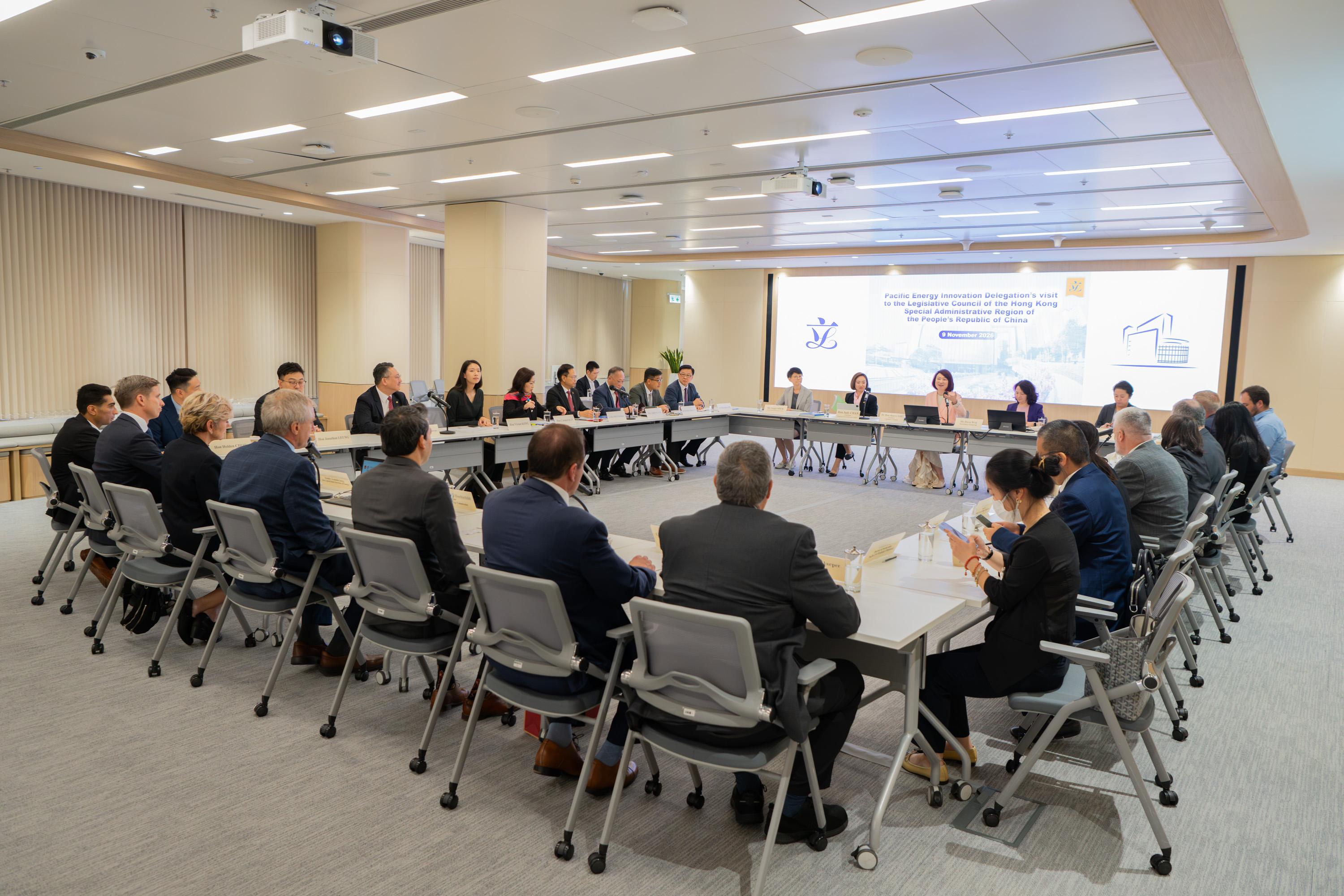
LegCo Members meet with Pacific Energy Innovation Delegation to promote green development and exchanges between legislatures of Hong Kong and US (with photo)

The following is issued on behalf of the Legislative Council Secretariat:

     The President of the Legislative Council (LegCo), Dr Starry Lee, together with a number of Members (including the Chairman and members of the Panel on Environmental Affairs), met with the Pacific Energy Innovation Delegation at the LegCo Complex on November 9. The delegation comprised stakeholders from the United States (US) with an interest in energy policy, including delegates from legislatures of several states of the US and representatives of think tanks.
 
     The two sides held in-depth discussions and exchanges on advancing clean energy transition, stability and reliability of power grid, electricity demand from data centres, and developments of green finance and green transportation. Members also briefed the delegation on the relevant policy blueprints and specific measures set out in the First Five-Year Plan for Economic and Social Development of the Hong Kong Special Administrative Region (2026–2030) (Hong Kong's First Five-Year Plan) and the Chief Executive's 2026 Policy Address. They highlighted in particular the development opportunities that the Northern Metropolis will create for the innovation and technology sector and green industry in Hong Kong.
 
     Dr Lee said, "Under the principle of 'one country, two systems', Hong Kong enjoys the unique advantage of having the strong support of the motherland while being closely connected to the world. The Government of the Hong Kong Special Administrative Region (HKSAR) has drawn up Hong Kong's First Five-Year Plan to align with the National 15th Five-Year Plan's approach of 'synergistically advancing carbon reduction, pollution reduction, greening expansion and growth'. This will help improve the quality of the ecological environment and strengthen the momentum for green development. LegCo will continue to support and complement the HKSAR Government in actively advancing green transition and environmental sustainability, with the aim of building Hong Kong into a green and liveable city and contributing to the nation's high-quality economic development.”
 
     Dr Lee also said that the meeting was meaningful, fully demonstrating Hong Kong's distinctive value in the overall national development. LegCo will, as always, promote exchanges and co-operation with different countries and regions to fulfil Hong Kong's important role as "super connector" and "super value-adder".
 
     A total of 11 Members attended the meeting, including LegCo President, Dr Starry Lee; the Chairman of the Panel on Environmental Affairs, Ms Judy Chan; Panel members (Dr Junius Ho, Dr Hoey Simon Lee, Mr Andrew Lam, Mr Chan Siu-hung, Ms Carmen Kan, Ms Vivian Kong, Mr Jonathan Stuart Lamport and Mr Jonathan Leung); and Mr Holden Chow.

Photo