Sheet metal fabrication company fined £48,000 after employee suffers life-changing injury

  • Employee lost part of his right thumb and suffered a crush injury to his hand during a manual handling task, just days after a near-identical incident
  • HSE investigation found employee had not been given clear instructions on how to carry out task safely
  • Worker was amateur boxer before hand injury – describing hobby as his ‘whole life’
  • A had occurred in the days before this one.

Fitzpatrick Fabrications Ltd, a sheet metal fabrication company in Lancashire, has been fined £48,000 after an employee lost part of his right thumb and suffered a crush injury to his hand during a manual handling task.

On 24 October 2024, at around 11.30am, Mr Todd Marshall, a welder/fabricator, was working at the Fitzpatrick Fabrications factory at Malvern Mill, Nelson. The job involved welding and fabricating large pieces of stainless steel to form a finished hopper.
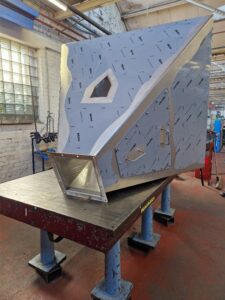
The hopper

The hopper consisted of five component parts, which needed to be welded together. When each side of the hopper was welded, it needed to be lifted and repositioned so the next side could be welded.

Mr Marshall was carrying out this task on his own, holding the larger side of the 133kg hopper in the air while the smaller side rested on a desk. The hopper slipped on the smooth desk and came down onto his hand, causing a crush injury and partial loss of his right thumb.

An investigation by the Health and Safety Executive (HSE) found that the company had not conducted a risk assessment for the task and no safe system of work was in place. As a result, workers had not been given clear instructions on how to perform the task safely.

Upon further investigation, HSE found that a near-identical incident had occurred in the days leading up to this one.

HSE guidance states that employers must assess the risks associated with manual handling and take appropriate steps to avoid hazardous manual handling operations where reasonably practicable, or reduce the risk of injury where they cannot be avoided. The Manual Handling Assessment Charts (MAC Tool) can also help employers assess the most common risk factors associated with lifting and carrying activities.

In a statement, Mr Marshall said:

“Things I used to do without thinking are now hard for me. I need two hands to do something as simple as pick up small things. I struggle fastening buttons or zips. I was an amateur boxer before my injury. Boxing was my whole life. It wasn’t just a pastime or hobby. I think I could have gone further with it, but now I’ll never know.”

Fitzpatrick Fabrications Ltd, of Malvern Mill, Waterford Street, Nelson, pleaded guilty to breaching Regulation 4(1) of the Manual Handling Operations Regulations 1992. The company was fined £48,000 and ordered to pay £10,089 in costs at Warrington Magistrates’ Court on 6 October 2026.

HSE Inspector Derek McLauchlan said:

“This was a wholly preventable incident which has had a profound and long-lasting impact on Todd Marshall’s life, made more shocking by the fact a near-identical incident had taken place just days before.

“Businesses should always give thought to the safest way to undertake manual handling operations; this means carrying out a robust assessment of the risks, and considering tools such as the Manual Handling Assessment Chart (MAC Tool) to help plan the task.

“The company failed in its duty to properly plan this task, and the fine imposed should serve as a clear reminder to everyone that HSE will hold to account those who fail to keep their workers safe.”

This HSE prosecution was brought by HSE enforcement lawyer Tom Ledden-Rocks and paralegal officer Stephen Grabe.


Further information:

  1. The Health and Safety Executive (HSE) is Britain’s national regulator for workplace health and safety. We are dedicated to protecting people and places, and helping everyone lead safer and healthier lives.
  1. More information about the legislation referred to in this case is available.
  2. Further details on the latest HSE news releases is available.
  3. Relevant guidance can be found here: Manual handling at work – HSE, Manual handling – HSE and Manual handling assessment charts (the MAC tool) – HSE
  4. HSE does not pass sentences, set guidelines or collect any fines imposed. Relevant sentencing guidelines must be followed unless the court is satisfied that it would be contrary to the interests of justice to do so.  The sentencing guidelines for health and safety offences can be found here.

Painter and decorator sentenced after stepson electrocuted on job

  • Connor Lambert, a trainee painter, was electrocuted while working in Chester
  • The 24-year-old and his partner were expecting their first child
  • His step dad has been sentenced for failing to properly plan for the work

A sole trader has been sentenced after his stepson was fatally electrocuted while working on a domestic property in Chester.

Daniel Watton, 50, trading as Inside Out Painters and Decorators Property Maintenance, was given a suspended jail sentence in relation to the death of trainee painter Connor Lambert. The 24-year-old, from Market Drayton, died after coming into contact with electricity, when a ladder was being moved near overhead power lines. He had been working at the house in Farndon on 29 July 2024 when the incident occurred.

Connor had been expecting his first child with partner Megan McCann at the time, and she described him as having the ‘cheekiest grin’ and being someone who loved family life.

Connor Lambert was killed while working on a home near Chester

Connor’s partner Megan McCann said:

“Connor was amazing. He had the cheekiest grin and would light up any room he was in – he was so funny.

“He was a caring person who always put everyone else first. He was very ambitious and he was an avid Arsenal fan. He went to loads of matches with my father and brother.

“He was a happy person who loved family life.

“We had been trying for our own family for three years and he was over the moon when we found out I was pregnant. 

“He never missed a midwife appointment and was elated when we found out we were having a baby girl.

“We had been on the phone talking the morning he died – I had just taken delivery of a moses basket and I was heavily pregnant at 32 weeks.

“But within minutes I got another phone call to say there had been accident and Connor was dead.

“I never thought I would have buried the love of my life and then given birth to our daughter 23 days later.

“She knows daddy is in the sky and at night he shines as a star – I’m making sure she knows who Connor is, but at some point I will have to explain to her what happened.

“I will never get over Connor’s death – I still feel angry, numb and feel a massive part of my world has gone.”

An investigation by the Health and Safety Executive (HSE) found that Connor had been moving a fully extended ladder with a colleague at the gable end of the property. During this process, the ladder either came into contact with an overhead power line or came close enough for an electrical arc to form. While Connor was killed, his colleague suffered burns to his hands, feet, and stomach.

The investigation also found the work at height had not been properly planned, supervised, or carried out safely. The selected equipment and methods of work were unsuitable for the task and the risks associated with working near overhead power lines had not been adequately assessed or controlled. Additionally, the investigation identified issues in relation to the training and competence of those carrying out the work.

The work had not been properly planned

The original plan of work involved using a tower scaffold and ladders to paint the exterior of the property, including an area with a glass canopy; however, this approach was neither suitable nor safe. In practice, the work deviated from this plan, with ladders used throughout. This method was approved by Daniel Watton, but was also unsuitable and unsafe as demonstrated by the fatal incident.

Connor’s father Craig West, said the loss of his son had changed him, adding:

“This experience has changed me, my emotions, my temperament and my outlook on life.

“I’m agitated regularly and can become angry easily. I have lost the spring in my step and no longer have the drive I once had and work now has become a chore.

“After the findings of the inquest I find Connor’s accident even more tragic as it should have so easily been avoided.

“I do hold people responsible for this situation.”

HSE guidance states that where work at height cannot be avoided, it must be properly planned, appropriately supervised, and carried out safely. This includes using suitable equipment and work methods and ensuring those involved are competent. Where work near overhead power lines is unavoidable, measures must be taken to eliminate or reduce the risk, such as isolating the power supply, using appropriate equipment, and maintaining safe distances.

Daniel Watton, of Bean Bank, Wollerton, Market Drayton, pleaded guilty to breaching Regulation 4(1) of the Work at Height Regulations 2005 and was sentenced to 16 weeks imprisonment, suspended for 12 months and ordered to pay £10,645 in costs at Warrington Magistrates Court on 6 October 2026.

HSE inspector Keeley Eves said:

“This tragic incident meant a father never got to meet and hold his baby daughter.

“The fact it could and should have been prevented with proper planning and control measures, makes it all the more stark.

“Work at height and work near overhead power lines are both high-risk activities. Employers must ensure that suitable equipment is selected, risks are fully assessed, and workers are adequately trained and supervised.

“The very lives of those workers depend on these decisions.

“Our thoughts remain with all of Connor’s loved ones.”

This HSE prosecution was brought by HSE enforcement lawyer Jonathan Bambro and paralegal officer Lynne Thomas. The investigation was supported by Natalka Heath, HSE Visiting Officer.


Further information:

  1. The Health and Safety Executive (HSE) is Britain’s national regulator for workplace health and safety. We are dedicated to protecting people and places, and helping everyone lead safer and healthier lives.
  2. More information about the legislation referred to in this case is available.
  3. Further details on the latest HSE news releases is available.
  4. HSE does not pass sentences, set guidelines or collect any fines imposed. Relevant sentencing guidelines must be followed unless the court is satisfied that it would be contrary to the interests of justice to do so.  The sentencing guidelines for health and safety offences can be found here.