More than $350 million pledged for refugees in Uganda; ‘A good start, we cannot stop,’ says UN chief

23 June 2017 – A ‘Solidarity Summit’ for refugees hosted by Uganda has raised some $358 million in pledges, the United Nations announced today.

UN Secretary-General António Guterres told reporters in the Ugandan capital, Kampala, that it was a &#8220good starting point&#8221 although the international conference was looking to raise $2 billion.

In just the past year, the overall refugee population in Uganda has more than doubled, largely due to an influx of desperate people fleeing violence and instability in South Sudan &#8211 from 500,000 to more than 1.25 million &#8211 making the East African country host to the world’s fastest growing refugee emergency.

Convened by President Yoweri Museveni and the UN Secretary-General, the Summit sought to rally international support for refugees and host communities in the form of donations, investments and relevant programmes, over the next four years.

Mr. Guterres noted that the World Bank and the African Development Bank had promised &#8220innovative funding&#8221 for projects involving both refugees and the local communities.

&#8220We cannot stop,&#8221 he underscored, recalling that several of the countries agreed to put forward their pledges in the weeks to come.

MORE TO FOLLOW

Security ‘number one concern’ of displaced Iraqis seeking to return home – UN study

23 June 2017 – With three million Iraqis remaining internally displaced across the country, the United Nations migration agency today published findings of a study showing that the decision to return or remain displaced depends largely on how close their home is to the frontline of conflict.

The study, titled Obstacles to Return in Retaken Areas of Iraq, commissioned by the International Organization for Migration (IOM), has surveyed more than 1.7 million Iraqis who opted to return, posing questions as to the factors that motivate, or inhibit, Iraqis from returning to their areas of origin.

The qualitative and quantitative data collection was carried out in eight sub-districts the Government has recently retaken from the Islamic State in Iraq and the Levant (ISIL/Da’esh).

Security in the areas of origin topped all other factors in influencing the decision to return home or remain displaced, with proximity to the frontline &#8211 and perceived instability in the place of origin &#8211 remaining the most relevant obstacle for return, according to the study.

Speaking to reporters at the regular bi-weekly news briefing in Geneva, IOM spokesperson Joel Millman said security is the &#8220number one concern. If they feel fighting is still going on or that the people who had destroyed their homes are still at large in the community &#8211 that is a major deterrent.&#8221

Feelings of trust towards the security actors in control of the areas of origin promotes a higher number of returns, while fear of security actors in the place origin is a strong drawback and reinforces the perceived advantage of staying in displacement, the study finds.

Fear of reprisal back home is a concern for more than 30 per cent of all internally displaced persons (IDPs) interviewed. However, that perception is much lower among interviewed returnees, at 10 per cent.

The data suggest that damage to housing does not constitute an obstacle to return, although the presence of actors whom IDPs hold responsible for the damage inflicted in a given location is, noted IOM.

Livelihood options and previous or current employment status also play an important role in influencing the decision to return. IDPs who have jobs in the location of displacement are less inclined to return home. By contrast, those who are unemployed appear to be more likely to return to seek new opportunities.

The study shows that almost a quarter of interviewed IDPs who decided to return were prevented from doing so, mostly by delays in processing their documentation, or by being stopped at checkpoints on the way back to their place of origin.

Speech: Building stronger UK-Chile sustainable construction links

First I would like to take a moment to reflect on the terrible events that have occurred in London. There has been a terrible fire in an apartment block in London. The cause is still not known, but the incident illustrates the importance of standards, structures and materials within the construction sector. Our thoughts are with all of those affected; the lives and homes lost and a community devastated. Here in Chile we are all aware of the terrible consequences caused by fires.

Today we are here to talk about sustainable and innovative construction. Over the last 15 years the UK has made substantial investment in energy and low carbon technology research, development and demonstration. This has created a strong foundation for low carbon solutions in buildings, electricity networks, renewable energy, waste and transport. In the big picture, these low carbon solutions are also paving the way for smarter cities and improved living environments. New advancements and innovative practices in sustainable construction are vital to the growth of future low carbon smart cities.

In the UK, practices in driving innovation in sustainable construction are never ending. Some examples include the development of innovation parks that pilot cutting-edge sustainable building designs and the application of efficient building systems via UK Building Information Modelling (BIM) technologies.

The UK’s BRE Environmental Assessment Method (BREEAM) began in 1990 as the world’s first sustainability assessment method for buildings. The method’s focus on sustainable value and adaptability to local and climatic conditions has led to BREEAM becoming an international best practice. Since 1990, the BREEAM has been adapted and applied in over 70 countries and used to certify over 500,000 BREEAM developments globally.

From 2013-2014 we were able to adapt the best practices, lessons learned and experiences related to sustainable construction in the UK to the Chilean context through the project “Code for Sustainable Homes in Chile”. This project, supported by the British Embassy Santiago’s Prosperity Fund, was implemented by BRE in collaboration with the Chilean Ministry of Housing. Through this collaboration we were able to develop the standards and references for Chile’s first sustainable construction code.

It is great to see that the results and collaborations from this project remain sustainable not only through the Ministry of Housing’s sustainable construction strategy, but also through new collaboration opportunities set out between BRE and IDIEM from the University of Chile in the MOU that will be signed today.

We look forward to the development of new low carbon solutions, research links and innovative products for the sustainable construction sector in Chile as a result of this MOU collaboration and future work between IDIEM, BRE and a number of key local stakeholders as part of the upcoming technological innovation centre on sustainable construction.

Xi stresses reform, development, stability during inspection tour

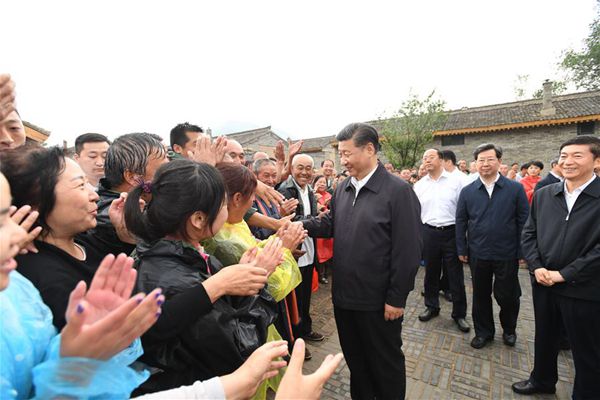
Chinese President Xi Jinping meets with local villagers at Songjiagou New Village, a centralized resettlement site under the approach of alleviating poverty through relocation, in Kelan County of Xinzhou City, north China’s Shanxi Province, June 21, 2017. Xi had a three-day inspection tour in Shanxi from Wednesday. (Xinhua/Li Xueren)

Chinese President Xi Jinping has urged all Party committees to advance reform, development and stability to create a sound environment for the upcoming 19th National Congress of the Communist Party of China (CPC).

Xi, also general secretary of the CPC Central Committee, made the remarks during an inspection tour in northern Shanxi Province, calling the congress a significant event for the Party and national political life.

During his inspection tour from Wednesday to Friday, Xi visited a revolutionary memorial museum, villages and enterprises in Shanxi Province.

At the revolutionary memorial museum in Xing County of Lyuliang city, Xi left a basket of flowers Wednesday morning to pay respect to the country’s war heroes.

The president said he was deeply moved after seeing pictures and old objects that reminded people of the old days of revolutionary struggle.

“Each part of the CPC’s revolutionary history is a vivid textbook of ideals and faith,” Xi said, urging Party members to forge ahead while staying true to the mission taken up by the CPC when it was founded in 1921.

He said that every Party member should remember the revolutionaries who devoted their lives to national independence and the people’s liberation, keep the mettle of the CPC members, be honest with the people, and create a better life for the people.

Xi met representatives of the old revolutionaries, spoke highly of their contribution and wished them good health.

On Wednesday afternoon, after over an hour’s drive, Xi visited three households in Zhaojiawa village in the destitute areas of Lyuliang Mountain region. He asked villagers the reasons for their poverty and the effects of anti-poverty measures.

After hearing that villager Liu Fuyou, his 71-year-old wife and 92-year-old mother were ill, Xi urged local officials to pay close attention to poverty caused by illness.

“In the past, I could not even dream that impoverished households could receive so much help from the Party and the government,” villager Cao Liuren told Xi.

“The Party and the government aim to serve the people, and it is our duty to let people live a better life,” Xi said.

Villager Wang Sannyu’s husband and son have passed away and her grandson and granddaughter are disabled. Xi urged local officials to arrange special education for her grandchildren.

To know drought-relief measures, Xi inspected a shallow well, the only water source for the village, as well as a cornfield. He also visited officials who were sent to help with poverty alleviation.

“It’s the Party’s solemn promise to let poverty-stricken people and areas enter a ‘moderately prosperous society’ along with the rest of the nation,” said Xi. He said efforts must be made to deliver on the promise no matter how arduous the process.

He called on poverty relief staff to stay humble, improve their abilities and realize their value by solving problems for the poor.

All the villagers came to see Xi off, applauding and cheering.

Xi visited Songjiagou New Village in Kelan county, where new houses have been built for people relocated from poor areas. Xi visited the home of impoverished villager Zhang Guiming, chatting with him about subsidies for resettlement as well as his new life and current troubles.

Xi said a major issue was to solve abject poverty. He said resettlement projects must respect the people’s will, taking relocation sites, investment, income, environmental protection and village management into consideration.

The president called on the villagers to “roll up sleeves and work harder together with the CPC Central Committee.”

Xi stressed technological innovation while visiting a rail transit equipment producer and a carbon materials company Thursday.

He inspected innovations in equipment manufacturing, electronic information, energy conservation and environmental protection, as well new materials and the coal chemical industry.

“Enterprises should play a major role in promoting industrial upgrading which is market-oriented. Breakthroughs should be made in technological transformation and innovation,” he said.

He called on the rail transit equipment company to grasp the opportunities of China’s transport development and the building of the Belt and Road to promote technological innovation and brand building.

“The creativity of enterprises, research institutes and researchers should be mobilized,” said Xi while inspecting the carbon materials company, adding they should get both a sense of achievement in innovation as well a sense of gains from the transformation of their achievements.

After hearing reports of Shanxi provincial officials, Xi praised their achievements in social and economic development, calling on local authorities and people to be bold in reform and innovation, and in tackling challenges.

Xi asked local authorities to enhance economic transformation by creating a good business environment and deepening supply-side structural reform.

Stating that issues of farmers, agriculture and the countryside are key priorities of the whole Party, Xi urged speeding up agricultural modernization and raising income of farmers via means ranging from better training to better basic public services.

Xi called for more efforts to improve people’s livelihoods by offering them better education and healthcare services.

Xi stressed green development, saying that stronger measures should be taken in economic transformation, environmental pollution control, ecological protection and restoration, as well as resource saving.

He called for strict intra-Party life, asking all Party organizations and Party members to follow rules on intra-Party political life and observe regulations and discipline.

“Officials who are both clean and willing to work deserve more opportunities of development,” Xi said.

Press release: Scottish limited partnerships to reveal identity of owners thanks to new laws

  • New laws will force Scottish limited partnerships to disclose ownership and control information
  • Partnerships who fail to comply within 28 days will face fines
  • Laws will help to improve transparency of partnerships and act as a deterrent against their use for criminal ends

Around 30,000 firms registered as Scottish limited partnerships will be forced to reveal their owners’ identities under laws.

There have been allegations that some of these companies have been using these arrangements as vehicles of crime, with a 236% increase in the number of Scottish limited partnerships registered between March 2011 and March 2016.

Scottish Partnerships (Register of People with Significant Control) Regulations 2017, which come into force on Monday (26 June 2017), will bring these firms into line with others in the UK, requiring them to disclose the identity of their beneficial owners within 28 days. If they fail to do so, these partnerships will face daily fines of up to £500.

UK government Business Minister Margot James said:

This government is committed to ensuring all businesses are run responsibly.

These new laws will help to improve transparency of Scottish limited partnerships and act as a deterrent against their use for criminal ends.

Scottish Secretary David Mundell said:

These new laws are a sign of the UK government’s commitment to transparency around Scottish limited partnerships.

Campaign groups and media activity have highlighted growing concerns that SLPs had the potential to be used for criminal activity, and by introducing stronger deterrents the UK government is encouraging transparency.

Separately, earlier this year the government launched a review into ‘limited partnerships’ across the country, with a particular focus on those registered in Scotland following allegations that some of these businesses are being used for criminal purposes.

Unlike those set up in England, Wales and Northern Ireland, Scottish limited partnerships have their own ‘legal personality’, meaning they can hold assets, borrow money from banks and enter into contracts. A limited partnership is a particular type of business made up of a number of partners, who can be people or other business entities.

  1. Scottish limited partnerships will need to provide information about the people or legal entities that have significant control.
  2. Guidance will be published alongside the regulations to help Scottish limited partnerships to establish who has significant control over them and to understand the detail of the new regulations.
  3. Information provided by Scottish limited partnerships will be available on the Companies House register.