The company must now end the conduct within 90 days or face penalty payments of up to 5% of the average daily worldwide turnover of Alphabet, Google’s parent company.
Commissioner Margrethe Vestager, in charge of competition policy, said: “Google has come up with many innovative products and services that have made a difference to our lives. That’s a good thing. But Google’s strategy for its comparison shopping service wasn’t just about attracting customers by making its product better than those of its rivals. Instead, Google abused its market dominance as a search engine by promoting its own comparison shopping service in its search results, and demoting those of competitors.
What Google has done is illegal under EU antitrust rules. It denied other companies the chance to compete on the merits and to innovate. And most importantly, it denied European consumers a genuine choice of services and the full benefits of innovation.“
Google’s strategy for its comparison shopping service
Google’s flagship product is the Google search engine, which provides search results to consumers, who pay for the service with their data. Almost 90% of Google’s revenues stem from adverts, such as those it shows consumers in response to a search query.
In 2004 Google entered the separate market of comparison shopping in Europe, with a product that was initially called “Froogle”, re-named “Google Product Search” in 2008 and since 2013 has been called “Google Shopping”. It allows consumers to compare products and prices online and find deals from online retailers of all types, including online shops of manufacturers, platforms (such as Amazon and eBay), and other re-sellers.
When Google entered comparison shopping markets with Froogle, there were already a number of established players. Contemporary evidence from Google shows that the company was aware that Froogle’s market performance was relatively poor (one internal document from 2006 stated “Froogle simply doesn’t work“).
Comparison shopping services rely to a large extent on traffic to be competitive. More traffic leads to more clicks and generates revenue. Furthermore, more traffic also attracts more retailers that want to list their products with a comparison shopping service. Given Google’s dominance in general internet search, its search engine is an important source of traffic for comparison shopping services.
From 2008, Google began to implement in European markets a fundamental change in strategy to push its comparison shopping service. This strategy relied on Google’s dominance in general internet search, instead of competition on the merits in comparison shopping markets:
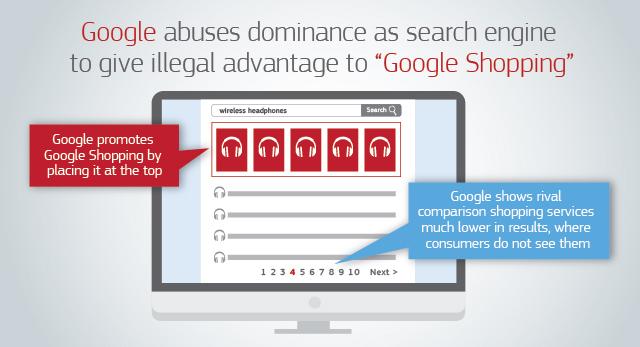
- Google has systematically given prominent placement to its own comparison shopping service: when a consumer enters a query into the Google search engine in relation to which Google’s comparison shopping service wants to show results, these are displayed at or near the top of the search results.
- Google has demoted rival comparison shopping services in its search results: rival comparison shopping services appear in Google’s search results on the basis of Google’s generic search algorithms. Google has included a number of criteria in these algorithms, as a result of which rival comparison shopping services are demoted. Evidence shows that even the most highly ranked rival service appears on average only on page four of Google’s search results, and others appear even further down. Google’s own comparison shopping service is not subject to Google’s generic search algorithms, including such demotions.
As a result, Google’s comparison shopping service is much more visible to consumers in Google’s search results, whilst rival comparison shopping services are much less visible.
The evidence shows that consumers click far more often on results that are more visible, i.e. the results appearing higher up in Google’s search results. Even on a desktop, the ten highest-ranking generic search results on page 1 together generally receive approximately 95% of all clicks on generic search results (with the top result receiving about 35% of all the clicks). The first result on page 2 of Google’s generic search results receives only about 1% of all clicks. This cannot just be explained by the fact that the first result is more relevant, because evidence also shows that moving the first result to the third rank leads to a reduction in the number of clicks by about 50%. The effects on mobile devices are even more pronounced given the much smaller screen size.
This means that by giving prominent placement only to its own comparison shopping service and by demoting competitors, Google has given its own comparison shopping service a significant advantage compared to rivals.
Breach of EU antitrust rules
Google’s practices amount to an abuse of Google’s dominant position in general internet search by stifling competition in comparison shopping markets.
Market dominance is, as such, not illegal under EU antitrust rules. However, dominant companies have a special responsibility not to abuse their powerful market position by restricting competition, either in the market where they are dominant or in separate markets.
- Today’s Decision concludes that Google is dominant in general internet search markets throughout the European Economic Area (EEA), i.e. in all 31 EEA countries. It found Google to have been dominant in general internet search markets in all EEA countries since 2008, except in the Czech Republic where the Decision has established dominance since 2011. This assessment is based on the fact that Google’s search engine has held very high market shares in all EEA countries, exceeding 90% in most. It has done so consistently since at least 2008, which is the period investigated by the Commission. There are also high barriers to entry in these markets, in part because of network effects: the more consumers use a search engine, the more attractive it becomes to advertisers. The profits generated can then be used to attract even more consumers. Similarly, the data a search engine gathers about consumers can in turn be used to improve results.
- Google has abused this market dominance by giving its own comparison shopping service an illegal advantage. It gave prominent placement in its search results only to its own comparison shopping service, whilst demoting rival services. It stifled competition on the merits in comparison shopping markets.
Google introduced this practice in all 13 EEA countries where Google has rolled out its comparison shopping service, starting in January 2008 in Germany and the United Kingdom. It subsequently extended the practice to France in October 2010, Italy, the Netherlands, and Spain in May 2011, the Czech Republic in February 2013 and Austria, Belgium, Denmark, Norway, Poland and Sweden in November 2013.
The effect of Google’s illegal practices
Google’s illegal practices have had a significant impact on competition between Google’s own comparison shopping service and rival services. They allowed Google’s comparison shopping service to make significant gains in traffic at the expense of its rivals and to the detriment of European consumers.
Given Google’s dominance in general internet search, its search engine is an important source of traffic. As a result of Google’s illegal practices, traffic to Google’s comparison shopping service increased significantly, whilst rivals have suffered very substantial losses of traffic on a lasting basis.
- Since the beginning of each abuse, Google’s comparison shopping service has increased its traffic 45-fold in the United Kingdom, 35-fold in Germany, 19-fold in France, 29-fold in the Netherlands, 17-fold in Spain and 14-fold in Italy.
- Following the demotions applied by Google, traffic to rival comparison shopping services on the other hand dropped significantly. For example, the Commission found specific evidence of sudden drops of traffic to certain rival websites of 85% in the United Kingdom, up to 92% in Germany and 80% in France. These sudden drops could also not be explained by other factors. Some competitors have adapted and managed to recover some traffic but never in full.
In combination with the Commission’s other findings, this shows that Google’s practices have stifled competition on the merits in comparison shopping markets, depriving European consumers of genuine choice and innovation.
Evidence gathered
In reaching its Decision, the Commission has gathered and comprehensively analysed a broad range of evidence, including:
1) contemporary documents from both Google and other market players;
2) very significant quantities of real-world data including 5.2 Terabytes of actual search results from Google (around 1.7 billion search queries);
3) experiments and surveys, analysing in particular the impact of visibility in search results on consumer behaviour and click-through rates;
4) financial and traffic data which outline the commercial importance of visibility in Google’s search results and the impact of being demoted; and
5) an extensive market investigation of customers and competitors in the markets concerned (the Commission addressed questionnaires to several hundred companies).
Consequences of the Decision
The Commission’s fine of €2 424 495 000 takes account of the duration and gravity of the infringement. In accordance with the Commission’s 2006 Guidelines on fines (see press release and MEMO), the fine has been calculated on the basis of the value of Google’s revenue from its comparison shopping service in the 13 EEA countries concerned.
The Commission Decision requires Google to stop its illegal conduct within 90 days of the Decision and refrain from any measure that has the same or an equivalent object or effect. In particular, the Decision orders Google to comply with the simple principle of giving equal treatment to rival comparison shopping services and its own service:
Google has to apply the same processes and methods to position and display rival comparison shopping services in Google’s search results pages as it gives to its own comparison shopping service.
It is Google’s sole responsibility to ensure compliance and it is for Google to explain how it intends to do so. Regardless of which option Google chooses, the Commission will monitor Google’s compliance closely and Google is under an obligation to keep the Commission informed of its actions (initially within 60 days of the Decision, followed by periodic reports).
If Google fails to comply with the Commission’s Decision, it would be liable for non-compliance payments of up to 5% of the average daily worldwide turnover of Alphabet, Google’s parent company. The Commission would have to determine such non-compliance in a separate decision, with any payment backdated to when the non-compliance started.
Finally, Google is also liable to face civil actions for damages that can be brought before the courts of the Member States by any person or business affected by its anti-competitive behaviour. The new EU Antitrust Damages Directive makes it easier for victims of anti-competitive practices to obtain damages.
Other Google cases
The Commission has already come to the preliminary conclusion that Google has abused a dominant position in two other cases, which are still being investigated. These concern:
1) the Android operating system, where the Commission is concerned that Google has stifled choice and innovation in a range of mobile apps and services by pursuing an overall strategy on mobile devices to protect and expand its dominant position in general internet search; and
2) AdSense, where the Commission is concerned that Google has reduced choice by preventing third-party websites from sourcing search ads from Google’s competitors.
The Commission also continues to examine Google’s treatment in its search results of other specialised Google search services. Today’s Decision is a precedent which establishes the framework for the assessment of the legality of this type of conduct. At the same time, it does not replace the need for a case-specific analysis to account for the specific characteristics of each market.
Background
See also Factsheet.
Today’s Decision is addressed to Google Inc. and Alphabet Inc., Google’s parent company.
Article 102 of the Treaty on the Functioning of the European Union (TFEU) and Article 54 of the EEA Agreement prohibit abuse of a dominant position. Today’s Decision follows two Statements of Objections sent to Google in April 2015 and July 2016.
More information on this investigation is available on the Commission’s competition website in the public case register under the case number 39740.