ESMA provides market size calculations for MiFID II ancillary test

Under the revised Markets in Financial Instruments Directive (MiFID II) market participants are required to measure their own activity against total market sizes in commodity derivatives. Those market participants exceeding a certain market share are required to apply for an authorisation as an investment firm.

ESMA provides indication of market sizes

ESMA collected data for the calculation of the on-venue market size from the trading venues located in the Euopean Economic Aarea (EEA), which it provides for the total year of 2015 and for the second half of the year 2016. In addition, ESMA also looked at the size of the OTC market for the second half of 2016 based on data from trade repositories. The exact methodology applied and the way market participants can use the data published by ESMA for their market share calculations are described in detail in the opinion.

Due to the lack of publicly available data for commodity derivatives and emission allowances, ESMA’s intention behind this publication is to help market participants in performing the ancillary activity test in MiFID II.

€70 million to further support European fruit producers

The measures were first introduced by the Commission in the wake of the Russian import ban in August 2014. The extended scheme is worth up to €70 million to EU fruit producers, and provides a safety net for producers who might not find a market outlet for their products as a result of the import ban. It will compensate European fruit farmers who choose for example to distribute their excess products to organisations (i.e. charity, schools) or make use of it for other purposes (i.e. animal feed, composting, processing).

Commissioner for Agriculture and Rural Development, Phil Hogan, said: “the Commission has done everything in its power to support European producers negatively affected by the Russian ban. This latest extension sends yet another clear signal that we will remain firmly and fearlessly on the side of our farmers. These support measures go hand in hand with our ongoing work to modernise and simplify the CAP for the benefit of both our farmers and our wider European society”.

The extended scheme comes in addition to a number of other exceptional support measures for the agricultural market related to the Russian ban. Regular market monitoring and assessment by the Commission shows that these measures have improved the market situation for non-permanent crops (typically vegetables). Most of the production affected by the Russian import ban has been redirected to alternative markets and market prices have stabilised. However, since so-called permanent crops (fruit trees) are less able to adapt to changing situations, the new measures are specifically designed to help this sector.

Under the exceptional measures, individual producers benefit from higher rates of EU co-financing than under regular support measures. Farmers receive 100% EU-funded support for withdrawals for so-called free distribution (i.e. giving the fruit away to charity for consumption) which avoids food waste. Fruit that is withdrawn from the market but not actually consumed (for example, sent directly to composting), or that is harvested before it is ripe (so-called green-harvesting) or not harvested at all, receives lower levels of support.

The scheme covers a maximum quantity of 165,835 tonnes of fruit, shared between four different types of trees: apples and pears; plums; citrus fruits; and peaches and nectarines. The measures cover 12 Member States, and different withdrawal volumes will apply to ensure that the financial support reaches the producers most in need (see table below).

In addition to the extension of these exceptional measures, European fruit and vegetables producers continue to benefit from other measures under the EU’s common agricultural policy such as direct payments, rural development funding and financial support for producer organisations, reaching a total of around €700 million a year.

For More Information

Fruit and vegetables: crisis prevention and management

Annex

Maximum quantities of products allocated per Member State

(tonnes)

Apples and

pears

Plums

Oranges,

clementines,

mandarins

and lemons

Peaches and

nectarines

Belgium

21 845


Germany

1 615


Greece

680

4 165

2 040

5 355

Spain

1 955

1 275

14 110

9 775

France

3 060


Croatia

510

850


Italy

4 505

3 910

850

2 380

Cyprus

3 060


Netherlands

5 865


Austria

510

Poland

75 565

425


510

Portugal

935


Xi pledges firm commitment to ‘one country, two systems’


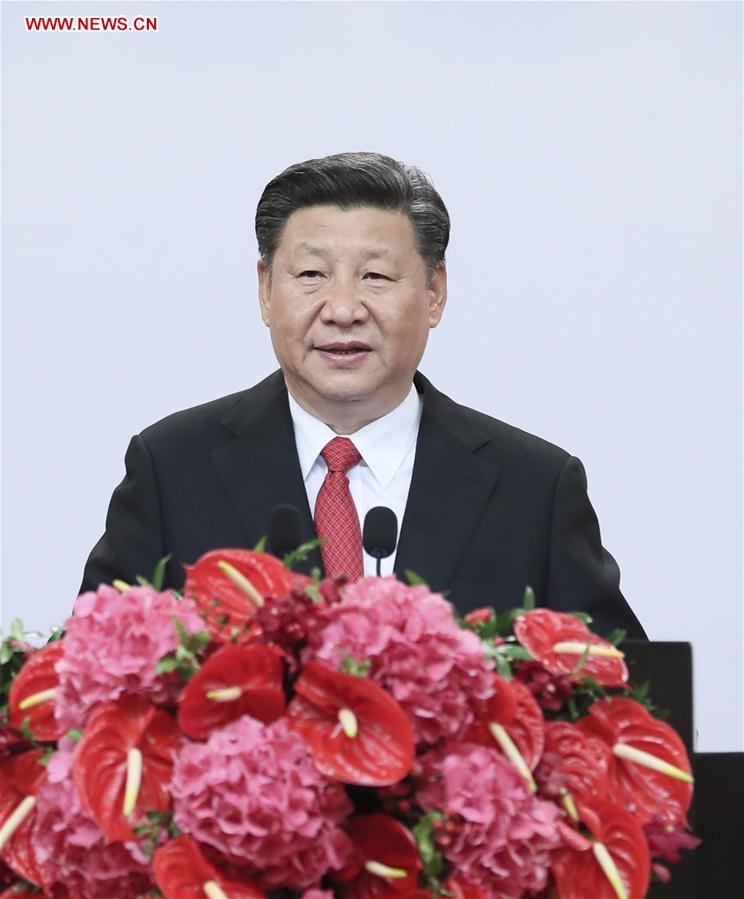
Chinese President Xi Jinping speaks at a welcome dinner hosted by the government of the Hong Kong Special Administrative Region, in Hong Kong, south China, June 30, 2017. (Xinhua/Lan Hongguang) 

President Xi Jinping reiterated the central government’s firm commitment to “one country, two systems” on multiple occasions Friday, a day before the 20th anniversary of Hong Kong’s return to China.

“The road ahead may not be smooth, but our commitment to ‘one country, two systems’ remains unchanged, and our resolve remains firm and strong,” said Xi when addressing a welcome dinner hosted by the government of the Hong Kong Special Administrative Region (HKSAR).

The president compared the practice of “one country, two systems” in Hong Kong over the past two decades to the growth of a seedling, which has become strong and robust despite wind and rain and yielded many fruits.

Hailing “one country, two systems” a great pioneering initiative by China, Xi said its practice, featuring socialism in the main body of the country and capitalism in certain regions, is unprecedented in human political history.@ “It is a breakthrough those before us made through exploration and with extraordinary courage. We the succeeding generation should practice and develop ‘one country, two systems’ with firm resolve,” Xi said.

“We should have full confidence in ourselves, in Hong Kong and in our country,” the president said, calling for persistent and unrelenting efforts to achieve even greater success in the practice of “one country, two systems” in Hong Kong.

Riding in an open-top camouflage jeep, Xi, also general secretary of the Central Committee of the Communist Party of China and chairman of the Central Military Commission, inspected the Chinese People’s Liberation Army Garrison in the HKSAR at Shek Kong barracks Friday.

Xi told the troops to firm up the responsibility for and commitment to safeguarding “one country, two systems.”

“The garrison is an important embodiment of national sovereignty, an important force to safeguard ‘one country, two systems,’ and an important cornerstone of Hong Kong’s prosperity and stability,” Xi said.

He urged the garrison to make efforts to enhance “combat readiness” so as to fulfill its role as a powerful stabilizing force.

The president’s tight schedule Friday also included whirlwind meetings with local dignitaries, the HKSAR’s first chief executive Tung Chee-hwa, the Macao Special Administrative Region’s chief executive Chui Sai On, and central government officials based in Hong Kong and executives of Hong Kong branches of mainland enterprises and institutions.

During the meeting with a group of dignitaries from all walks of life of Hong Kong, Xi said the central government stands firm on the “one country, two systems” principle.

For Hong Kong, the focus is not whether the principle will change or not, but how to implement it comprehensively and accurately, Xi stressed.

Since Hong Kong’s return to the motherland two decades ago, the successful practice of the “one country, two systems” in Hong Kong has won global recognition, Xi said.

New situations and new problems emerging in practice should be treated in a correct and reasonable manner, Xi said, adding ways must be found to solve the problems.

When difficulties are overcome and problems solved, progress is made in the practice of “one country, two systems,” he said.

INSTITUTIONAL ADVANTAGE

Addressing the dinner held in honor of him Friday, the president called on Hong Kong to leverage its institutional advantage of “one country, two systems” to create new growth drivers and new space for development.

The practice of “one country, two systems” has given Hong Kong an “institutional advantage,” enabling it both to share in the mainland’s vast market and development opportunities and often serve as a testing ground for the country’s new opening-up initiatives, Xi said.

By building on and leveraging its strengths, Hong Kong will surely be able to seize opportunities presented by economic globalization and regional cooperation to promote innovative local business start-ups, and develop new growth drivers, he said.

“The motherland has given and will always give a strong backing to Hong Kong,” the president said.

Hong Kong has leveraged the combined advantages of “one country” and “two systems,” continuously expanded its functions, and has played the role of “super-connector” between the mainland and the world in the past 20 years, said outgoing HKSAR Chief Executive Leung Chun-ying in his welcoming remarks at the banquet.

The continuous development of the country will give new and huge impetus to Hong Kong’s social and economic development, and provide the young generation with a more diverse, larger and more colorful stage of life, he noted.

Enjoying a light moment on the eve of the return anniversary, the president attended a grand gala marking the event at the waterfront Hong Kong Convention and Exhibition Center Friday night.

The show culminated when Xi stepped onto the stage and sang in chorus the song “Ode to the Motherland” with the performers and the audience.

Xi arrived here Thursday to attend celebrations for Hong Kong’s 20th return anniversary and the inauguration of the HKSAR’s fifth-term government. Inspection of the HKSAR is also on the schedule for his three-day stay.

It is right that the Kensington and Chelsea Leader has resigned after his handling of the Grenfell fire – Gwynne

Labour’s
Shadow Secretary of State for Communities and Local Government, Andrew Gwynne
MP,

commenting on Nick Paget-Brown stepping down as Leader of Kensington and
Chelsea Council, said: 

“It
is right that the Kensington and Chelsea Leader has resigned after his handling
of the Grenfell fire.

“It
is clear that that the community has lost trust in their council, and Sajid
Javid needs to finally show some leadership and make sure all residents are
getting the support they need.

“The
lack of management of this tragedy, from both local and central government, has
been a disgrace – and Javid needs to call an immediate review into the
council’s corporate governance with a view to sending in commissioners to take
control of the council.”