First Taiwan-born panda cub celebrates birthday

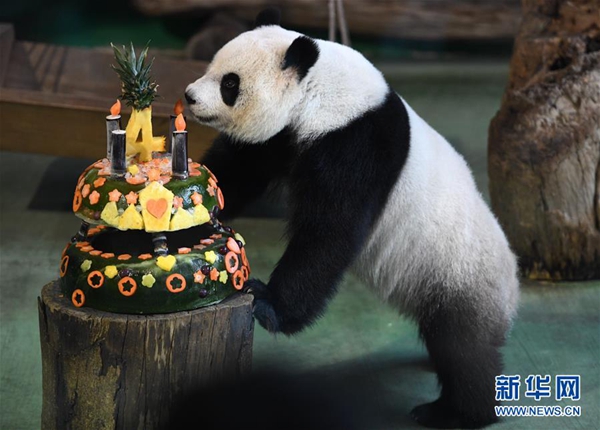
A birthday party was held Thursday at Taipei Zoo as Yuan Zai, the first panda cub born in Taiwan, turned four. [Photo/Xinhua]

A birthday party was held Thursday at Taipei Zoo as Yuan Zai, the first panda cub born in Taiwan, turned four.

Numerous visitors and panda lovers waited in a long queue before the zoo opened to public at 9 a.m., hoping to send their best wishes to the female cub.

Sixty members from a local panda lovers’ club joined the celebration by wearing T-shirts printed with images of “Yuan Zai”. They handed out panda-shaped stickers and notebooks to visitors to mark the day.

“Our club has more than 1,000 members and we have taken turns to visit Yuan Zai since she was born,” Chou Yu-Ru, a member of the club said. “We are so happy to see how she has grown from a little pink meatball.”

Keepers prepared a birthday cake decorated with the panda’s favorite food including bamboo shoots, pineapple, grapes and carrots.

Wong Yi-Man, chief of the Panda House at Taipei Zoo, said Yuan Zai is doing well and shows signs of maturity.

“We will work with the giant panda breeding center in Sichuan to find Yuan Zai a suitable mate when she is mature enough,” Wong said, explaining six and twelve are the pandas prime years of reproduction.

Born on July 6, 2013, Yuan Zai was the first baby of giant pandas Tuan Tuan and Yuan Yuan, who were gifted to Taiwan by Chinese mainland in 2008.

The panda family are major attractions at Taipei Zoo. Around 8,000 to 10,000 people visit the pandas each day during holidays.

New solid-fuel carrier rocket to be ready by 2018

China is developing a carrier rocket that can be launched from ships at sea, according to a rocket scientist.

Tang Yagang, deputy director of carrier rocket development at the China Academy of Launch Vehicle Technology in Beijing, told reporters on Thursday that the rocket is being developed based on the academy’s existing solid-fuel rocket and will be capable of sending a 500-kilogram satellite to a sun-synchronous orbit about 500 kilometers above Earth.

The academy only has one type of solid-fuel rocket-the Long March 11-which conducted its first mission in September 2015 and a second in November 2016.

“We plan to conduct some tests this year to verify the new rocket’s design and technologies, and will put it on the market in 2018,” he said on the sidelines of a conference in Beijing for users of China’s Long March carrier rockets, held by China Great Wall Industry Corp, the nation’s only authorized firm for international space collaboration.

Tang said that the new solid-fuel rocket will be launched from ships and will mainly carry out space launches for nations near the equator.

“This is especially suitable for those countries because a satellite launched near the equator will orbit above that line, so users along the equator will have more time each day to receive its data,” Tang said. “Another advantage is that a sea-based launch involves fewer risks compared with launching over populated regions. Moreover, there is less chance of conflict with air traffic, increasing safety.”

He added that compared with liquid-fuel rockets, a solid-fuel rocket requires less support from the launch facility. “Therefore we only need to refit a conventional cargo ship that has a displacement of 10,000 metric tons, which basically means installing a launchpad on it.”

In addition, Tang said the Long March 8 medium-lift carrier rocket that is under development at his academy will conduct its first flight in around 2019.

Designers at the academy previously said the Long March 8 would satisfy the needs of commercial launches in domestic and international markets. It will be capable of sending about 4.5 metric tons of payload to a sun-synchronous orbit or 2.5 tons to a geosynchronous transfer orbit, according to researchers.

Fu Zhiheng, vice-president of China Great Wall Industry Corp, said his company has been sparing no efforts to promote the country’s new-generation rockets.

“Our new-generation Long March 6 and Long March 11 can carry out a launch after a short time of preparation so are attractive to many clients,” he said. “The sea-based launch service will also have good prospects because it meets some clients’ requirements, and currently, there is no such service on the international market.”

Cambodia deports 74 Chinese fraud suspects

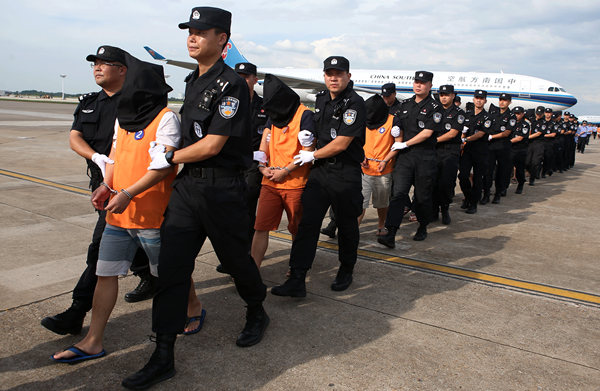
Chinese suspects arrive in Hunan Province from Cambodia on Thursday. [Photo/China Daily]

Cambodia deported 74 Chinese nationals suspected of involvement in telecom fraud, and they were taken to Hunan Province on Thursday afternoon, a senior Cambodian police official said.

“The Chinese police sent a plane to pick them up after we decided to deport them,” said Major General Ouk Hai Seila, chief of the investigation and procedure department at the General Department of Immigration, in an interview with Xinhua.

The deportees, including 21 women, were arrested on Saturday by Cambodian authorities in simultaneous raids on 12 locations in the capital, Phnom Penh, and Kandal and Kampot provinces, he said, adding that they would face legal action in China.

The 74 were suspected of using internet phones from Cambodia to extort money from victims in China, he said, adding that a number of phones and laptops were seized.

Seila said the raids came at the request of the Chinese embassy.

Scammers often use overseas internet servers to make scam calls to their victims, claiming to be court or police officials. They typically tell their targets that their bank accounts have been breached, so they need to transfer the money to a separate safe account, which is provided to the victim.

BCC at Chevening meeting: Put UK business and economy first in Brexit talks

As the BCC attends a meeting at Chevening House on Brexit, it calls on the government to put the economy first in the negotiations.


7 July 2017

On the day (Friday) that the British Chambers of Commerce attends a high-level Brexit meeting at Chevening House with the Department for Exiting the EU and other representatives from the business world, the leading business organisation is calling on the UK government to put British business and economic considerations first in the on-going Brexit negotiations.

BCC Director General Adam Marshall will argue that achieving a good deal for the UK economy may require the Government to be more flexible in its position over the coming months, in order to prioritise jobs, investment and certainty for the future. 

In recent weeks the BCC has, together with other business organisations, called on the government to seek to maintain the economic benefits of the Single Market and the Customs Union, until a comprehensive final settlement between the UK and EU is agreed and implemented.

The BCC has also called for the negotiators to agree to start the trade elements of the talks as early as possible, to give businesses on both sides greater confidence and clarity. 

 Dr Adam Marshall, Director General of the British Chambers of Commerce (BCC), said:

“Business communities across the UK want the government to take a pragmatic and flexible approach to Brexit negotiations that puts the needs of the economy front and centre. 

“Most businesses are a long way away from the theoretical debates we hear in Westminster, and just want answers to the practical, real-world questions they face. ‘Will our goods get stuck at border crossings? Who can we hire, and for how long? Who do we pay VAT to? Whose regulations and standards do we need to comply with?’ And so on.

“Answering these questions will require government to work in lock-step with business throughout the Brexit process, both on high-level strategy and on the detailed technical and legal issues that affect specific sectors. The meeting at Chevening with the Secretary of State has to be the start of a process of sustained engagement between government and business in order to get the best possible Brexit deal.

“At the same time, we will tell ministers loudly and clearly that Brexit isn’t the only game in town. Unless the UK has the best domestic business environment, even the best Brexit deal would fall flat. A high-cost, high-tax Britain with patchy infrastructure and serious skills gaps would be no recipe for future success.” 

Ends


Notes to editors:

The British Chambers of Commerce (BCC) sits at the heart of a powerful network of 52 Accredited Chambers of Commerce across the UK, representing thousands of businesses of all sizes and within all sectors. Our Global Business Network connects exporters with nearly 40 markets around the world. For more information, visit: www.britishchambers.org.uk

Media contacts:

Allan Williams – Senior Press Manager

020 7654 5812 / 07920583381

Orla Hennessy – Press and Communications Officer

020 7654 5813 / 07825746812

UN Member States set to adopt ‘historic’ treaty prohibiting nuclear weapons

6 July 2017 – In what is set to be a “historic” moment at the United Nations, Member States will adopt on Friday a legally-binding treaty prohibiting nuclear weapons.

“After our final review of the text yesterday, I am convinced that we have achieved a general consensus on a robust and comprehensive prohibition,” said Ambassador Elayne Whyte Gómez of Costa Rica, who serves as the President of the conference to negotiate a legally-binding instrument to prohibit nuclear weapons.

“This will be a historic moment and it is the first multilateral nuclear disarmament treaty to be concluded in more than 20 years,” she told a news conference at UN Headquarters.

According to the draft text, the treaty covers the full range of nuclear-weapons-related activities, prohibiting undertaking by any State party to develop, test, produce, manufacture, acquire, possess or stockpile nuclear weapons or other nuclear explosive devices.

The prohibitions also include any undertaking to use or threaten to use nuclear weapons or other nuclear explosive devices.

The treaty will be open for signature to all States at UN Headquarters in New York on 19 September 2017, and enter into force 90 days after the 50th instrument of ratification, acceptance, approval or accession has been deposited.

To date, however, a number of countries have stayed out of the negotiations, including the United States, Russia and other nuclear-weapon States, as well as many of their allies. The Democratic People’s Republic of Korea (DPRK) has not joined the talks either.

In a recent interview, the newly appointed High Representative for Disarmament Affairs, Izumi Nakamitsu, told UN News that “nuclear-weapon States and some of their allies are not able to join the negotiations at the moment, but hopefully a treaty will be something they will be able to join eventually.”

She said that “the door must be open to all States, and this inclusiveness will have to be built into the treaty.”

The draft treaty does include various pathways for nuclear-armed States to join. For instance, a State must first eliminate its nuclear weapons programme prior to joining. That State would then need to cooperate with the UN International Atomic Energy Agency (IAEA) in verifying the correctness and completeness of its nuclear inventory, thus following the same path as South Africa in the 1990s.

“Since this is a negotiation, no delegation can leave having gained everything they asked for from their national perspective,” noted Ms. Gómez, while adding that she was confident that “the final draft has captured the aspirations of the overwhelming majority of those participating in the conference, including civil society, whose enthusiasm, knowledge and collective experience have been a key driver of this process.”

In response to questions, Ms. Gómez stressed the importance of putting an international legal norm in place as a first step towards achieving a nuclear-weapons-free world, explaining that when conditions later become ripe for those nuclear-armed States to join, an architecture by which to do so exists.

All humanity expects that nuclear-armed States join the treaty “sooner than later,” but “I have no dates,” she said.

Asked about the impact on the negotiations of the current tensions over the DPRK’s nuclear programme and ballistic missiles activities, she said that having a norm in place does influence the behaviors of a State. It also plays a fundamental role in shaping a new security paradigm for the 21st century, she added.

“The treaty, no doubt, will compliment and strengthen the global architecture on nuclear disarmament and the non-proliferation regime. This is a historic event for humanity.”