BCC and DIHK: Joint UK-German call to put shared economic interests first in Brexit negotiations

The British Chambers of Commerce (BCC), and the Association of German Chambers of Commerce (DIHK) have called for UK and EU negotiators to put a clear focus on our shared economic interests as Brexit talks reconvene in Brussels.

 28th August 2017

The leading German and UK business organisations are challenging political leaders to build an atmosphere of mutual trust and constructive dialogue, to deliver clarity and certainty for trading businesses across Europe.

With the third round of Brexit negotiations underway, a number of business-critical areas that form part of the withdrawal agreement are yet to be resolved, including the rights of EU workers in the UK and UK workers in the EU27. Additionally, there are hundreds of practical and technical issues, including customs arrangements and tax procedures, that need to be negotiated as part of the future EU-UK relationship during later stages of the negotiations. Businesses in both the UK and Germany want to see talks move on to these fundamental issues – and particularly customs concerns – as soon as possible.

There is great uncertainty in the business community all across Europe. A DIHK survey has found out that the business outlook of companies that are engaged in trade with the United Kingdom is worsening, due to the expectation of cost burdens from limits on free movement of workers, taxes, tariffs and increasing bureaucratic hurdles at Europe’s new borders negatively affecting business on both sides.

Meanwhile, respondents to a recent British Chambers of Commerce survey have expressed their preference for a substantial transition period, with 68% saying they seek a transition period of at least three years. Both German and British businesses also want clarity at the start on the overall shape of the final destination settlement.

The United Kingdom is the third-largest market for German goods exports; in turn, Germany is the UK’s second-largest goods and services exports destination. German companies maintain about 2,500 branch offices in the UK, which employ nearly 400,000 workers. British companies have 1,200 branch offices in Germany, which employ about 220,000 workers.

Dr Adam Marshall, Director General of the British Chambers of Commerce, said:

“As Brexit talks continue, it’s clear that companies in the UK and on the Continent all want economic issues to rise to the top of the negotiations agenda. There is real business appetite from both sides for a focus on practical, day-to-day business concerns, and a desire for clarity on future trading arrangements.

“The UK and the EU must begin work on transitional arrangements, particularly on customs, so that firms on both sides of the Channel have the confidence to make investment decisions.

“Chambers of Commerce in the UK and in Germany want to see thriving trade continue between our firms, both now and into the future. Politicians must do everything in their power to help this happen.”

Dr Martin Wansleben, Chief Executive Officer of the Association of German Chambers of Industry and Commerce (DIHK):

“Businesses are very concerned that Brexit will have a major negative impact. Not only it could lead to more trade barriers – additional bureaucracy, increased waiting time and stricter border controls resulting in higher costs. The terms of exit are still completely unclear. Many of our members are reporting that they are already shifting investments away from the UK in anticipation of these barriers.

“The first effects of the Brexit vote are already being observed: German exports to the United Kingdom were down by 3 percent in the first half of this year compared to the first half of last year, whilst exports to the EU increased with 6 percent in the same period.

“A transitional period would be helpful for business, but it is important to businesses on both sides that the contours of a future trading relationship are becoming clearer over the next months.”

ENDS


The British Chambers of Commerce (BCC) sits at the heart of a powerful network of 52 Accredited Chambers of Commerce across the UK, representing 75,000 businesses of all sizes and within all sectors, who employ 5 million people around the UK. Our Global Business Network connects exporters with nearly 40 markets around the world. For more information, visit: www.britishchambers.org.uk

The Association of German Chambers of Industry and Commerce (Deutscher Industrie- undHandelskammertag – DIHK) is the umbrella organisation of 79 Chambers in Germany (IHKs) and the worldwide network of 130 business representations abroad. All companies registered in Germany, with the exception of handicraft businesses, the liberal professions and farms, are required by law to join a Chamber. Thus, the DIHK speaks for more than 3.6 million enterprises: www.dihk.de  

BCC media contact: Allan Williams, Tel. +44 20 7654 5812, a.williams@britishchambers.org.uk or Orla Hennessy, +44 20 76545813, o.hennessy@britishchambers.org.uk

DIHK media contact: Mathias Dubbert, Tel. +32 2 286 1638, dubbert.mathias@dihk.de
News story: Career break returner programmes launched to help people back to work

New initiatives to help people return to work after career breaks have been launched today by the Minister of State for Apprenticeships, Skills and Women Anne Milton.

The returner programmes – part of the £5 million fund announced in this year’s Budget – are formal schemes offered by employers to provide training and support to people who have taken time out of the workplace. The Government Equalities Office will be establishing four new returner schemes across the public sector.

They will be open to women and men, with the aim of giving people who have taken career breaks the opportunity to refresh their skills and build professional networks.

According to research by PwC, addressing the career break penalty could provide a £1.7 billion boost to our annual economic output. For female professionals, that could increase the annual earnings of that group by an average of £4,000 per woman.

Later this year, returners will be able to apply to programmes for social workers, allied health professionals, and civil servants.

It is part of the government’s work to support parents and carers returning to work, build home-grown skills, and close the gender pay gap.

Minister of State for Apprenticeships, Skills and Women Anne Milton said:

We want to help people who are looking to get into work, which is why we are going to do more to help people get back into work after a career break.

Millions of us need to take time out from our careers, but it can be really hard to return. This is bad for the people affected, and the businesses who miss out on their talents. Women in particular find the routes back into employment closed off after taking time out to start a family.

These returner programmes will make it routine for women to go back to the workplace and get on with their careers. It ultimately should also help us to tackle the gender pay gap. I think it’s important that the public sector leads by example and introduces programmes to support people returning to the workplace.

Working alongside the Local Government Association, Health Education England and Civil Service HR, the Government Equalities Office will look to establish returner programmes for:

  • Civil servants: Civil Service HR will launch an initial returner programme for 50 returners across the UK this October. Returners will be offered paid placements between six weeks to six months, which will include a bespoke learning and development opportunities.

  • Social workers: The Local Government Association (LGA) will build on the success of its Come Back to Social Work pilot and this November will partner with three regions across England to offer placements to 100 social work returners. The placements will include tailored training and development to prepare them to return to practice.

  • Allied health professionals: The Department for Health will build on the existing nurses scheme and run a returner programme with Health Education England for 300 allied health professional returners across England, including physiotherapists, podiatrists, dietitians, and radiographers. The placements will include education, re-training and tailored support with the aim of returners ready to practice within six to 12 months.

  • Teachers: GEO will also work with the Department for Education to explore a returner programme for teachers.

The government will also be working with business groups to identify how to boost further the opportunities for women returning to work.

The career returner programmes also form part of the government’s work to tackle the gender pay gap, which is at a record low of 18.1%. By next April, the government is requiring all employers with 250 or more staff to report their gender pay gap and bonus gap.

Statistics show that the gender pay gap for women in their twenties is less than 7 per cent, but widens to 25% for women in their forties. The Institute for Fiscal Studies has found that women who take time out of work earn less when they return, receiving around 2 per cent less for every year spent out of paid work.

The new programmes will help develop best practice on what works to support career returners back to work most effectively. The Government Equalities Office has also launched a public call for evidence to allow individuals and employers to contribute to its understanding of how best to support people returning to work, particularly within the private sector. The call for evidence will run for eight weeks, concluding on 29 October. It will be an opportunity for returners, employers and the wider public to inform the government’s future plans on returners.

Minister of State for Health Philip Dunne said:

Former allied health professionals have the talent and experience the NHS needs so we absolutely want to encourage them to return to work.

A new programme run by Health Education England will offer returners tailored education and re-training, so they feel confident and supported to return to providing outstanding patient care.

Professor Lisa Bayliss-Pratt, Director of Nursing and Deputy Director Education and Quality at Health Education England said:

Health Education England is extremely pleased to be able support AHPs back into our NHS as we know they contribute expert skills across the whole health and care system. Clinicians of all backgrounds returning to practice have a vital role to play in our NHS, as they tend to be more experienced and highly skilled.

In our work with AHPs, HEE will seek to build on our successful “Come Back to Nursing” campaign focused on nurses who have left the nursing profession but would come back if the right training and support was available. Over 2445 nurses have successfully completed a returner programme ready for employment on the front line to provide care and support for patients.

News story: Cleaner journeys as government commits £11 million to greener buses

Local authorities and bus companies in Bristol, York, Brighton, Surrey, Denbighshire and Wiltshire have been awarded the funding under the government’s ‘Low emission bus scheme’ to help them buy 153 cleaner buses.

The successful bidders will use the funding to buy new electric and gas buses, and to install stations to fuel or charge them.

The government is determined to clean up air in towns and cities across the country, and today’s (28 August 2017) investment in green buses comes after our air quality plan was published last month.

Transport Minister Paul Maynard said:

Low emission buses are an important part of our plans to make motoring cleaner and improve air quality across the country.

New greener buses will be more comfortable for passengers, they are cost efficient and are good for the environment.

I am pleased to announce this latest group of successful bidders, which should make a real difference to air quality in towns and cities across the country.

The successful bidders are:

  • Denbighshire County Council, Wales – £500,000 for 4 electric buses to be used on services in mid-Denbighshire
  • City of York Council – £3.3 million for 24 electric buses to be used on park and ride services in York
  • South Gloucestershire Council – £4.8 million for 110 gas buses for services around Bristol
  • Surrey County Council, Guildford – £1.5 million for 9 electric buses to be used on park and ride services in Guildford
  • The Big Lemon, £500,000 for 3 electric buses to be used in the Brighton area
  • Go South Coast / Wiltshire County Council – £500,000 for 3 electric buses to be used on park and ride services around Salisbury

The government’s support for low emission buses is one part of a £600 million package of measures from the Office for Low Emission Vehicles by 2020, plus £270 million announced in the 2016 Autumn Statement to support the roll out of low emission cars, taxis and buses and supporting infrastructure.

This follows an initial £30 million awarded to bus companies and local councils in July 2016 under the ‘Low emission bus scheme’ to help put over 300 more low emission buses on the country’s roads.

Later this year, the government will also publish plans for a second round of the ‘Low emission bus scheme’ with a view to putting even more of the cleanest buses on our streets.

News story: Planes fuelled by waste could take off from British airports

As part of plans to promote clean alternative fuels, the government is offering funding for projects in the UK to develop low carbon waste-based fuels for planes and lorries, with matching funding from industry.

The government is already planning to revolutionise the motor industry with ultra-low emission electric cars, and now we are going further and investing in a new generation of fuels which will power our aircraft and lorries.

Trials of sustainable jet fuel, made from waste materials, have taken place in Europe and North America, and now the launch of a UK competition will see British experts conduct pioneering research in this sector.

The department has already had interest from more than 70 groups in bidding for the funding.

The new fuels are chemically very similar to conventional fuels, so can be used in existing aircraft without the need for any engine modifications.

The low carbon transport fuels made from waste materials could be worth £600 million a year to the British economy by 2030, and could also support up to 9,800 new jobs.

Transport Minister Jesse Norman said:

We are committed to cutting carbon emissions and promoting new environmentally-friendly fuels that will help us meet that goal.

We are making funding available to innovative businesses which will lead the way in developing alternative fuels that are efficient, sustainable and clean.

We want every new car and van in the UK to be zero emission by 2040, but we know lorries and aeroplanes will rely on more traditional fuels for years to come so we must promote environmentally friendly alternatives.

The £22 million fund could help us deliver up to 5 new low carbon fuel plants by 2021. The money is available to projects that will produce low carbon waste-based fuels, to be used in planes and lorries where it is not viable today to switch to electric power, because of the large weight of the vehicles.

Planes and lorries powered by waste fuels could use up to 90% less carbon than traditional fossil fuels.

The Future fuels for flight and freight competition is part of the government’s ‘Modern industrial strategy’, which sets out to support evolving industries with the potential to boost the economy.

The government is committed to cutting greenhouse gas emissions by 80% by 2050, and transport emissions must be slashed if we are to meet that target.

Biofuels made from waste products could be even more sustainable than current crop-based biofuels, already used in some road-based vehicles.

News story: Cleaner journeys as government commits £11 million to greener buses

Local authorities and bus companies in Bristol, York, Brighton, Surrey, Denbighshire and Wiltshire have been awarded the funding under the government’s ‘Low emission bus scheme’ to help them buy 153 cleaner buses.

The successful bidders will use the funding to buy new electric and gas buses, and to install stations to fuel or charge them.

The government is determined to clean up air in towns and cities across the country, and today’s (28 August 2017) investment in green buses comes after our air quality plan was published last month.

Transport Minister Paul Maynard said:

Low emission buses are an important part of our plans to make motoring cleaner and improve air quality across the country.

New greener buses will be more comfortable for passengers, they are cost efficient and are good for the environment.

I am pleased to announce this latest group of successful bidders, which should make a real difference to air quality in towns and cities across the country.

The successful bidders are:

  • Denbighshire County Council, Wales – £500,000 for 4 electric buses to be used on services in mid-Denbighshire
  • City of York Council – £3.3 million for 24 electric buses to be used on park and ride services in York
  • South Gloucestershire Council – £4.8 million for 110 gas buses for services around Bristol
  • Surrey County Council, Guildford – £1.5 million for 9 electric buses to be used on park and ride services in Guildford
  • The Big Lemon, £500,000 for 3 electric buses to be used in the Brighton area
  • Go South Coast / Wiltshire County Council – £500,000 for 3 electric buses to be used on park and ride services around Salisbury
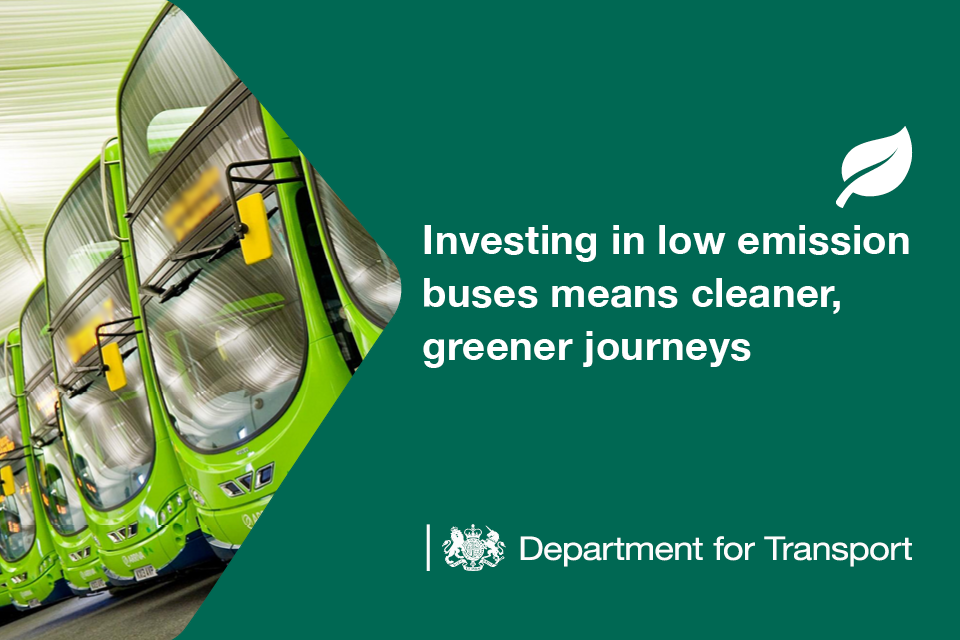
Investing in low emission buses means cleaner, greener journeys.

The government’s support for low emission buses is one part of a £600 million package of measures from the Office for Low Emission Vehicles by 2020, plus £270 million announced in the 2016 Autumn Statement to support the roll out of low emission cars, taxis and buses and supporting infrastructure.

This follows an initial £30 million awarded to bus companies and local councils in July 2016 under the ‘Low emission bus scheme’ to help put over 300 more low emission buses on the country’s roads.

Later this year, the government will also publish plans for a second round of the ‘Low emission bus scheme’ with a view to putting even more of the cleanest buses on our streets.

Roads media enquiries