News story: Headley Court partners with Loughborough University for research study

The Biomechanical Associations and Efficacy of Injectable Therapies in Tendinopathy (BEFIT) study is funded with a grant from the Higher Education Funding Council for England and brings together university academics and MOD collaborators to investigate risk factors and treatment of tendon pain in our regular armed forces.

The main focus of the project is a randomised controlled trial investigating the effect of high volume injection therapy in Achilles and patellar tendinopathy. There have been some encouraging results from other centres but currently there is no controlled study to provide evidence for the use of these injections in military personnel.
Commenting on the importance of this programme the Director of Defence Rehabilitation, Col John Etherington, said:

Reducing musculoskeletal injuries (MSKI) remains our main effort in improving the health and operational readiness of our personnel. We know that approximately 60% of medical downgradings and 60% of medical discharges are associated with MSKI. Getting the very best treatment at the right place and at the right time is key to us helping our personnel fulfil their potential. I am delighted that we have been able to pool resources in this type of project to drive forward best practice.

The research has made good use of the Help for Heroes motion tracking laboratory at Headley Court together with Loughborough University biomechanics. Factors which may predict tendon pain and its response to treatment are also being analysed.

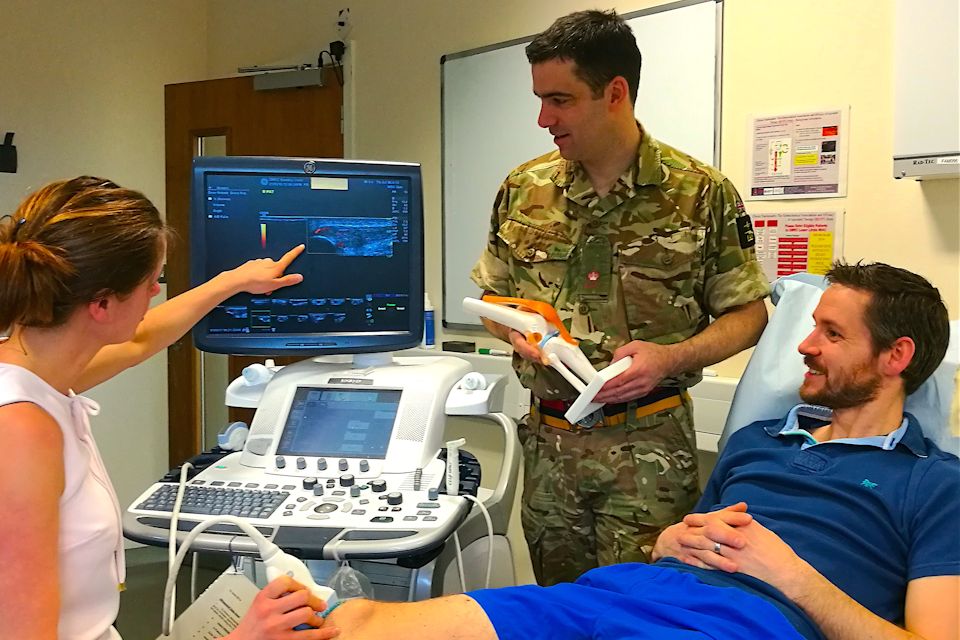
BEFIT study clinic. Crown Copyright. All rights reserved

Gp Capt Alex Bennett the Head of Research at Headley Court and Defence Professor for Rehabilitation described the need for this research within defence:

This well designed clinical trial has been approved not only by the MOD Research Ethics Committee but also the Medicines and Healthcare products Regulatory Agency and gives us the best opportunity to test fully whether these injections can benefit our patients.

Professor Mark Lewis, Dean of the School of Sport Exercise and Health Sciences at Loughborough University said:

The relationship between Loughborough University and the Academic Department of Military Rehabilitation at Headley Court via the National Centre for Sport and Exercise Medicine is of critical importance to the university. This project not only cements that relationship but, more importantly, has the potential to deliver huge benefits to tendinopathy sufferers in the UK military and more widely to the general public. We are grateful to the HEFCE for supporting this project through a Catalyst fund.

A dedicated BEFIT study clinic has been established at DMRC Headley Court. Anyone with questions about the research programme should email Sqn Ldr Robert Barker-Davies at DMRC-SEM3@mod.uk or phone 95238 ext 7497 or 01372371310.


News story: Headley Court partners with Loughborough University for research study

The Biomechanical Associations and Efficacy of Injectable Therapies in Tendinopathy (BEFIT) study is funded with a grant from the Higher Education Funding Council for England and brings together university academics and MOD collaborators to investigate risk factors and treatment of tendon pain in our regular armed forces.

The main focus of the project is a randomised controlled trial investigating the effect of high volume injection therapy in Achilles and patellar tendinopathy. There have been some encouraging results from other centres but currently there is no controlled study to provide evidence for the use of these injections in military personnel.
Commenting on the importance of this programme the Director of Defence Rehabilitation, Col John Etherington, said:

Reducing musculoskeletal injuries (MSKI) remains our main effort in improving the health and operational readiness of our personnel. We know that approximately 60% of medical downgradings and 60% of medical discharges are associated with MSKI. Getting the very best treatment at the right place and at the right time is key to us helping our personnel fulfil their potential. I am delighted that we have been able to pool resources in this type of project to drive forward best practice.

The research has made good use of the Help for Heroes motion tracking laboratory at Headley Court together with Loughborough University biomechanics. Factors which may predict tendon pain and its response to treatment are also being analysed.

BEFIT study clinic. Crown Copyright. All rights reserved

Gp Capt Alex Bennett the Head of Research at Headley Court and Defence Professor for Rehabilitation described the need for this research within defence:

This well designed clinical trial has been approved not only by the MOD Research Ethics Committee but also the Medicines and Healthcare products Regulatory Agency and gives us the best opportunity to test fully whether these injections can benefit our patients.

Professor Mark Lewis, Dean of the School of Sport Exercise and Health Sciences at Loughborough University said:

The relationship between Loughborough University and the Academic Department of Military Rehabilitation at Headley Court via the National Centre for Sport and Exercise Medicine is of critical importance to the university. This project not only cements that relationship but, more importantly, has the potential to deliver huge benefits to tendinopathy sufferers in the UK military and more widely to the general public. We are grateful to the HEFCE for supporting this project through a Catalyst fund.

A dedicated BEFIT study clinic has been established at DMRC Headley Court. Anyone with questions about the research programme should email Sqn Ldr Robert Barker-Davies at DMRC-SEM3@mod.uk or phone 95238 ext 7497 or 01372371310.


News story: A new way to pay

Instead of paying in advance, a new ‘Pay on Invoice’ process will streamline the way we manage a range of applications.

We are committed to reducing the regulatory burden and improving the process for licence applications.

From 1 April those making applications will no longer need to attach proof of payment making the end-to-end process simpler, easier and quicker.

The benefits of the new process include removing the need to work out complex fees and reducing the chance of applications being rejected for incorrect payment details.

Additionally the simplified payment process should result in fewer delays and make it easier for companies to reconcile financial records and accounts.

Overall the process is aimed at saving companies time and money.

Richard Humphreys, MHRA’s Deputy Director of Finance said:

We have listened to our customers and launched this new project in order to make the process of payment much easier and quicker.

We hope the new process will reduce the regulatory burden and reduce unnecessary delays.

As with everything we do, we welcome your feedback.

If you have any questions please get in touch by emailing sales.invoices@mhra.gsi.gov.uk

There have been no changes to our payment terms and invoices must be settled on receipt of invoice. Penalty fees can be incurred for non-payment, details of the penalties are set out in the Fees Regulations. Non-payment may also result in suspension of any licence or authorisation, followed by legal proceedings for unpaid amounts, as a debt due to the Crown.

More information can be found here


News story: Exercise Wessex Flare pump test being held in Somerset

A high-volume pump used during major flood events will be tested in Somerset next week (4 to 6 April 2017) as part of Exercise Wessex Flare – a 3-day training exercise run by the Environment Agency.

The 24-inch diameter steel and alloy diesel pump is capable of pumping 1,650 litres of water per second – the equivalent of filling 20 baths in a second. It will be loaded onto an 8-wheel lorry at its base in Bawdrip village, and transported to the remote North Drain pumping station several miles away.

A team of incident operatives and experienced pump specialists from across the country will then attach the 12-tonne pump to 40 metres of pipework over a period of at least 8 hours before setting it in motion.

Operations manager Robbie Williams said:

Flooding can have a devastating impact on people’s lives and homes. We care about our communities and want to do whatever we can to help prevent this type of incident. Using pumps to manage water levels and reduce the impact of flooding is one of the many ways we can do this, alongside temporary defence barriers.

Preparing and practising pump deployment helps to ensure we act more quickly and effectively. It’s also an opportunity to develop knowledge and skills so people can confidently operate this type of heavy machinery nationwide, with the help of the military and other groups.

The exercise builds on Exercise Wessex Teal where Wiltshire-based soldiers were trained to deploy temporary defence barriers. Some of those soldiers will be on hand to watch the pump in action and learn how it works. The Environment Agency’s new Incident Command Unit (ICU) will also be on-site streaming live images of the exercise back to the Agency’s Bridgwater incident room.

The ICU serves as a mobile incident room and temporary headquarters for staff out in the field, enabling better site management, situational awareness and visibility in flood risk communities.

It is important everybody is aware of their own flood risk. People can find out how to get ready and check their flood risk on GOV.UK or calling Floodline on 0345 988 1188.


Press release: Charities in Wales benefit from Tampon Tax Fund

The Tampon Tax Fund is designed to benefit charities that support women and girls, particularly those affected by violence and domestic abuse.

In 2016 / 17, the Tampon Tax Fund has awarded £15m across the UK.

The fund is equivalent to the amount HMRC estimate is raised from VAT on sanitary products. The fund was announced at Autumn Statement 2015.

The four Welsh projects to benefit from the fund are: Volunteering Matters (SAFE) in Gwent, North Wales Women’s Centre, Rape and Sexual Abuse North Wales and the National Youth Advocacy Service in Wales.

Lord Nick Bourne, Parliamentary under Secretary of State for Wales, said:

This year’s funding will benefit projects all over Wales and will help provide many women, girls and young children, some of them in vulnerable situations, with a better standard of living through education, support and self-help programmes.

This Government is a Government that works for everyone and this funding demonstrates its commitment to the union and supporting projects across the whole of the UK.

Rob Wilson, Minister of Civil Society said:

From Cornwall to Dundee, the Tampon Tax Fund continues to benefit organisations in every corner of the UK working to improve the lives of disadvantaged women and girls, including those who’ve been affected by violence.

This Fund is helping to improve lives, supporting our ambition to create a fairer, shared society for everyone. I’m glad that so many worthwhile organisations will benefit from this money.

An outline of the planned activity for each of the four Welsh charities is below:

  • Volunteering Matters (SAFE) The SAFE (‘Sexual Awareness for Everyone’) project – This will improve the personal safety and maintain good sexual health of 300 young women (aged 16-35) with learning difficulties, from deprived areas in Gwent, South Wales through workshops, one-to-one peer support and production and distribution of a SAFE card. Learning will be shared with the wider community by 50 of the young women, who will be trained as SAFE Champions and deliver peer support within local youth, educational and community services.

  • North Wales Women’s Centre – The project aims to improve the lives of 300 (minimum) disadvantaged women and girls targeting those with multiple and complex needs who are at risk of offending or reoffending. Existing issues for this group of women will be addressed whilst empowering them to be more resilient. This will be achieved by provision of community based support across North Wales where referred women will be assessed to identify their needs and a care plan will be developed with them. Learning will be shared by working with a wider group of community-based organisations to plan service provision for the future.

  • Rape and Sexual Abuse North Wales – The aim is to pilot and evaluate, through partnership and collaboration, a self-help programme developed for survivors of sexual violence suffering with Sexual Trauma Specific Post Traumatic Stress Disorder (STS-PTSD). The project is to be trialled in three groups of eight annually, then expanded to groups of 12 once the pilot is complete. Following the pilot, they plan to train facilitators across Wales and the UK, to offer practical help to thousands of female survivors.

  • National Youth Advocacy Service – The aim of this project is to improve the lives of young women and girls leaving the care system in Wales especially those who are pregnant, those at risk of teenage pregnancy, at risk of child sexual exploitation and care experienced parents. The project will be bespoke and tailored to the needs of the young person increasing their confidence and resilience and giving them information and support on sexual health, healthy relationships, gender equality and body image. In addition to establishing a number of support networks the project aims to identify what works best for women and girls in this disadvantage cohort and having learned these lessons will look to seek funding to roll this project out to other parts of the country.