Scotland has a hidden jobs crisis

7th April 2017

Scotland has a hidden jobs crisis, with real unemployment standing at nearly 10 per cent.

Analysis from the independent Scottish Parliament Information Centre (SPICe) has revealed that real unemployment in Scotland between 2015 and 2016 stood at 322,000 – or 9.4 per cent of the labour market.

Why is real unemployment so much higher than the stats we normally see?

Real unemployment is calculated by combining the figure for unemployment people with those who are economically inactive but want a job.

People who are economically inactive but want a job make up 23.8% of those aged 16-64 who are defined as  “Economically inactive”

That's an additional 190,000 people.

What do the experts say?

Professor Brian Ashcroft has written abvout economic inacitivty before. He was warning about real unemployment rising five years ago.

The STUC – Scotland's Trades union Congress – have raised concerns before that official stats don't show the real condition of our jobs market:

“Understandably, the political debate revolves around the headline employment and unemployment rates and rarely addresses these other trends. The STUC has sought to highlight that the true level of demand for labour is not always reflected in the ILO and claimant count and has published regular labour market reports which have included the development of a measure of ‘Scotland’s Full-Time Employment Deficit.'

And the respected think tank the Fraser of Allander Institute recently talked about rising levels of inacitvity:

“[inacitivty rates] have increased over the past 18 months. What is interesting is that women account for much of the rise. The increase in female inactivity of over 50,000 (16-64) coincides with falling unemployment (-19,000) and employment (-32,000) (both 16+) over the past 18 months.”

How would Labour fix this?

We would would stimulate our economy by using the power of procurement to ensure high quality jobs and front load investment in housebuilding.

We'd make work pay and invest in skills so we can comepte for the jobs of the future. Building our economy from the ground up and for the long term. You can read more here.

Agree with our plan? Then help spread our message. 


News story: Armed Forces Minister underlines UK commitment to Africa

From engineering support to the UN in South Sudan, to helping counter the threat from terror in Somalia, the Minister was able to see the breadth of the UK’s role in Africa.

In Mogadishu, Mr Penning met British troops working with the African Union Mission in Somalia (AMISOM), which is building stability, and tackling the threat posed by Al-Shabaab.

Following travel to Bentiu and Malakal, the Minister was greeted by UK military personnel providing support to the UN Mission in South Sudan, which is working to achieve stability in the East African nation. Up to 400 personnel will deploy this year – making it one of the UK’s largest operational deployments in the world – enabling the building of a field hospital to support UN peacekeepers.

As the visit moved to Uganda and Kenya, Mr Penning watched pre-deployment training of their military personnel, many of who go on to serve in AMISOM.

Minister of State for the Armed Forces Mike Penning said:

It has been a privilege to see our Armed Forces operating across multiple countries, in different environments, in support of our African partners. The training and support provided by our dedicated men and women clearly demonstrates that Britain has genuinely global reach. This is no less so in South Sudan where we are playing a major role in the international peacekeeping effort, meeting the commitment made by the Prime Minister last year to double our support to the United Nations.

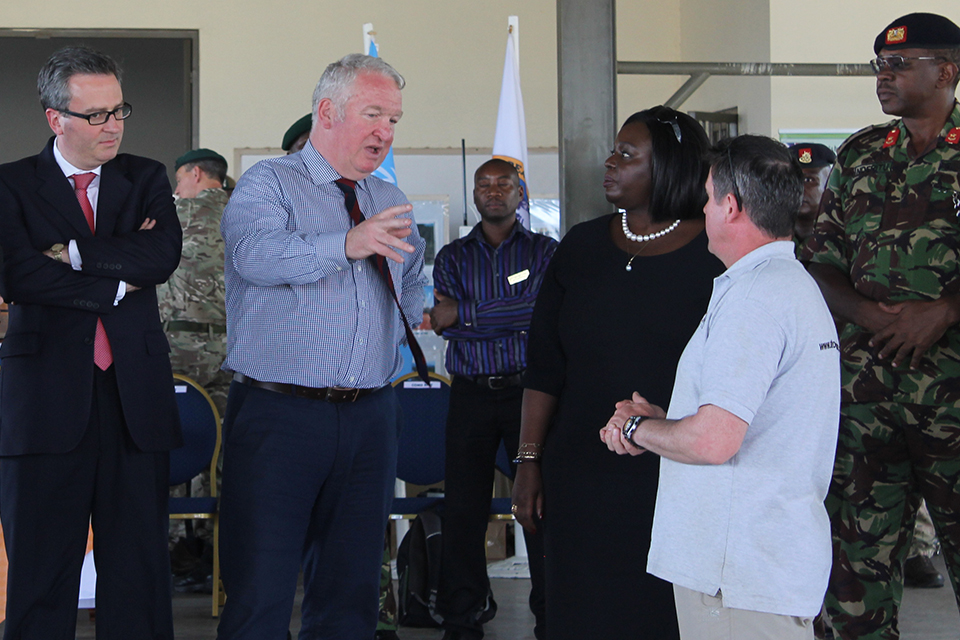
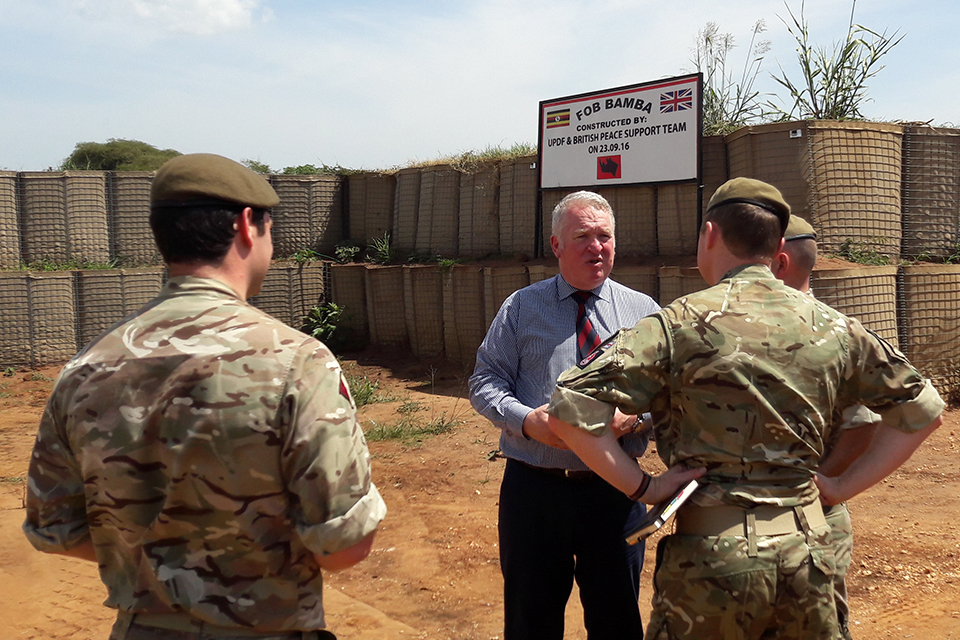
In Uganda, Armed Forces Minister Mike Penning met UK troops supporting pre-deployment training for the African Union Mission in Somalia. Crown Copyright.

Throughout the visit the Armed Forces Minister met with Government ministers and UN representatives to help deepen Defence relationships, and discuss shared interests and regional challenges.

In Somalia, The Minister met President Mohamed Abdullahi Mohamed Farmajo, Prime Minister Hassan Ali Khayre, National Security Minister Mohamed Abukar Islow, and Mr Penning became the first international Minister to meet Somalia’s new Defence Minister Abdirashid Abdullahi Mohamed. He also spoke with UN Special Representative Michael Keating.

After leaving Bentiu and Malakal, the Minister travelled to Juba and met Defence Minister Kuol Manyang Juuk, UN Special Representative David Shearer, and Commanding Officer of the UK engineers in South Sudan Lt Col Jason Ainley.

Uganda and Kenya provide important contributions to AMISOM, and in both countries Mr Penning saw UK delivered pre-deployment training.

In Uganda, the Minister saw Ugandan troops receiving training at the Peace Operations Training Centre, Singo, before meeting Defence Minister Adolf Mwesige in Kampala.

Finally, in Nairobi, the Minister met personnel from the British Army Training Unit Kenya, which trains thousands of UK troops every year.

Mr Penning also visited the Humanitarian Peace Support School and British Peace Support Team Eastern Africa, which deliver AMISOM pre-deployment and other training to international military personnel, before meeting Kenyan Defence Minister Raychelle Omamo.

Armed Forces Minister Mike Penning’s visit included Kenya, where he met Kenyan Defence Minister Raychelle Omamo. Crown Copyright.


News story: Armed Forces Minister underlines UK commitment to Africa

From engineering support to the UN in South Sudan, to helping counter the threat from terror in Somalia, the Minister was able to see the breadth of the UK’s role in Africa.

In Mogadishu, Mr Penning met British troops working with the African Union Mission in Somalia (AMISOM), which is building stability, and tackling the threat posed by Al-Shabaab.

Following travel to Bentiu and Malakal, the Minister was greeted by UK military personnel providing support to the UN Mission in South Sudan, which is working to achieve stability in the East African nation. Up to 400 personnel will deploy this year – making it one of the UK’s largest operational deployments in the world – enabling the building of a field hospital to support UN peacekeepers.

As the visit moved to Uganda and Kenya, Mr Penning watched pre-deployment training of their military personnel, many of who go on to serve in AMISOM.

Minister of State for the Armed Forces Mike Penning said:

It has been a privilege to see our Armed Forces operating across multiple countries, in different environments, in support of our African partners. The training and support provided by our dedicated men and women clearly demonstrates that Britain has genuinely global reach. This is no less so in South Sudan where we are playing a major role in the international peacekeeping effort, meeting the commitment made by the Prime Minister last year to double our support to the United Nations.

In Uganda, Armed Forces Minister Mike Penning met UK troops supporting pre-deployment training for the African Union Mission in Somalia. Crown Copyright.

Throughout the visit the Armed Forces Minister met with Government ministers and UN representatives to help deepen Defence relationships, and discuss shared interests and regional challenges.

In Somalia, The Minister met President Mohamed Abdullahi Mohamed Farmajo, Prime Minister Hassan Ali Khayre, National Security Minister Mohamed Abukar Islow, and Mr Penning became the first international Minister to meet Somalia’s new Defence Minister Abdirashid Abdullahi Mohamed. He also spoke with UN Special Representative Michael Keating.

After leaving Bentiu and Malakal, the Minister travelled to Juba and met Defence Minister Kuol Manyang Juuk, UN Special Representative David Shearer, and Commanding Officer of the UK engineers in South Sudan Lt Col Jason Ainley.

Uganda and Kenya provide important contributions to AMISOM, and in both countries Mr Penning saw UK delivered pre-deployment training.

In Uganda, the Minister saw Ugandan troops receiving training at the Peace Operations Training Centre, Singo, before meeting Defence Minister Adolf Mwesige in Kampala.

Finally, in Nairobi, the Minister met personnel from the British Army Training Unit Kenya, which trains thousands of UK troops every year.

Mr Penning also visited the Humanitarian Peace Support School and British Peace Support Team Eastern Africa, which deliver AMISOM pre-deployment and other training to international military personnel, before meeting Kenyan Defence Minister Raychelle Omamo.

Armed Forces Minister Mike Penning's visit included Kenya, where he met Kenyan Defence Minister Raychelle Omamo. Crown Copyright.
Armed Forces Minister Mike Penning’s visit included Kenya, where he met Kenyan Defence Minister Raychelle Omamo. Crown Copyright.


Press release: PM meeting with Donald Tusk: 6 April 2017

The Prime Minister and President of the European Council Donald Tusk had talks this afternoon in Downing Street following last week’s Article 50 notification.

The PM reiterated the UK’s desire to ensure a deep and special partnership with the European Union following its exit and noted the constructive approach set out by the Council in its draft guidelines published last week.

She said the UK looked forward to formally beginning negotiations once the 27 member states agreed guidelines. Both leaders agreed that the tone of discussions had been positive on both sides, and agreed that they would seek to remain in close touch as the negotiations progressed.

The PM also made clear that on the subject of Gibraltar, the UK’s position had not changed: the UK would seek the best possible deal for Gibraltar as the UK exits the EU and there would be no negotiation on the sovereignty of Gibraltar without the consent of its people.

With the UK also remaining a full and engaged member of the EU for the next 2 years, the PM and Donald Tusk also discussed the agenda for the next EU Council meeting.


Press release: Appeal for information following pollution in Hampshire

The Environment Agency is appealing for information in the Andover area following a pollution incident on the River Anton.

The Environment Agency were alerted to a pollution of oil on the River Anton close to Andover College on 4 April.

Since then, Environment Officers have been working on site to determine the source and reduce the impact on the environment, and booms have been deployed across the river to contain the pollution.

Adam Fulton, Area Duty Manager for the Environment Agency, said:

Our Environment Officers are working hard at the site to manage the environmental impact, and at the moment we have had no reports of dead fish.

We will continue to investigate the source of pollution, and are asking anyone who might be able to assist our enquiries to call our Incident Hotline on 0800 807060.