Press release: Making sense of big data to improve the nation’s defence, security and prosperity

The Defence Science and Technology Laboratory (Dstl) has today announced the launch of the Data Science Challenge. The challenge is designed to bring the brightest minds in data science together to solve real-world problems. The first challenges – detecting and classifying vehicles from aerial imagery and the classification of documents by themes– are now open to entrants, with each challenge boasting a total prize fund of £40,000.

The Data Science Challenge is part of a wider programme set out in the Defence Innovation Initiative that aims to build an open innovation ‘ecosystem’, harnessing the talents of individuals, academia and industry to develop new approaches to complex problems. The Data Science Challenge is piloting new ways of working including the use of crowdsourcing to engage the data science community to develop cutting edge solutions to Defence and Security problems.

The Data Science Challenge includes two distinct problems that will test the participants’ ability to mine large unstructured datasets to extract useful information:

  • Safe passage: detecting and classifying vehicles in aerial imagery

Being able to automatically detect and categorise vehicles in aerial imagery will dramatically improve how quickly we can assess and identify them. This challenge asks participants to detect and classify vehicles such as buses, cars and motorbikes, from a set of aerial images.

  • Growing instability: classifying crisis reports

Analysing data in documents such as media reports can provide a better understanding of a potential crisis situation, growing instability in a particular region or specific theme such as terrorism. Using news material, this challenge asks participants to predict topic tags for classifying unseen reports so that they can be used to improve awareness and understanding.

Minister for Defence Procurement Harriett Baldwin MP said:

Our Innovation Initiative is about harnessing diverse and talented individuals from business, academia, and beyond to keep the UK ahead of our adversaries.

In this latest challenge, supported by our £800 million Innovation Fund, we are calling on experts to develop the latest technology to crunch big data and identify the solutions that will keep us safe.

James Srinivasan, a Principal Data Scientist at Dstl added:

Around the world, governments are using the power of data to meet many of the huge challenges that they are facing. By analysing complex, evolving information, data science can provide invaluable insight that informs how we can best respond to event.

There is real talent out there and we want to encourage the curious to experiment and learn. We are determined to push the boundaries of what can be done, and to keep striving to always be better. This is why we are launching the Data Science Challenge today.

We are keen to encourage all data scientists, not just those in the defence and security sectors, who want to rise to the challenges that we have thrown-down today, to get involved.

The Data Science Challenge is sponsored by Dstl, the Government Office for Science, Secret Intelligence Service and MI5.

Participants can register from today at www.datasciencechallenge.org and have between 3 April and 11.59pm on 17 May 2017 to develop and submit their solutions. Winners from each of the challenges will be announced at the end of May 2017.

The top three entrants will receive cash prizes. The first prize is £20,000, the second placed entrant will receive £12,000 whilst the third will get £8,000.



News story: Royal Fleet Auxiliary’s new tanker arrives in UK for customisation work sustaining 300 jobs

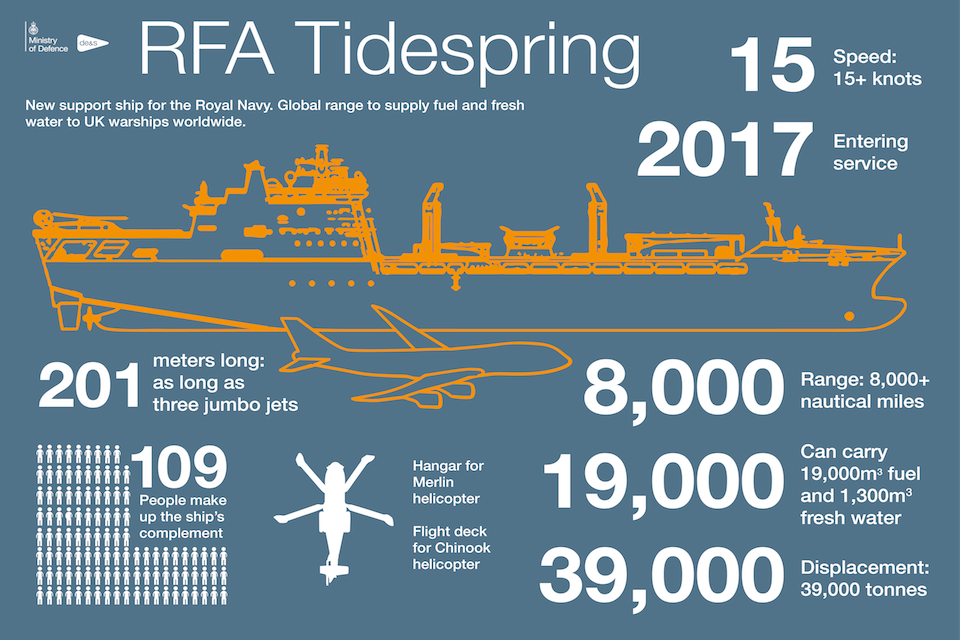
The 39,000-tonne tanker, which can carry up to 19,000 cubic metres of fuel and 1,300 cubic metres of fresh water, will join the Royal Fleet Auxiliary, a civilian-manned fleet which provides support for warships, helping the Royal Navy to maintain its operations 24/7, 365 days a year, around the world.

Tidespring is the first of a fleet of four Tide Class tankers which will all be taken through customisation in Falmouth. She will now undergo an intense programme of work at the A&P shipyard, and is expected to enter service before the end of the year. The new Tide Class tankers will provide key support to the Queen Elizabeth Class carriers when they come into service, alongside the wider fleet.

The arrival is a significant milestone in the ‘Year of the Navy’ which will also see the debut in Portsmouth of the first of the Queen Elizabeth-Class aircraft carriers, the start of construction for the fleet of new Type 26 Frigates and the opening of the first permanent Royal Navy base east of Suez in more than half a century.

RFA Tidespring
The first of the newest support ships for the Royal Navy, RFA Tidespring.

Minister for Defence Procurement Harriett Baldwin said:

RFA Tidespring’s UK arrival is a key milestone in 2017, the Year of the Royal Navy, which will also see the MOD develop world-class ships and submarines in support of Britain’s role as a leading naval power.

Backed by a rising Defence budget, the delivery of the Tide Class tankers is a crucial element of the Government’s £178 billion plan to ensure our armed forces have the equipment they need.

The customisation work is helping to support around 300 jobs at A&P Falmouth. The UK work content in the wider Tide Class programme is worth around £150 million, sustaining further jobs at 27 UK-based companies. The project is being delivered well within budget by the MOD.

Systems to be installed in Falmouth include the communications equipment, self-defence weapons and armour needed to allow the ship to operate in the most challenging environments.

RFA Tidespring
RFA Tidespring. Crown Copyright.

Vice Admiral Simon Lister, who led procurement of the Tide Class at Defence Equipment and Support, said:

RFA Tidespring will be a familiar and reassuring presence for Royal Navy ships as they undertake missions in defence of the UK’s interest.

The continued successful delivery of the Tide Class programme, meeting all requirements and under budget stands as a testament to the excellent working relationships which DE&S has built with suppliers in the UK and around the world.

The Tide Class has a flight deck able to accommodate the large Chinook helicopter and offer significant improvements over previous RFA tankers such as double hulls and greater environmental protection measures.


News story: Royal Fleet Auxiliary’s new tanker arrives in UK for customisation work sustaining 300 jobs

The 39,000-tonne tanker, which can carry up to 19,000 cubic metres of fuel and 1,300 cubic metres of fresh water, will join the Royal Fleet Auxiliary, a civilian-manned fleet which provides support for warships, helping the Royal Navy to maintain its operations 24/7, 365 days a year, around the world.

Tidespring is the first of a fleet of four Tide Class tankers which will all be taken through customisation in Falmouth. She will now undergo an intense programme of work at the A&P shipyard, and is expected to enter service before the end of the year. The new Tide Class tankers will provide key support to the Queen Elizabeth Class carriers when they come into service, alongside the wider fleet.

The arrival is a significant milestone in the ‘Year of the Navy’ which will also see the debut in Portsmouth of the first of the Queen Elizabeth-Class aircraft carriers, the start of construction for the fleet of new Type 26 Frigates and the opening of the first permanent Royal Navy base east of Suez in more than half a century.

The first of the newest support ships for the Royal Navy, RFA Tidespring.

Minister for Defence Procurement Harriett Baldwin said:

RFA Tidespring’s UK arrival is a key milestone in 2017, the Year of the Royal Navy, which will also see the MOD develop world-class ships and submarines in support of Britain’s role as a leading naval power.

Backed by a rising Defence budget, the delivery of the Tide Class tankers is a crucial element of the Government’s £178 billion plan to ensure our armed forces have the equipment they need.

The customisation work is helping to support around 300 jobs at A&P Falmouth. The UK work content in the wider Tide Class programme is worth around £150 million, sustaining further jobs at 27 UK-based companies. The project is being delivered well within budget by the MOD.

Systems to be installed in Falmouth include the communications equipment, self-defence weapons and armour needed to allow the ship to operate in the most challenging environments.

RFA Tidespring. Crown Copyright.

Vice Admiral Simon Lister, who led procurement of the Tide Class at Defence Equipment and Support, said:

RFA Tidespring will be a familiar and reassuring presence for Royal Navy ships as they undertake missions in defence of the UK’s interest.

The continued successful delivery of the Tide Class programme, meeting all requirements and under budget stands as a testament to the excellent working relationships which DE&S has built with suppliers in the UK and around the world.

The Tide Class has a flight deck able to accommodate the large Chinook helicopter and offer significant improvements over previous RFA tankers such as double hulls and greater environmental protection measures.


SNP spin on income tax rates ‘astonishing’

3 Apr 2017

Campaign photography for Murdo Fraser by Angus Forbes

The Scottish Conservatives have accused the SNP government of “blatant spin” after ministers today described their decision not to pass on tax cuts to thousands of Scottish workers as a sign of “fairness and equality”.

In a press release heralding new Scottish rates of income tax, finance secretary Derek Mackay also claimed that his decision – which will drag more workers into the higher rate of income tax – would make Scotland “an attractive place to live and work”.

This is despite the fact that business leaders have warned that higher rates in Scotland could create a “dangerous precedent” for the Scottish economy.

Following pressure from the Scottish Greens, the SNP government decided last month to freeze the higher rate of income tax at £43,000.

By contrast, in the rest of the UK, the threshold for the higher rate will rise this week to £45,000.

Scottish Conservative shadow finance secretary Murdo Fraser said:

“Even for the nationalists, this blatant attempt to spin the SNP’s tax plans is astonishing.

“The truth is that, later this week, tens of thousands of families elsewhere in the UK will get a long overdue tax break.

“But, thanks to the actions of this SNP government, families in Scotland earning the exact same in their pay packet will be denied it.

“Instead, many police officers, teachers and senior nurses will continue to be dragged into the higher rate of tax.

“Derek Mackay’s claim that this provides ‘fairness and equality’ for people in Scotland suggests the SNP has finally gone through the looking glass.

“Nicola Sturgeon’s decision to make Scotland the highest-taxed part of the UK is utterly unnecessary and unjustified.

“The fact that her government is resorting to spin in order to hide the fact suggests she knows it too.”


The full Scottish Government release is here from today is here:  https://news.gov.scot/news/scottish-income-tax

Scottish Chambers of Commerce reaction to the SNP budget is here: http://www.scottishchambers.org.uk/press-policy/press-releases/2016/12/882


Aldi’s new Welsh regional Distribution Centre opens having created 422 new jobs – with a further 400 jobs in the pipeline across South Wales

The news was warmly welcomed by Economy Secretary Ken Skates when he launched the company’s new 40,000 sq. mt.  distribution centre and regional offices on the Capital Business Park in Wentloog. 

This major development, which will serve as a hub for Aldi’s growing portfolio of stores across South Wales and the South West of England, was supported with £4.5m business finance from the Welsh Government. 

Speaking at the opening Ken Skates said the Welsh Government is continuing to support Aldi’s expansion plans across South Wales targeting Cardiff, Swansea and west Wales which will create a significant number of additional jobs and career opportunities over the next four years.

Ken Skates described the retail sector as one of the most important sectors for Wales, both in numbers of businesses and the number of people working in the sector and the range of job opportunities they provided.

He said: 

“Retail is one of those sectors where both youth and experience are equally valued and each can find its place in either sustaining or driving the business forward. 

“Supermarkets, along with their various operational support structures, provide different opportunities – from that first Saturday job for young people to fully fledged careers for those seeking supervisory and management roles. 

“For many young people it is almost a rite of passage into the world of work and in many cases entire families can be employed by the same business.

“I also know that Aldi offers career paths for graduates and given its wider global reach, the opportunity to gain vital international experience of working in some of the world’s largest market places which is very welcome.”

He said the opening of the centre was a mark of confidence in the Welsh economy that has already created hundreds of jobs as well as opportunities for Welsh food producers.

Dan Oakenfull, Managing Director of the Cardiff Regional Distribution Centre, said: 

“South Wales and the South West of England continue to be areas of significant growth for us, and the new distribution centre will help support our immediate and future expansion across the regions. 

“The centre has created over 420 jobs for people living in Cardiff and the surrounding areas.” 

The Welsh Government has run a number of Meet the Buyer events with Aldi and will continue to discuss further opportunities for Welsh suppliers. Last month Aldi announced it has introduced five new Welsh lamb products to its stores in North Wales. It follows a similar initiative in South Wales last year and means that all of Aldi’s 38 stores in Wales will now stock an extensive range of fresh Welsh lamb products all year round.

Welsh Government support ensured the new centre was based in Wales as alternative sites in England were under consideration. 

Funding was towards the abnormal land development costs of more than £5m to get the site ready for construction. Unforeseen ground conditions and hydrological and ecological restraint meant the construction of the new centre would not have been viable without funding support.