Press release: £250,000 of UK Government funding for the International Fund for Ireland

Secretary of State for Northern Ireland, Rt Hon James Brokenshire MP, has today announced an additional £250,000 of UK Government funding to tackle the underlying causes of sectarianism and violence and to build a stronger society.

The financial package is a further contribution by the UK Government to support the work of the International Fund for Ireland. The new money builds on the financial package put in place under the Fresh Start agreement which allocated £500 million to assist the Executive in tackling issues unique to Northern Ireland, including support for their programme to remove peace walls.

Announcing the additional funding, the Rt Hon James Brokenshire MP said:

By working towards the removal of peace walls, preparing young people from all walks of life to become economically and socially engaged and promoting shared education, the International Fund for Ireland makes a vital contribution to overcoming division within Northern Ireland society. They are helping to create a genuinely shared future for people in Northern Ireland.

This extra money from the UK Government will support this important work.

Under the Fresh Start Agreement in November 2015, the UK Government undertook to provide £60 million over 5 years in support of the Executive’s delivery of confidence and relationship building measures between communities which would provide the conditions to allow for the removal of peace wall and the creation of a shared future.

Welcoming the announcement by the Secretary of State, IFI Chairman, Dr Adrian Johnston commented:

We are grateful for the generous support and encouragement from the UK Government. Along with the Irish Government, they have enabled the Fund to support many communities that have become marginalised and divided as a result of the conflict. The value of the Fund’s international support and the independence it fosters has never been greater nor has our willingness to take measured risks for a lasting peace. The achievements of our approach are significant and set us apart from other funders.


News story: Home Secretary visits Birmingham to see anti-radicalisation work

The event included a meeting with Kikit, a West Midlands-based group that works with mosques and communities to provide mentoring and support for individuals who are vulnerable to terrorist recruiters.

The Home Secretary also attended a workshop run by Families Against Stress and Trauma (FAST) who encourage and empower family members to intervene where they fear their loved ones may be at risk of becoming radicalised or committing acts of terrorism.

The Home Secretary said:

After the horrific Westminster attack last month, groups and communities across the country came together and continued to challenge the threat of terrorism.

I came to Birmingham today to meet with some of the individuals who are at the forefront of this vital work, and see how they responded in light of the recent attack.

I am impressed and grateful for the determination of groups such as Kikit and FAST to work together within their communities to make sure those who prey on the vulnerable will not succeed.

British Muslim communities are delivering inspiring work to tackle extremism. This is a job for all of us and we stand together in rejecting all forms of extremism including Islamist and extreme right wing, to ensure terror attacks are not exploited by those who would seek to divide our society.


Scotland has a hidden jobs crisis

7th April 2017

Scotland has a hidden jobs crisis, with real unemployment standing at nearly 10 per cent.

Analysis from the independent Scottish Parliament Information Centre (SPICe) has revealed that real unemployment in Scotland between 2015 and 2016 stood at 322,000 – or 9.4 per cent of the labour market.

Why is real unemployment so much higher than the stats we normally see?

Real unemployment is calculated by combining the figure for unemployment people with those who are economically inactive but want a job.

People who are economically inactive but want a job make up 23.8% of those aged 16-64 who are defined as  “Economically inactive”

That's an additional 190,000 people.

What do the experts say?

Professor Brian Ashcroft has written abvout economic inacitivty before. He was warning about real unemployment rising five years ago.

The STUC – Scotland's Trades union Congress – have raised concerns before that official stats don't show the real condition of our jobs market:

“Understandably, the political debate revolves around the headline employment and unemployment rates and rarely addresses these other trends. The STUC has sought to highlight that the true level of demand for labour is not always reflected in the ILO and claimant count and has published regular labour market reports which have included the development of a measure of ‘Scotland’s Full-Time Employment Deficit.'

And the respected think tank the Fraser of Allander Institute recently talked about rising levels of inacitvity:

“[inacitivty rates] have increased over the past 18 months. What is interesting is that women account for much of the rise. The increase in female inactivity of over 50,000 (16-64) coincides with falling unemployment (-19,000) and employment (-32,000) (both 16+) over the past 18 months.”

How would Labour fix this?

We would would stimulate our economy by using the power of procurement to ensure high quality jobs and front load investment in housebuilding.

We'd make work pay and invest in skills so we can comepte for the jobs of the future. Building our economy from the ground up and for the long term. You can read more here.

Agree with our plan? Then help spread our message. 


News story: Armed Forces Minister underlines UK commitment to Africa

From engineering support to the UN in South Sudan, to helping counter the threat from terror in Somalia, the Minister was able to see the breadth of the UK’s role in Africa.

In Mogadishu, Mr Penning met British troops working with the African Union Mission in Somalia (AMISOM), which is building stability, and tackling the threat posed by Al-Shabaab.

Following travel to Bentiu and Malakal, the Minister was greeted by UK military personnel providing support to the UN Mission in South Sudan, which is working to achieve stability in the East African nation. Up to 400 personnel will deploy this year – making it one of the UK’s largest operational deployments in the world – enabling the building of a field hospital to support UN peacekeepers.

As the visit moved to Uganda and Kenya, Mr Penning watched pre-deployment training of their military personnel, many of who go on to serve in AMISOM.

Minister of State for the Armed Forces Mike Penning said:

It has been a privilege to see our Armed Forces operating across multiple countries, in different environments, in support of our African partners. The training and support provided by our dedicated men and women clearly demonstrates that Britain has genuinely global reach. This is no less so in South Sudan where we are playing a major role in the international peacekeeping effort, meeting the commitment made by the Prime Minister last year to double our support to the United Nations.

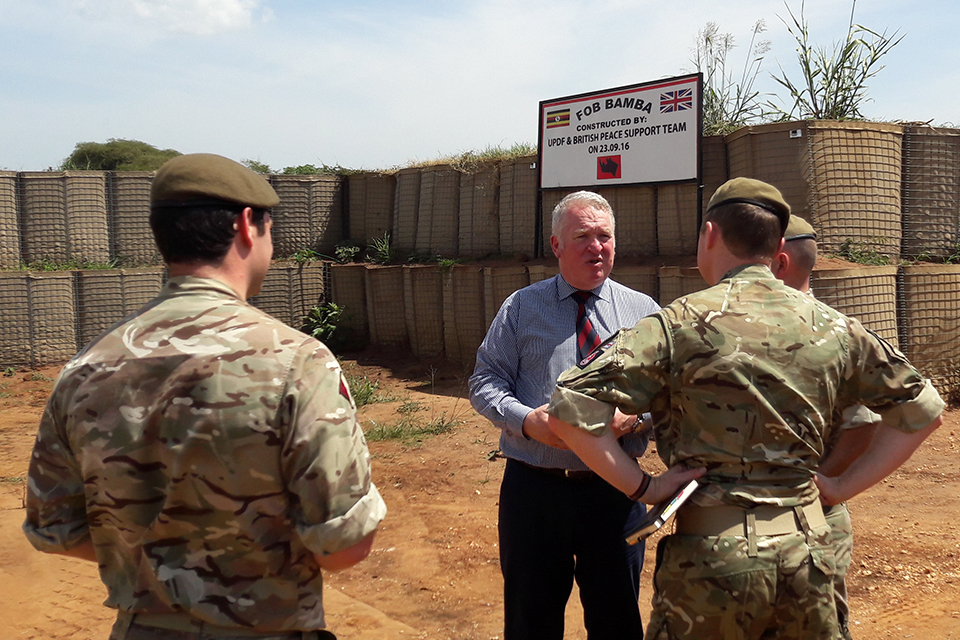
In Uganda, Armed Forces Minister Mike Penning met UK troops supporting pre-deployment training for the African Union Mission in Somalia. Crown Copyright.

Throughout the visit the Armed Forces Minister met with Government ministers and UN representatives to help deepen Defence relationships, and discuss shared interests and regional challenges.

In Somalia, The Minister met President Mohamed Abdullahi Mohamed Farmajo, Prime Minister Hassan Ali Khayre, National Security Minister Mohamed Abukar Islow, and Mr Penning became the first international Minister to meet Somalia’s new Defence Minister Abdirashid Abdullahi Mohamed. He also spoke with UN Special Representative Michael Keating.

After leaving Bentiu and Malakal, the Minister travelled to Juba and met Defence Minister Kuol Manyang Juuk, UN Special Representative David Shearer, and Commanding Officer of the UK engineers in South Sudan Lt Col Jason Ainley.

Uganda and Kenya provide important contributions to AMISOM, and in both countries Mr Penning saw UK delivered pre-deployment training.

In Uganda, the Minister saw Ugandan troops receiving training at the Peace Operations Training Centre, Singo, before meeting Defence Minister Adolf Mwesige in Kampala.

Finally, in Nairobi, the Minister met personnel from the British Army Training Unit Kenya, which trains thousands of UK troops every year.

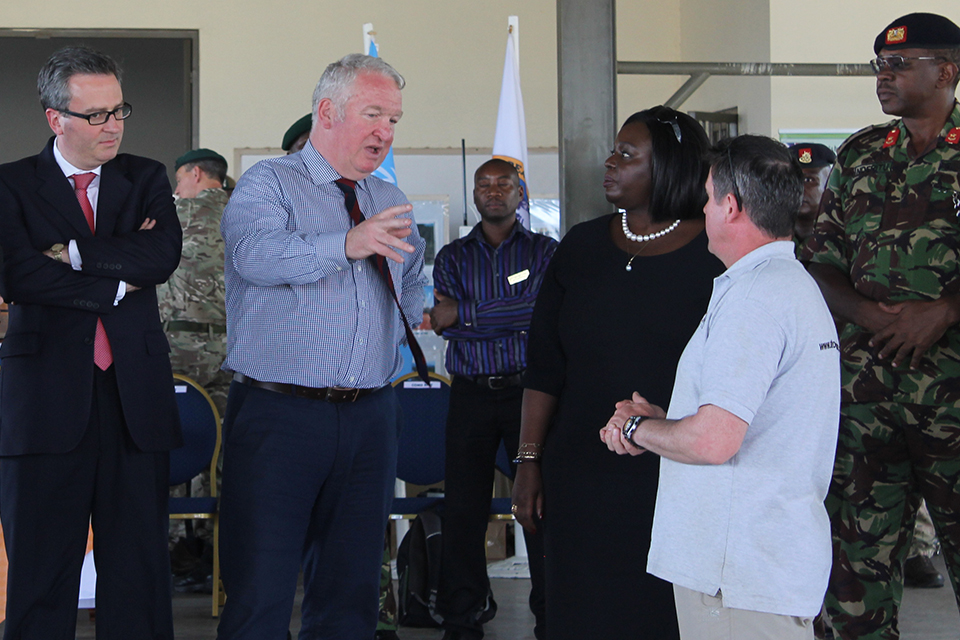
Mr Penning also visited the Humanitarian Peace Support School and British Peace Support Team Eastern Africa, which deliver AMISOM pre-deployment and other training to international military personnel, before meeting Kenyan Defence Minister Raychelle Omamo.

Armed Forces Minister Mike Penning's visit included Kenya, where he met Kenyan Defence Minister Raychelle Omamo. Crown Copyright.
Armed Forces Minister Mike Penning’s visit included Kenya, where he met Kenyan Defence Minister Raychelle Omamo. Crown Copyright.


News story: Armed Forces Minister underlines UK commitment to Africa

From engineering support to the UN in South Sudan, to helping counter the threat from terror in Somalia, the Minister was able to see the breadth of the UK’s role in Africa.

In Mogadishu, Mr Penning met British troops working with the African Union Mission in Somalia (AMISOM), which is building stability, and tackling the threat posed by Al-Shabaab.

Following travel to Bentiu and Malakal, the Minister was greeted by UK military personnel providing support to the UN Mission in South Sudan, which is working to achieve stability in the East African nation. Up to 400 personnel will deploy this year – making it one of the UK’s largest operational deployments in the world – enabling the building of a field hospital to support UN peacekeepers.

As the visit moved to Uganda and Kenya, Mr Penning watched pre-deployment training of their military personnel, many of who go on to serve in AMISOM.

Minister of State for the Armed Forces Mike Penning said:

It has been a privilege to see our Armed Forces operating across multiple countries, in different environments, in support of our African partners. The training and support provided by our dedicated men and women clearly demonstrates that Britain has genuinely global reach. This is no less so in South Sudan where we are playing a major role in the international peacekeeping effort, meeting the commitment made by the Prime Minister last year to double our support to the United Nations.

In Uganda, Armed Forces Minister Mike Penning met UK troops supporting pre-deployment training for the African Union Mission in Somalia. Crown Copyright.

Throughout the visit the Armed Forces Minister met with Government ministers and UN representatives to help deepen Defence relationships, and discuss shared interests and regional challenges.

In Somalia, The Minister met President Mohamed Abdullahi Mohamed Farmajo, Prime Minister Hassan Ali Khayre, National Security Minister Mohamed Abukar Islow, and Mr Penning became the first international Minister to meet Somalia’s new Defence Minister Abdirashid Abdullahi Mohamed. He also spoke with UN Special Representative Michael Keating.

After leaving Bentiu and Malakal, the Minister travelled to Juba and met Defence Minister Kuol Manyang Juuk, UN Special Representative David Shearer, and Commanding Officer of the UK engineers in South Sudan Lt Col Jason Ainley.

Uganda and Kenya provide important contributions to AMISOM, and in both countries Mr Penning saw UK delivered pre-deployment training.

In Uganda, the Minister saw Ugandan troops receiving training at the Peace Operations Training Centre, Singo, before meeting Defence Minister Adolf Mwesige in Kampala.

Finally, in Nairobi, the Minister met personnel from the British Army Training Unit Kenya, which trains thousands of UK troops every year.

Mr Penning also visited the Humanitarian Peace Support School and British Peace Support Team Eastern Africa, which deliver AMISOM pre-deployment and other training to international military personnel, before meeting Kenyan Defence Minister Raychelle Omamo.

Armed Forces Minister Mike Penning’s visit included Kenya, where he met Kenyan Defence Minister Raychelle Omamo. Crown Copyright.