Press release: £50 million for satellite solutions to help developing countries

The Agency’s International Partnerships Programme (IPP) is a five-year, £152 million programme, designed to partner UK space expertise with overseas governments and organisations. It is part of the Global Challenges Research Fund (GCRF), which aims to support cutting-edge research and innovation that addresses the challenges faced by developing countries.

More than £70 million in funding has already been given to projects in partnership with the UK space industry, applying inventive satellite solutions to a range of areas such as deforestation, illegal fishing, marine pollution, disaster recovery, drought and flooding. The latest tranche of funding will focus on issues around health and education.

This file may not be suitable for users of assistive technology. Request an accessible format.

If you use assistive technology (such as a screen reader) and need a version of this document in a more accessible format, please email info@ukspaceagency.bis.gsi.gov.uk. Please tell us what format you need. It will help us if you say what assistive technology you use.

Universities and Science Minister Jo Johnson said:

“The UK space sector is thriving with innovative developments and technologies that can be used to solve some of the most pressing global challenges of our time.

“The International Partnerships Programme has already harnessed Britain’s world-leading expertise in analysing satellite data to make a real difference to a number of countries. The latest round of funding is exactly the sort of project our Industrial Strategy is looking to support – boosting the UK space sector and delivering benefits to millions around the world.”

Call 2 for funding opens today (11 April 2017) and will close on 5 September 2017. The assessment is due to take place in October 2017 and successful projects will begin by the end of the year.

During the first round of funding, announced in January 2017, 20 projects were selected to provide solutions for local issues in countries across Africa, Asia and Central and South America. All of the projects will have a sustainable impact in the country they are working with, which is a vital element of IPP.

The programme’s current projects include providing communications in remote areas for education in Tanzania, improving maritime safety for small fishing vessels in South Africa and Madagascar and reducing illegal logging in Guatemala.

Projects funded in Call 1 included:

  1. Forests 2020: A £23.8 million project led by Ecometrica UK in conjunction with a large consortium of national and international partners to protect and restore forests across the globe.

The Forests 2020 project aims to help protect and restore up to 300 million hectares of tropical forests by improving national forest monitoring systems for the use of governments, universities and Non-Governmental Organisations (NGOs) in the 6 partner countries: Brazil, Colombia, Mexico, Ghana, Kenya and Indonesia. By using freely available Earth Observation data to address critical gaps in current systems, Forests 2020 will improve partners’ capacity to:

  • measure forest change
  • provide information on the risks and drivers of forest loss (such as forest fires)
  • map suitable areas for restoration

It will also build in-country capacity for the international partners by improving digital infrastructure to manage forest data more effectively and establishing a network of Earth Observation Labs.

  1. Satellite connectivity for Nigerian healthcare: A £6.1 million project between Inmarsat UK, InStat and the end customer, Nigerian Federal Ministry of Health, to extend health services to remote populations using satellite communications.

This project addresses a key development need for Nigeria by extending the reach of basic medical services into remote areas of the country (84 clinics in 3 states) using a satellite-based system. This will deliver professional training, data collection and disease monitoring in areas which are inaccessible by conventional methods.

It aims to reduce the mortality rate in rural Nigeria by providing access to better health information and training for health workers by:

  • providing video-based training to health workers to an agreed government standard
  • improving health systems management and governance using an information system application
  • improving disease surveillance capabilities


KEZ CALLS ON RUTH DAVIDSON TO END ‘RAPE CLAUSE’ SILENCE

11 April 2017

Below is Kezia Dugdale's Daily Record column calling on Ruth Davidson to end her shameful silence on the Tories' disgusting 'rape clause':

“SHE is different to other Tories”.

It’s a familiar refrain when people talk about Scottish Conservative leader Ruth Davidson.

But if that really is the case, why hasn’t Ruth spoken out against the disgusting ‘rape clause’ her Westminster colleagues have introduced to the tax credit system?

In a barbaric move that should shame and anger the Scottish Tory leader and every single Conservative MSP, victims of rape now must fill out an eight page form if they have a child conceived through such a sexual assault.

It’s a policy that would have caused anger and astonishment if Margaret Thatcher had introduced it in the 1980s. But here in 2017, in an era when the fight for women’s rights has made real strides, we have a female Prime Minister content to press ahead with a horrifically cruel and uncaring policy.

Months have passed since SNP MP Alison Thewliss first stunned us all by uncovering the details of the ‘rape clause’.

As part of plans to restrict tax credits to families of just two children, the UK Government decided to force women to provide evidence of exceptional circumstances, such as rape, to claim the social security payment for a third child.

So now women who have been raped – possibly by their husbands – but who have perhaps not reported it to the police will have to sign a document saying their child is the product of rape.

Alison has led a powerful campaign against the heartless Tory government on this crucial issue, and has secured cross-party support. I have nothing but praise for her tireless campaigning, and she has and will continue to receive the support of Labour MSPs and MPs in the hope of forcing the Tories into a U-turn.

For Ruth Davidson has been silent on this issue. So today I make a direct plea to her: stand up for rape victims and tell Theresa May she is wrong.

You normally have the sharpest elbows when it comes to getting noticed, so don’t remain silent when it comes to standing up to your own party.

Readers of this newspaper know just how keen the Tories are to attack our cherished welfare state.

The Daily Record has exposed time and again just how distressing the Conservative government’s social security cuts can be.

The way to ensure that people’s reliance on social security reduces is not to penalise the poorest but to ensure that work pays and living standards rise.

Labour is committed to rebalancing the UK’s economy so that no one and no community is left behind, which is why Jeremy Corbyn has announced plans for a £10-an-hour minimum wage, which would benefit 430,000 workers in Scotland alone.

And we must also ensure that everyone claims the social security payments they are entitled to – with over £2 billion presently going unclaimed in Scotland.

The Vow delivered huge new powers for the Scottish Parliament, and an opportunity to radically reshape our country to be a fairer nation, and it’s time to see real action on this.


News story: DPRTE 2017: the best and busiest yet for DIT DSO

The 2017 Defence Procurement, Research, Technology and Exportability (DPRTE) conference and exhibition, took place at the Motorpoint Arena, Cardiff on 28 March.

Department for International Trade Defence and Security Organisation (DIT DSO) is a main partner in this highly successful annual event.

This event gave DIT DSO an excellent opportunity to showcase government engagement with UK industry, in support of winning overseas defence and security business.

DIT DSO offered advice, information and support from their business growth and exportability knowledge transfer zone, and more hands on support from the adjacent exhibition stand.

The themed presentations, which attracted over 230 delegates throughout the day, focused on export support aimed at:

  • UK SMEs
  • regional marketing advice
  • military support
  • the Defence Growth Partnership initiative
  • media engagement and
  • export licensing regulations

The DIT DSO exhibition stand, staffed by members of the DIT DSO Small Business Unit, Events Team and Military Export Support Team, received a constant stream of enquiries from UK companies. Many of which were considering military and security markets as an outlet for overseas trade for the first time.

Post event engagement with these companies has been significant and DPRTE remains a priority occasion for us to promote our support and services for the benefit of UK compaies.


News story: Royal Marines to be restructured in line with growing Royal Navy

With billions being invested into a growing Royal Navy, the Royal Marines have decided to restructure to better balance skills across the force.

The move comes as part of the Navy’s regular review of its structure to ensure that it suits the operational demands of the 21st century, and is appropriately balanced for the future with 400 more personnel, more ships, new aircraft carriers and submarines entering front line service.

Around half of the 200 roles being repurposed are backroom function roles, like drivers and administrative staff. Freeing these up to be carried out by Reservists and civilians will enable skills to be used more appropriately across the Navy.

The other half of the restructure comes as part of plans developed by 3 Commando Brigade, who are responsible for the deployment of the Marines, who decided it would be beneficial to the Corps to make 42 Commando a specialised Maritime Operations unit.

A Royal Marines Commando performs roles ranging from maritime operations like countering piracy and protecting our trade routes across the globe, to land-based operations like warfighting and peace-keeping. Under this re-balancing, 42 Commando will become the specialised, go-to unit for maritime operations – meaning some of their posts, like heavy weapons specialists, can be reallocated across the Navy.

No Royal Marines will be made redundant as a result of today’s news – when those in the roles which have been identified for repurposing leave, their position will simply transfer to a different area of the Navy.

The First Sea Lord, Admiral Sir Philip Jones, said:

As someone who has worked with Royal Marines at every stage of my career, most notably when commanding the Amphibious Task Group from RM Stonehouse, I know how vital their role is as the UK’s premier high readiness contingency force. However, as First Sea Lord, I also know we must adapt to meet the challenges of a dangerous and uncertain world.

The Government is investing in a new generation of ships, submarines and aircraft. As we introduce these capabilities into Service, we must ensure we have the right mix of skills across each of the Navy’s Fighting Arms to optimise how we use them, and the Commandant General and I have sought to find the right balance between sailors and marines in responding to this challenge.

The Royal Marines remain bound in to every part of the Royal Navy’s future, from conducting sophisticated operations from the sea, at a variety of scales and against a range of threats, using our new aircraft carriers as a base, to leading the Service’s development of information warfare. They will continue to be as vital to the Defence of the Realm in the years ahead as they have been for the past 350.

Commandant General Royal Marines, Major Robert Magowan, said:

As Royal Marines, we pride ourselves in being the first to understand, the first to adapt and the first to overcome. So as we confront a changing and unstable security environment, we are defining an exciting future for our Corps, which will ensure that we remain as relevant tomorrow as we do today.

With a £178 billion equipment plan backed by a rising defence budget, this year sees the first of two giant 65,000-tonne Queen Elizabeth Class Aircraft Carriers arrive in Portsmouth, the first of the Navy’s five next generation patrol ships begin her sea trials and the fourth Astute Class submarine enter the water.

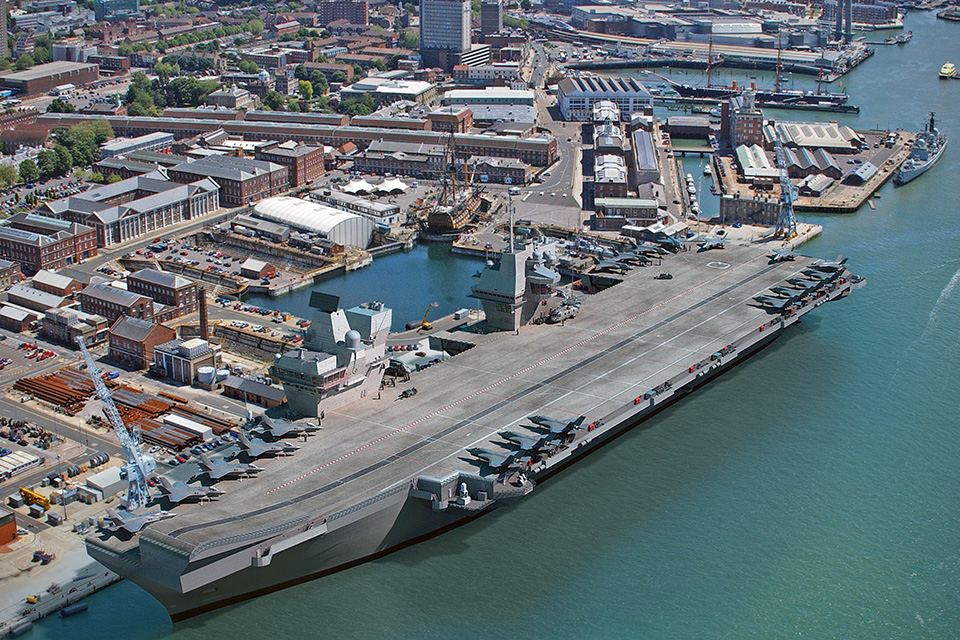
A computer generated image (CGI) of one of the two new Royal Navy aircraft carriers. Crown Copyright.


News story: Royal Marines to be restructured in line with growing Royal Navy

With billions being invested into a growing Royal Navy, the Royal Marines have decided to restructure to better balance skills across the force.

The move comes as part of the Navy’s regular review of its structure to ensure that it suits the operational demands of the 21st century, and is appropriately balanced for the future with 400 more personnel, more ships, new aircraft carriers and submarines entering front line service.

Around half of the 200 roles being repurposed are backroom function roles, like drivers and administrative staff. Freeing these up to be carried out by Reservists and civilians will enable skills to be used more appropriately across the Navy.

The other half of the restructure comes as part of plans developed by 3 Commando Brigade, who are responsible for the deployment of the Marines, who decided it would be beneficial to the Corps to make 42 Commando a specialised Maritime Operations unit.

A Royal Marines Commando performs roles ranging from maritime operations like countering piracy and protecting our trade routes across the globe, to land-based operations like warfighting and peace-keeping. Under this re-balancing, 42 Commando will become the specialised, go-to unit for maritime operations – meaning some of their posts, like heavy weapons specialists, can be reallocated across the Navy.

No Royal Marines will be made redundant as a result of today’s news – when those in the roles which have been identified for repurposing leave, their position will simply transfer to a different area of the Navy.

The First Sea Lord, Admiral Sir Philip Jones, said:

As someone who has worked with Royal Marines at every stage of my career, most notably when commanding the Amphibious Task Group from RM Stonehouse, I know how vital their role is as the UK’s premier high readiness contingency force. However, as First Sea Lord, I also know we must adapt to meet the challenges of a dangerous and uncertain world.

The Government is investing in a new generation of ships, submarines and aircraft. As we introduce these capabilities into Service, we must ensure we have the right mix of skills across each of the Navy’s Fighting Arms to optimise how we use them, and the Commandant General and I have sought to find the right balance between sailors and marines in responding to this challenge.

The Royal Marines remain bound in to every part of the Royal Navy’s future, from conducting sophisticated operations from the sea, at a variety of scales and against a range of threats, using our new aircraft carriers as a base, to leading the Service’s development of information warfare. They will continue to be as vital to the Defence of the Realm in the years ahead as they have been for the past 350.

Commandant General Royal Marines, Major Robert Magowan, said:

As Royal Marines, we pride ourselves in being the first to understand, the first to adapt and the first to overcome. So as we confront a changing and unstable security environment, we are defining an exciting future for our Corps, which will ensure that we remain as relevant tomorrow as we do today.

With a £178 billion equipment plan backed by a rising defence budget, this year sees the first of two giant 65,000-tonne Queen Elizabeth Class Aircraft Carriers arrive in Portsmouth, the first of the Navy’s five next generation patrol ships begin her sea trials and the fourth Astute Class submarine enter the water.

A computer generated image (CGI) of one of the two new Royal Navy aircraft carriers. Crown Copyright.