News story: Changes to UK anti-money laundering measures

On 26 June 2017 changes will be made to UK anti-money laundering measures to help prevent money laundering and terrorist financing. It’ll increase the transparency of who owns and controls companies in the UK. This legislation will make changes to current requirements about people with significant control (PSC) information.

Impact on companies

From 26 June PSC won’t be updated on the confirmation statement (CS01). Instead, you’ll need to tell us on forms PSC01 to PSC09 whenever there’s a change. You’ll have 14 days to update your register and another 14 days to send the information to us.

Changes to exemptions

DTR5 companies are exempt from requirements to hold information about their PSC. From 26 June these exemptions will change, and you may need to provide PSC information. If your company’s traded on an EEA or Schedule 1 specified market, it’s still exempt. If your company isn’t exempt, you’ll need to send PSC information to us when changes take place.

Impact on different types of corporate bodies

Scottish Limited Partnerships (SLP)

From 24 July, active SLPs must register PSC information with us. You must tell us about the changes within 14 days. Every year, you must confirm the details are correct. From 24 July, you need to give PSC information when registering a new SLP.

General Scottish Partnerships (SP)

From 24 July, any SPs where all the partners are corporate bodies, need to register PSC information with us. You must tell us of changes within 14 days and confirm this information every year on a confirmation statement.

Protection regime

There will be changes to the protection regime. When SPs and SLPs provide us with PSC information, the protection regime becomes available to them. You can apply for a restriction so your information isn’t disclosed on the public register. Only specified public authorities can access this information at the moment for company types in scope of PSC requirements. The new anti-money laundering legislation extends this to credit and financial institutions, as these carry out customer due diligence. Where appropriate, we’ll make protected PSC information available to them.


If Theresa May is so proud of her record, why won’t she debate it? – Jeremy Corbyn

Jeremy Corbyn MP, Leader of the
Labour Party
,
commenting on the news ITV are to host a pre-election debate, said:

“I welcome ITV’s decision to
attempt to hold a TV debate with the Prime Minister. If Theresa May is so proud
of her record, why won’t she debate it?

“She cannot be allowed to run away
from her duty to democracy and refuse to let the British people hear the
arguments directly.”


Press release: UK Space Agency and CNES join forces to curb climate change

The Agency’s Director of Growth, Catherine Mealing-Jones, and CNES President, Jean-Yves Le Gall, signed the MicroCarb cooperation agreement this morning (19th April) at the French Ambassador’s Residence in London, witnessed by Jo Johnson, the Minister of State for Universities, Science, Research and Innovation, and France’s Ambassador to the UK, Sylvie Bermann.

MicroCarb is a satellite mission which will measure sources and sinks of carbon, the principal greenhouse gas driving global warming. It is the first European mission intended to characterise greenhouse gas fluxes on Earth’s surface and gauge how much carbon is being absorbed by oceans and forests, the main sinks on the planet.

Credit: French Embassy Press Office.

The mission, scheduled to launch in 2020, will also contribute to international efforts to measure how much carbon gas is being emitted by natural processes and human activities. MicroCarb will enable the UK Space Agency and CNES to pave the way for a longer term operational system in response to the Paris Agreement.

The UK space sector is already thriving, employing more than 38,000 people all over the country and supporting over £250 billion of output across the wider economy. With its £10 million investment, the UK will provide key components and services for the MicroCarb satellite, securing and growing vital capability in understanding climate change. The University of Leicester and University of Edinburgh will also represent the UK on the joint science team.

Universities and Science Minister, Jo Johnson, said:

“UK collaboration with France on MicroCarb provides an excellent platform to demonstrate cutting-edge British science, our commitment to climate policy, and a productive relationship with a key European partner.

“The UK space sector is alive with talent and opportunity and through our modern Industrial Strategy we are ensuring the UK remains a vital contributor to international space research.”

CNES President, Jean-Yves Le Gall, added:

“CNES is working with the UK Space Agency to curb climate change, and MicroCarb is a fine example of spacefaring Europe’s commitment to this global effort and a further illustration of our ability to ‘invent the future of space’.”


News story: £1.4 billion deal for Royal Navy’s new attack submarine

The submarine, named Agamemnon, is part of the Astute Class, the largest, most advanced and most powerful attack submarines ever to enter service with the Royal Navy. The submarines are being built by BAE Systems in Barrow-in-Furness, Cumbria, which employs around 8,000 people in its Submarines business, with thousands more working in the UK submarine supply chain.

The new contract guarantees a better deal for the UK taxpayer and for the Armed Forces, with an incentivised contract arrangement that will help to save money and demands the best possible work from industry.

Defence Secretary Sir Michael Fallon said:

This latest investment means we are well on our way to completing our fleet of Astute submarines. These are the most advanced submarines ever operated by the Royal Navy and are already providing unprecedented levels of stealth and attack capability across the world.

Backed by a rising defence budget and a £178 billion equipment plan, Barrow will remain the hub of our submarine build programmes providing high skilled jobs for years to come.

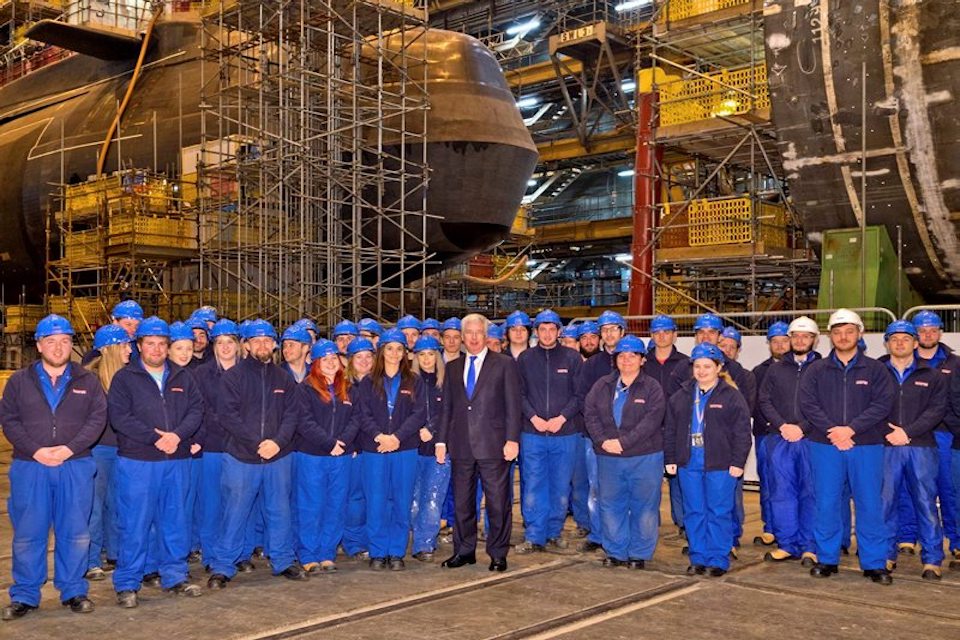
Defence Secretary Sir Michael Fallon with BAE Systems apprentices inside Devonshire Dock Hall where HMS Agamemnon is under construction.
Defence Secretary Sir Michael Fallon with BAE Systems apprentices inside Devonshire Dock Hall where HMS Agamemnon is under construction. Picture: Michael Vallance, BAE Systems.

Construction of the 7,400 tonne, 97-metre long Agamemnon began in 2012, and is well underway in the Devonshire Dock Hall at Barrow, alongside Boat 5 – Anson – and the yet-to-be-named Boat 7. Their sister submarines, HMS Astute, Ambush and Artful are already in service with the Royal Navy, contributing to operations around the globe.

Rear Admiral Paul Methven, Director Submarines Acquisition for the Submarine Delivery Agency, said:

The signature of this contract secures another world-class nuclear submarine for the Royal Navy. These are the most technologically advanced submarines we have ever operated, offering much greater firepower, better communications and more advanced stealth technology than their predecessors.  

Today marks another significant milestone for the Astute programme, that demonstrates the UK’s ability to deliver complex engineering projects, providing a fleet of submarines which will protect the UK’s interests around the globe.

Featuring the latest nuclear-powered technology, the Astute Class submarines can circumnavigate the world submerged, manufacturing the crew’s oxygen from seawater as they go. They also have the ability to operate covertly and remain undetected in almost all circumstances despite being 50 per cent bigger than the Royal Navy’s current Trafalgar Class submarines which are being replaced by the Astute Class.

Will Blamey, Managing Director of BAE Systems Submarines, said:

Securing the contract for the sixth Astute class submarine is a significant milestone for BAE Systems and the result of many years of hard work by our highly skilled workforce. The Astute class submarines are amongst the most highly capable and technologically advanced in the world and we’re immensely proud to build them for the Royal Navy.

Alongside work on the Astute Class, BAE Systems is also the industrial lead for the Dreadnought programme, the Royal Navy’s next generation of nuclear deterrent submarines.


News story: £1.4 billion deal for Royal Navy’s new attack submarine

The submarine, named Agamemnon, is part of the Astute Class, the largest, most advanced and most powerful attack submarines ever to enter service with the Royal Navy. The submarines are being built by BAE Systems in Barrow-in-Furness, Cumbria, which employs around 8,000 people in its Submarines business, with thousands more working in the UK submarine supply chain.

The new contract guarantees a better deal for the UK taxpayer and for the Armed Forces, with an incentivised contract arrangement that will help to save money and demands the best possible work from industry.

Defence Secretary Sir Michael Fallon said:

This latest investment means we are well on our way to completing our fleet of Astute submarines. These are the most advanced submarines ever operated by the Royal Navy and are already providing unprecedented levels of stealth and attack capability across the world.

Backed by a rising defence budget and a £178 billion equipment plan, Barrow will remain the hub of our submarine build programmes providing high skilled jobs for years to come.

Defence Secretary Sir Michael Fallon with BAE Systems apprentices inside Devonshire Dock Hall where HMS Agamemnon is under construction. Picture: Michael Vallance, BAE Systems.

Construction of the 7,400 tonne, 97-metre long Agamemnon began in 2012, and is well underway in the Devonshire Dock Hall at Barrow, alongside Boat 5 – Anson – and the yet-to-be-named Boat 7. Their sister submarines, HMS Astute, Ambush and Artful are already in service with the Royal Navy, contributing to operations around the globe.

Rear Admiral Paul Methven, Director Submarines Acquisition for the Submarine Delivery Agency, said:

The signature of this contract secures another world-class nuclear submarine for the Royal Navy. These are the most technologically advanced submarines we have ever operated, offering much greater firepower, better communications and more advanced stealth technology than their predecessors.  

Today marks another significant milestone for the Astute programme, that demonstrates the UK’s ability to deliver complex engineering projects, providing a fleet of submarines which will protect the UK’s interests around the globe.

Featuring the latest nuclear-powered technology, the Astute Class submarines can circumnavigate the world submerged, manufacturing the crew’s oxygen from seawater as they go. They also have the ability to operate covertly and remain undetected in almost all circumstances despite being 50 per cent bigger than the Royal Navy’s current Trafalgar Class submarines which are being replaced by the Astute Class.

Will Blamey, Managing Director of BAE Systems Submarines, said:

Securing the contract for the sixth Astute class submarine is a significant milestone for BAE Systems and the result of many years of hard work by our highly skilled workforce. The Astute class submarines are amongst the most highly capable and technologically advanced in the world and we’re immensely proud to build them for the Royal Navy.

Alongside work on the Astute Class, BAE Systems is also the industrial lead for the Dreadnought programme, the Royal Navy’s next generation of nuclear deterrent submarines.