New figures show the number of young people not in education, employment or training in Wales fell during 2016

Figures published today [27/04/17] from the Annual Population Survey (APS) show that in the twelve months ending 31 December 2016, 8.5% of 16-18 year olds were estimated to be NEET compared with 9.6% at the end of 2015. This represents 9,100 young people compared with 10,200.

During the same period ending 31 December 2016, 17.1% of 19-24 year olds (42,000 people) were estimated to be NEET, against 18.6% (46,600) at the year ending 31 December 2015.

The figures also include data recently published by Careers Wales which shows the number of Year 11 leavers from schools in Wales known to be NEET also decreased between 2015 and 2016 and now stands at 2.0% (619) compared to 2.8% (911) in 2015.  

Welcoming the results the Minister said: 

“Reducing the number of young people not in employment, education or training is a key priority for this government and we are committed to ensuring our policies and programmes continue to support young peoples’ educational and employment needs.

“For example, our Youth Engagement and Progression Framework  supports local authorities and other organisations to put systems in place to reduce the number of 16-18 year old NEET young people in Wales and today’s report shows we are producing good results.”

A number of Welsh Government schemes help young people into work, such as Jobs Growth Wales. Supported by the European Structural Fund, Jobs Growth Wales provides unemployed young people aged 16-24 with a job opportunity for six months. 

Since launching in 2012, almost 15,000 job vacancies were filled through scheme 1 of the programme, with a further 2,365 filled under scheme 2 by March 2017.

The Minister added: 

“While we are always looking at ways to improve our approaches to ensure they remain responsive to changing needs, these figures clearly show our focus on supporting young people into training or further education and into work are proving effective and we are delivering for Wales.”


Green Party agrees electoral alliance with Women’s Equality Party

27 April 2017

The Green Party has agreed an electoral alliance with the Women’s Equality Party in the Yorkshire seat of Shipley, in a bid to unseat the sitting Conservative MP, Philip Davies.

The Women’s Equality Party has agreed not to stand in five seats being contested by the Greens: Brighton Pavilion, Bristol West, Bath, Isle of Wight and Sheffield. In all these the Green Party is fielding a female candidate.

In return, local Green Party members have voted not to field a candidate in Shipley, where the Women’s Equality Party leader Sophie Walker is standing as a candidate in a bid to oust Mr Davies.

Caroline Lucas MP, Green Party co-leader, said:

“I’m delighted to endorse Sophie in Shipley. Under the Conservative government – the one Mr Davies has supported – we have seen the biggest rise in inequality since Margaret Thatcher was Prime Minister. Sophie and I are both committed to tackling that – from reversing the cuts that have left women behind and ending the gender pay gap, to increasing women’s representation in parliament and in business. Sophie has pledged to stand on an agenda that many Green Party members and supporters will agree with and I look forward to her playing an active role in my campaigns to undo the privatisation of our NHS and for a fairer voter system.”

Bradford Green Party is calling on the local Liberal Democrats and Labour to follow its bold lead and unite behind Sophie Walker as the single progressive candidate. The local party’s move has been applauded by the party nationally.

Lucas said:

“This was far-sighted and bold decision by our local members. On election day we’ll be urging people to vote for us because ours is the only policy platform which offers the bold changes so desperately needed to transform this country for the better. But to beat the Tories we need to be realistic about what’s needed to form a progressive Government. That’s why, in just a handful of places, our members will be taking brave decisions for the common good, as they have in Shipley.

“With an electoral system that benefits the Tories and locks out progressives, it’s easy to imagine that predictions of the Conservatives winning the General Election, and winning big, will prove accurate, and that there’s nothing we can do to change things. That isn’t true and an agreement reached between the Green Party and the Women’s Equality Party, together with other agreements being discussed locally, is a first step towards rewriting the future and fixing our failed politics. This could prove to be an historic moment and one that changes not just the course of this election but every future election too.”

Sophie Walker, Women’s Equality Party leader, said:

“I am glad to endorse Caroline Lucas for Brighton Pavilion. The Women’s Equality Party and the Greens share a desire to build a caring, tolerant and sustainable country that values women and works to create equal opportunities for all. Caroline’s commitment to challenging the Government on its austerity agenda, which has affected women disproportionately, to ending the gender pay gap and to ensuring equal representation of women across political and working life means many of our members and supporters in Brighton will, like me, get behind her campaign for re-election.”

The Green Party has renewed its call for the Liberal Democrat and Labour leaderships to sit down for talks about how to make the movement for electoral alliances work.

The Green Party’s five leading candidates are: Caroline Lucas, Brighton Pavilion; Molly Scott Cato, Bristol West; Natalie Bennett, Sheffield Central; Vix Lowthion, Isle of Wight and Eleanor Field, Bath.

Sarah Cope, the Green Party’s Women’s Spokesperson, said:

“The Green Party has long been feminist party, with policies including improved maternity services, quotas for women on boards and abortion rights, to name just three. Our women’s sub-group, Green Party Women, established almost a decade ago, has backed campaigns and worked wth organisations to advance women’s equality in the UK.

“In working with the Women’s Equality Party, we are leading the way in showcasing a progressive, cooperative form of politics. Even where we may have policy differences, we can find shared ground and work for the common good.”

Matt Edwards, Bradford District Green Party campaign coordinator, said:

“We have been convinced that Sophie is a candidate that the other progressive parties in Shipley should unite behind. People have been crying out for a new kind of politics where the left leaning parties work together to achieve their common goals, rather than attack each other over their differences.”

Back to main news page

Let’s block ads! (Why?)


News story: Track worker near miss incident, Ascot

Two track workers narrowly avoided being struck by a train, Ascot, Berkshire, 7 April 2017.

At around 01:30 hrs on 7 April, two track workers narrowly avoided being struck by a train at Ascot station. They climbed out of the way, onto platform 1, with little time to spare. Equipment they had placed on the track was struck, causing minor damage to the train.

We have undertaken a preliminary examination into the circumstances surrounding this incident. Having assessed the evidence which has been gathered to date, we have decided to publish a safety digest.

The safety digest will shortly be made available on our website.


Controls now lifted at Arden Lakes for Spring Viraemia of Carp (SVC)

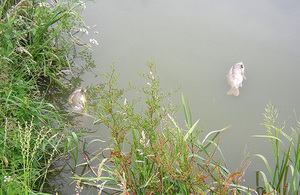
A fish mortality event

An outbreak of the SVC disease was confirmed at Arden Lakes, Stratford-Upon-Avon, Warwickshire in 2017. Fish Health Inspectorate at Cefas, acting on behalf of Defra and Welsh Government, have lifted the Confirmed Designation with immediate effect and that the conditions of this notice no longer apply to this site following the completion of the statutory surveillance and sampling programme at Arden Lakes which were negative for the presence of Spring Viraemia of Carp (SVC).

SVC has no implications for human health. It is nonetheless, a serious viral disease of fish, and is notifiable in the United Kingdom.

Anyone who suspects a notifiable disease in any aquatic animal should immediately contact the FHI.

  1. Cefas is an executive agency of the Department for Environment, Food and Rural Affairs (Defra). The Fish Health Inspectorate (FHI), based at Cefas’ Weymouth laboratory, is dedicated to maintaining and improving fish and shellfish health in England and Wales. Its primary role is to act for Defra and Welsh Government (WG) in undertaking statutory and inspection duties resulting from the EU fish health regime and other national legislation in the area of fish and shellfish health. The FHI is responsible for health certification of fish and shellfish movements from other countries, and runs an enforcement programme aimed at preventing the illegal importation of these animals.

  2. Spring Viraemia of Carp (SVC) is a notifiable disease under The Aquatic Animal Health (England and Wales) Regulations 2009. Outbreaks of this disease have been subject to statutory control in GB for over 30 years.

Published 27 April 2017
Last updated 6 February 2020 + show all updates

  1. Fish Health Inspectorate at Cefas, acting on behalf of Defra and Welsh Government, have lifted Confirmed Designation (CD) CD02/2017 with immediate effect and that the conditions of this notice no longer apply to this site following the completion of the statutory surveillance and sampling programme at Arden Lakes which were negative for the presence of Spring Viraemia of Carp (SVC). As a result this page has been updated to reflect this.

  2. Changed title of CP01/2017 to CP02/2017

  3. First published.


News story: Accelerator innovation network event: autonomous last mile resupply

The Defence and Security Accelerator is holding an event in London on 23 May 2017 to provide information on the autonomous last mile resupply themed competition.

Suppliers attending the event will be able to hear presentations about the autonomous last mile resupply themed competition which seeks to develop and demonstrate the use of autonomous systems to deliver mission-critical supplies, focusing on the challenging ‘last mile’ resupply in the land environment.

If you cannot attend the event, sign up for our webinar which will take place on 30 May 2017.

The competition is seeking new technologies, processes and ways of working to improve the way we deliver mission-critical supplies, focusing on the challenging ‘last mile’ resupply in the land environment.

It involves delivering combat supplies from the forward-most location to personnel engaged in combat operations. Although relatively small in distance, these resupply activities are challenging as they are in an environment that is typically hostile, complex and contested. These activities need to quickly and efficiently deliver vital supplies in order to enable successful mission outcomes.

The challenges of this Accelerator competition are to develop and demonstrate:

  • Challenge 1: unmanned air and ground load carrying platforms
  • Challenge 2: technologies and systems to allow load carrying platforms to operate autonomously
  • Challenge 3: technologies to autonomously predict, plan, track and optimise resupply demands from military users

Up to £3 million is available in total across phase 1 and 2 of this themed competition.