News story: Our Economists talking about the exciting opportunities in the Government Economic Service

For a flavour of what you can do as an government economist , check out these great mini career stories here:

I’m currently in my first role at the Department for Transport working on rail demand forecasting. This is a technical post which requires using excel and specialist rail software and I have attended training courses to help develop my skills. What I like about the job is the constant learning and development opportunities and that every day presents unique challenges. The thing I enjoy most about my career in the GES is that I am given a lot of responsibility in my job and my colleagues always take my opinion into account. I also get the opportunity to help out others with their work, getting exposure to different areas that are outside my remit. I will be rotating in October and my aim is to move department so that I can gain more experience of different working environments and policy areas. In the long term I am interested in the opportunity to take a year out and study for a Masters, and also doing a secondment at a consultancy firm.

Christopher Page

What attracted you to the GES?

In my final year of university, I still wasn’t sure what I wanted to do as a career. Despite a brief belief that I, like my peers, wanted to be an investment banker, I realised I wanted to do something that served the wider British public rather than the shareholders of a company. My tutor pointed me in the direction of the GES Fast Stream, the Bank of England, think tanks, and charities. I did research into the various sectors and decided that the GES Fast Stream was my preferred choice. It offered me the opportunity to apply everything I learned in my economics degree to everyday policy problems/solutions. I was impressed by the variety of work that was on offer, the emphasis put on development, and the level of responsibility that Fast Streamers were given.

What’s the best part about working as a government economist?

I think the best part of working as a government economist is also the most daunting, which is the level of responsibility Fast Streamers are given. In my first post as an economist, I led on the economic assessment of £500m worth of government capital spending, with my line manager providing support if I needed it. I was also entrusted to lead on my teams contribution to Spending Review 15, while other colleagues were on leave. While I was initially anxious about the level of responsibility given, I found the chance to be the lead economist on these projects helped develop my analytical and soft skills.


McDonnell challenges Hammond to a live TV debate on the economy

The
Shadow Chancellor today has challenged the Chancellor to a live TV debate on
the economy before 8th June. In a video released online after Labour published
their manifesto and full costings, John McDonnell, said:  

“The
Labour Party published its manifesto and we published the detailed costings of
all our policy proposals and where the funding would come from to pay for those
policies.

“We
set the framework  for the management of our economy for the future,
managing the economy for the many not the few. 

“Now
we want to have a democratic debate in this election. Theresa May is hiding
from a debate with Jeremy Corbyn on television, but you know in France they had
that debate between the two main contenders for the presidency and it’s part of
our democratic system.

“So
come on Mr Hammond, come and have a debate with me because I believe once
we’ve had that debate people will realise just what your government is all
about.

“More
austerity stifling our economy, failing to ensure that people in work are
properly paid and undermining those people who can’t work as a result of your
benefit cuts.

“I’m
challenging Philip Hammond to a debate on Tory cuts and on the economic
strategy that Labour has set out for strong economy that benefits the many and
not few.


Who will stand up for Scottish jobs?

Standing up for Scotland is what we do. In government we’ve protected vital industries and safeguarded jobs. And at Westminster we’re fighting to protect jobs in Scotland from the impact of Brexit.


News story: World War 1 soldier who was killed in the Battle of the Somme finally laid to rest a century later

Private Henry Parker, 5th Battalion The Yorkshire Regiment, has finally been laid to rest after he was killed in action during the Battle of the Somme on 26 September 1916, just 3 days short of his 23rd birthday. The burial, with full military honours, took place on Wednesday 17 May 2017 at the Warlencourt British Cemetery, near Arras, France.

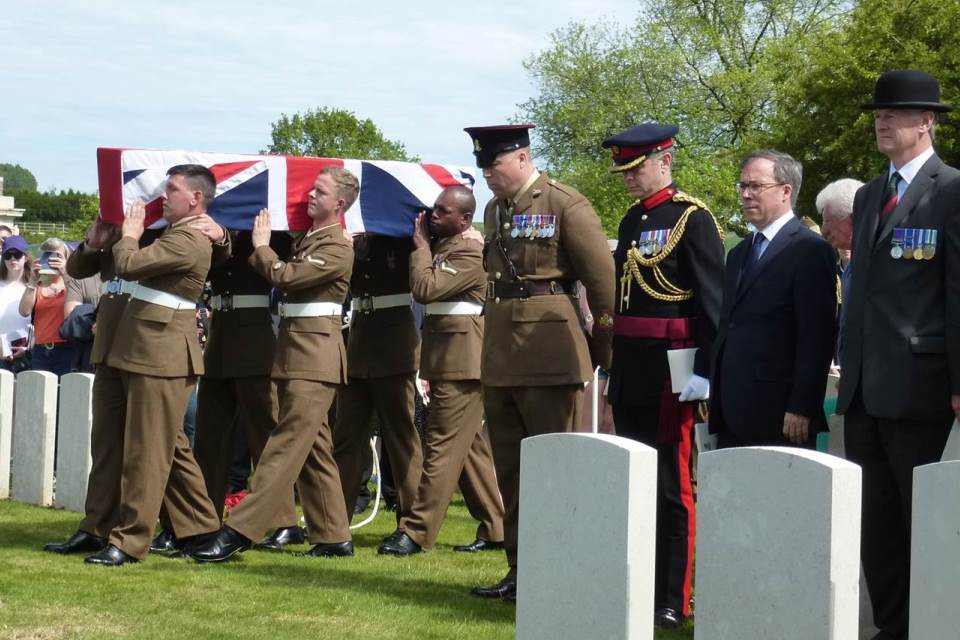
The bearer party carrying the coffin of Private Parker in view of senior dignitaries (left to right: WO Andrew Morrison; Defence Attaché to France and Lt Col David O’Kelly), Crown Copyright, All rights reserved

The service, organised by the MOD’s Joint Casualty and Compassionate Centre (JCCC), part of Defence Business Services, was conducted by The Reverend Jonathan Wylie CF, Chaplain to the 2nd Battalion The Yorkshire Regiment.

Beverley Simon, JCCC said:

It has been an honour for the Joint Casualty and Compassionate Centre to organise today’s ceremony and to ensure this brave soldier has been buried with the dignity and respect he deserves. It has been a privilege to have met Private Parker’s family and to personally involve them with the planning of his burial.

The greater part of Private Parker’s service was holding the frontline with his Battalion in the Ypres Salient area. It was not until August 1916 that his Battalion was redeployed from Flanders, along with the other units of the 50th (Northumbrian) Division, to the Somme. Private Parker was killed during an incremental advance towards the ‘Flers’ enemy trench from the ‘Starfish’ line on 26 September 1916. Henry’s body was never recovered from the battlefield until remains were found in a farmer’s field almost a century later.

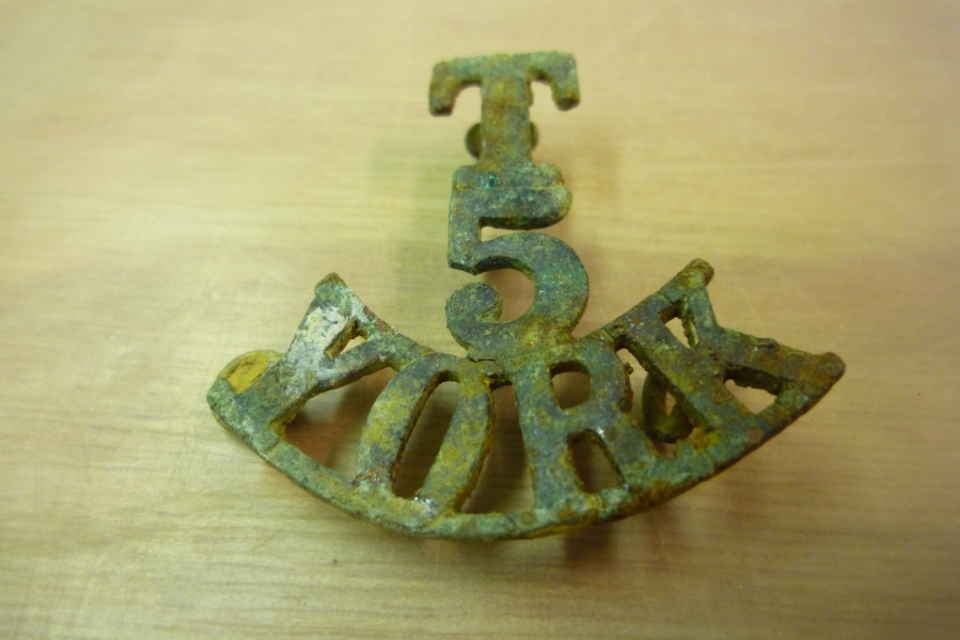
The recovered cap badge belonging to Private Parker, Crown Copyright, All rights reserved

Henry’s brothers James and Thomas Parker, who had both seen active service during the Great War, returned home safely.

Pat Burton, great-niece of Henry Parker said:

It is a great honour for us to be here today to pay our respects to a Great Uncle, Private Henry Parker. We are also here to represent Hazel Ranaldi, nee Croft, the daughter of Rosina Parker who was Henry’s sister.

We would like to thank the Joint Casualty and Compassionate Centre of the Ministry of Defence for inviting us to the burial ceremony here in Warlencourt, and feel very humble to be part of this occasion and extremely proud of our Great Uncle.

Margaret Parker, niece of Private Parker, who was unfortunately unable to accompany the other 20 family members to the ceremony, said:

Since the news that Uncle Henry has been found, I have had the honour and privilege to not only catch up with relatives I did know but also to meet others for the first time when I went to Richmond. We have been brought together through the brave actions of Uncle Henry, who, 100 years ago, gave his life for us and all that we hold dear.

I would like to thank all who have been involved, having given time and unstinting efforts to reunite Uncle Henry with us, his family, and bring us some closure. My thoughts are with you today, when I will be in Wansford Church thinking about Uncle Henry, our family and all those who have guided and supported us on this journey. God bless you all.

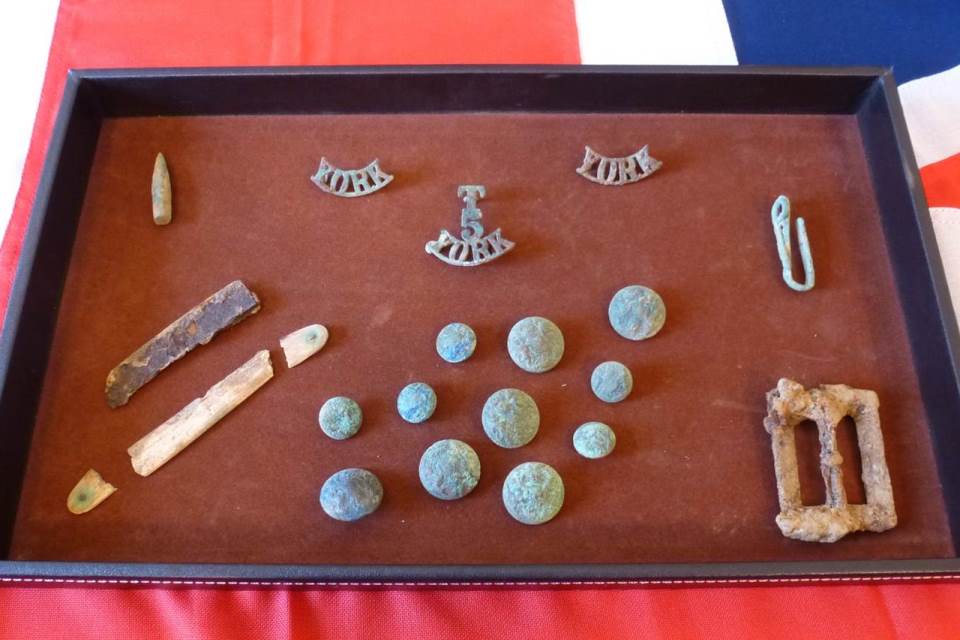
In 2014, the remains of Private Parker were discovered in a farmer’s field situated on the outskirts of Matinpuich, Nord-Pas-de-Calais, France. The military insignia recovered with the remains was key to the eventual identification of this soldier.

Steve Erskine, the Assistant Curator at The Green Howards Museum, responsible for extensive historical research in determining Henry’s identity, along with volunteer Mike Crisp, said:

We are incredibly proud to have played our part in helping identify this member of the regimental family after so many years. What’s followed has been a fascinating journey into local and family history research, capturing the interest of a range of people along the way who all want to understand more about the world in which Henry lived and the circumstances in which he died. It has been an honour to meet them all and work together to give Henry the resting place he deserves.

Having received formal notification of remains being found, the JCCC undertook genealogy and historical research with The Green Howards Museum in an attempt to discover a potential identity. A shortlist of 12 possible names was identified and JCCC was able to trace surviving relatives of all 12 families and arrange DNA testing. In February 2017, the news came through that Francis Storry, a great-nephew of Private Parker, had been confirmed as a surviving relative and the identification of Henry Parker was confirmed.

The recovered artefacts belonging to Private Parker that led to his identification, Crown Copyright, All rights reserved

Soldiers from the Yorkshire Regiment provided the bearer party and fired a salute at the service.

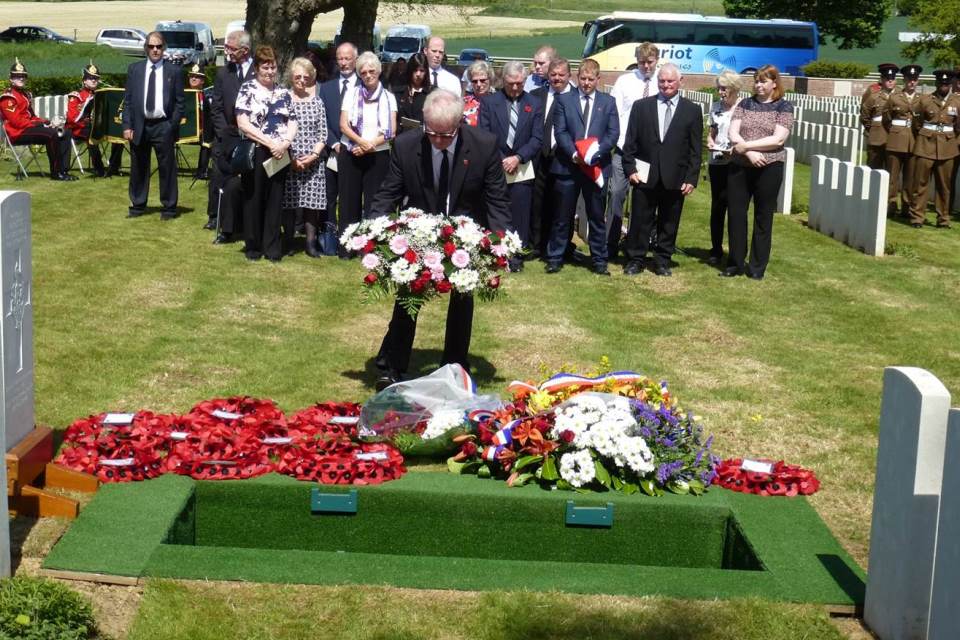
Francis Storry, great-nephew of Henry Parker, lays a wreath, Crown Copyright, All rights reserved

Francis Storry, great-nephew of Henry Parker said:

When we got the letter from the MOD Joint Casualty and Compassionate Centre, we were very surprised as we didn’t know anything about Henry Parker. It’s a great honour to be here today with 20 family members to pay our respects.

Lt Col David O’Kelly, Regimental Secretary of The Yorkshire Regiment said:

The Yorkshire Regiment is immensely proud to be able to lay to rest one of its brave soldiers, even 100 years on from the war in which he was tragically killed. He was an inspiration to his comrades then, and is still an inspiration to those who serve in the Regiment now. We will remember him.

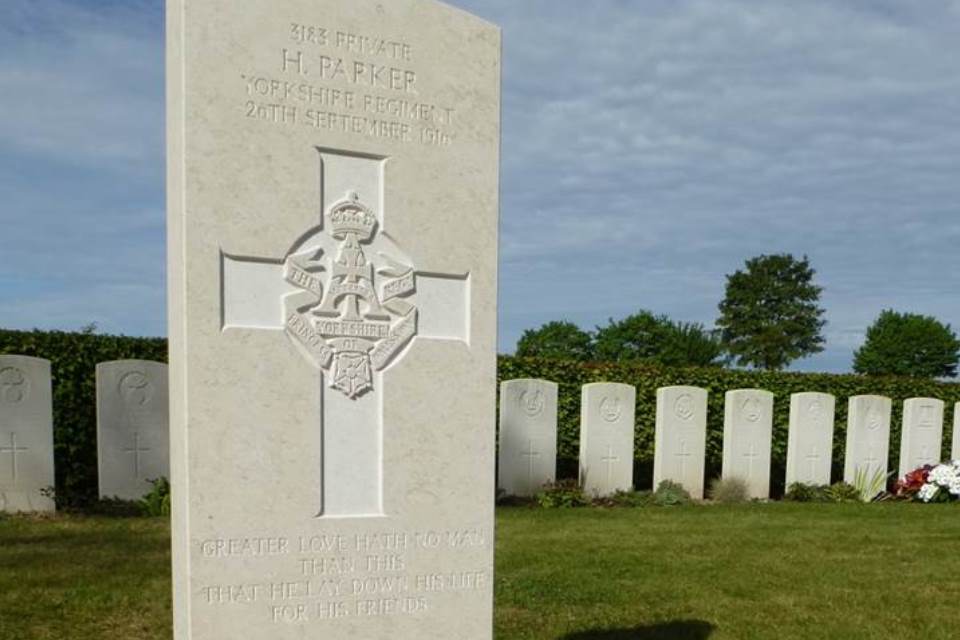
A new headstone bearing Private Parker’s name has been provided by the CWGC, who will now care for his final resting place in perpetuity.

Private Parker’s newly engraved headstone, Crown Copyright, All rights reserved

Peter Francis, CWGC said:

Today’s service is a poignant reminder of the human cost of the Great War. Henry has been given the honoured burial he so richly deserves and it is a privilege that we can care for his grave, and those of his comrades, at this cemetery and thousands of others across the world in perpetuity. In doing so, we will ensure they are never forgotten.
News story: World War 1 soldier who was killed in the Battle of the Somme finally laid to rest a century later

Private Henry Parker, 5th Battalion The Yorkshire Regiment, has finally been laid to rest after he was killed in action during the Battle of the Somme on 26 September 1916, just 3 days short of his 23rd birthday. The burial, with full military honours, took place on Wednesday 17 May 2017 at the Warlencourt British Cemetery, near Arras, France.

The bearer party carrying the coffin of Private Parker in view of senior dignitaries (left to right: WO Andrew Morrison; Defence Attaché to France and Lt Col David O’Kelly), Crown Copyright, All rights reserved

The service, organised by the MOD’s Joint Casualty and Compassionate Centre (JCCC), part of Defence Business Services, was conducted by The Reverend Jonathan Wylie CF, Chaplain to the 2nd Battalion The Yorkshire Regiment.

Beverley Simon, JCCC said:

It has been an honour for the Joint Casualty and Compassionate Centre to organise today’s ceremony and to ensure this brave soldier has been buried with the dignity and respect he deserves. It has been a privilege to have met Private Parker’s family and to personally involve them with the planning of his burial.

The greater part of Private Parker’s service was holding the frontline with his Battalion in the Ypres Salient area. It was not until August 1916 that his Battalion was redeployed from Flanders, along with the other units of the 50th (Northumbrian) Division, to the Somme. Private Parker was killed during an incremental advance towards the ‘Flers’ enemy trench from the ‘Starfish’ line on 26 September 1916. Henry’s body was never recovered from the battlefield until remains were found in a farmer’s field almost a century later.

The recovered cap badge belonging to Private Parker, Crown Copyright, All rights reserved

Henry’s brothers James and Thomas Parker, who had both seen active service during the Great War, returned home safely.

Pat Burton, great-niece of Henry Parker said:

It is a great honour for us to be here today to pay our respects to a Great Uncle, Private Henry Parker. We are also here to represent Hazel Ranaldi, nee Croft, the daughter of Rosina Parker who was Henry’s sister.

We would like to thank the Joint Casualty and Compassionate Centre of the Ministry of Defence for inviting us to the burial ceremony here in Warlencourt, and feel very humble to be part of this occasion and extremely proud of our Great Uncle.

Margaret Parker, niece of Private Parker, who was unfortunately unable to accompany the other 20 family members to the ceremony, said:

Since the news that Uncle Henry has been found, I have had the honour and privilege to not only catch up with relatives I did know but also to meet others for the first time when I went to Richmond. We have been brought together through the brave actions of Uncle Henry, who, 100 years ago, gave his life for us and all that we hold dear.

I would like to thank all who have been involved, having given time and unstinting efforts to reunite Uncle Henry with us, his family, and bring us some closure. My thoughts are with you today, when I will be in Wansford Church thinking about Uncle Henry, our family and all those who have guided and supported us on this journey. God bless you all.

In 2014, the remains of Private Parker were discovered in a farmer’s field situated on the outskirts of Matinpuich, Nord-Pas-de-Calais, France. The military insignia recovered with the remains was key to the eventual identification of this soldier.

Steve Erskine, the Assistant Curator at The Green Howards Museum, responsible for extensive historical research in determining Henry’s identity, along with volunteer Mike Crisp, said:

We are incredibly proud to have played our part in helping identify this member of the regimental family after so many years. What’s followed has been a fascinating journey into local and family history research, capturing the interest of a range of people along the way who all want to understand more about the world in which Henry lived and the circumstances in which he died. It has been an honour to meet them all and work together to give Henry the resting place he deserves.

Having received formal notification of remains being found, the JCCC undertook genealogy and historical research with The Green Howards Museum in an attempt to discover a potential identity. A shortlist of 12 possible names was identified and JCCC was able to trace surviving relatives of all 12 families and arrange DNA testing. In February 2017, the news came through that Francis Storry, a great-nephew of Private Parker, had been confirmed as a surviving relative and the identification of Henry Parker was confirmed.

The recovered artefacts belonging to Private Parker that led to his identification, Crown Copyright, All rights reserved

Soldiers from the Yorkshire Regiment provided the bearer party and fired a salute at the service.

Francis Storry, great-nephew of Henry Parker, lays a wreath, Crown Copyright, All rights reserved

Francis Storry, great-nephew of Henry Parker said:

When we got the letter from the MOD Joint Casualty and Compassionate Centre, we were very surprised as we didn’t know anything about Henry Parker. It’s a great honour to be here today with 20 family members to pay our respects.

Lt Col David O’Kelly, Regimental Secretary of The Yorkshire Regiment said:

The Yorkshire Regiment is immensely proud to be able to lay to rest one of its brave soldiers, even 100 years on from the war in which he was tragically killed. He was an inspiration to his comrades then, and is still an inspiration to those who serve in the Regiment now. We will remember him.

A new headstone bearing Private Parker’s name has been provided by the CWGC, who will now care for his final resting place in perpetuity.

Private Parker’s newly engraved headstone, Crown Copyright, All rights reserved

Peter Francis, CWGC said:

Today’s service is a poignant reminder of the human cost of the Great War. Henry has been given the honoured burial he so richly deserves and it is a privilege that we can care for his grave, and those of his comrades, at this cemetery and thousands of others across the world in perpetuity. In doing so, we will ensure they are never forgotten.