Regulator investigates charity over sanctioned trustees

The Charity Commission has opened a statutory inquiry into and frozen the bank account of a grant-making charity, after three of its founding trustees were made subject to financial sanctions.

Genesis Philanthropy Group was registered in 2018 with charitable purposes which include advancing the education of the public in the arts, culture, and heritage of the Jewish people.

Three of the four founding trustees of the charity (as previously recorded on the charity’s entry on the public register), Petr Aven, Mikhail Fridman and German Khan, have been named as ‘designated persons’, added to the list of those subject to financial sanctions by the UK government relating to Russia.

The Commission’s position is that individuals subject to financial sanctions in the UK cannot discharge their duties as a trustee of a charity.

The Commission’s register of charities has been amended to reflect the fact that the three individuals have ceased to be trustees of the charity.

The inquiry, which opened on 16 March 2022, will examine whether the charity can continue to operate and is viable, and whether the trustees have discharged their legal duties and responsibilities in their management and administration of the charity.

The regulator has frozen the charity’s bank account, meaning that no one can access or move funds held in its account without the Commission’s prior consent.

The Commission may extend the scope of the inquiry if additional issues emerge.

It is the Commission’s policy, after it has concluded an inquiry, to publish a report detailing what issues the inquiry looked at, what actions were undertaken as part of the inquiry and what the outcomes were.

[Reports of previous inquiries] are available on GOV.UK

Ends

Notes to Editors:

  1. The Charity Commission is the independent, non-ministerial government department that registers and regulates charities in England and Wales. Its purpose is to ensure charity can thrive and inspire trust so that people can improve lives and strengthen society.
  2. The effect of designation by the UK government, which include freezing financial assets, means that a designated person cannot hold, access, or manage funds. Matters relating to sanctions should be directed at the Office of Financial Sanctions Implementation.
  3. The resignation of an individual as a trustee does not preclude the Charity Commission from taking further action against them if this is deemed necessary and in the public interest.
  4. The charity proactively reported a serious incident to the Commission following the designation of two of the trustees by the EU and has been in regular contact with the Commission about the situation. A second serious incident was reported following the UK designation of the three founding trustees.


Government scheme that protected millions of jobs with £38 billion of support lent to businesses closes today

  • The Covid Corporate Financing Facility which provided a quick and cost-effective way to raise working capital for large firms comes to an end, with every penny repaid.
  • The Bank of England facility provided almost £38 billion of support to more than 100 of the UK’s biggest firms, and made a profit for the taxpayer whilst protecting millions of jobs.
  • Firms that employ almost 2.5 million people were directly supported including those in the car industry, travel, hospitality, and high street stores.

Household names, such as Gatwick Airport, the Football Association and the National Trust, were among more than 100 of the UK’s biggest employers that benefitted from the Covid Corporate Financing Facility (CCFF). The scheme has recouped every penny that was lent – plus a profit of over £60 million.

Rishi Sunak said the Bank of England administered scheme, which was launched in March 2020 at the start of the pandemic, was another example of the government offering support at unprecedented speed to protect millions of jobs and taxpayer’s money simultaneously.

Chancellor Rishi Sunak said:

We not only took unprecedented action but did so at unprecedented speed to protect jobs and businesses throughout the pandemic.

The CCFF scheme ensured that many of the UK’s biggest employers could continue to pay wages and suppliers, protecting millions of jobs – and on top of that every penny has been repaid.

The final CCFF repayments were made today, with all companies paying back what they owed. The scheme has made a profit of over £60 million for the taxpayer because the rate of interest applied to the cash provided by the Bank of England was priced at rates comparable to the market before Covid. Companies therefore paid back a slightly larger amount at maturity compared to the finance they borrowed initially.

Peter Vermeulen, Chief Financial Officer at the National Trust, said:

The HM Treasury team did an amazing job during the height of the pandemic. The National Trust, like many other large organisations, experienced an unprecedented liquidity squeeze, accompanied by enormous levels of uncertainty around the future.

The CCFF was set up swiftly and in a highly transparent manner. The team at HM Treasury issued clear guidance and worked tirelessly to support us with the application and the associated legalities.

We cannot commend the team highly enough for the excellent work they have done. It was an essential lifeline for the National Trust and has safeguarded some of the essential work we do on cultural and natural heritage, for the Nation. Thank you.

Mark Burrows, Chief Operating Officer at The Football Association, said:

The pandemic was a serious challenge for The FA. We were faced with huge losses from cancelled events and competition disruptions affecting our broadcasting rights.

As a not-for-profit organisation that reinvests its surplus into grassroots football, being able to rely on the security of CCFF as a quick and cost-effective way to raise working capital meant we were able not only to continue to support our business, but grassroots football across the country.

Through the purchasing of short-term corporate debt – known as commercial paper – the CCFF provided a quick and cost-effective way to raise working capital for companies who were fundamentally strong but were at risk of experiencing severe disruption to cashflows. Because it lent directly to large companies, the scheme also provided banks with the space to lend to a wider population of firms who could have otherwise gone bust during the pandemic.

The scheme helped companies across a range of sectors including the car industry, travel, hospitality, and high street stores. It kept cash flowing and delivered on the government’s commitment to do everything it could to support the economy and protect jobs.

Further information

  • UKGI, as the government’s centre of excellence in corporate finance and corporate governance, established the Covid Intervention Resolution Group (CIRG) to support the Chancellor in his lending decisions as part of the access review process introduced in October 2020, and to monitor the loan portfolio until maturity.
  • The CCFF was part of an unprecedented package of support for business throughout the pandemic including VAT cuts, business rates holidays and government backed loans worth around £400 billion.

Further stakeholder reaction

Stewart Wingate, Chief Executive Officer, Gatwick Airport, said:

The CCFF loan provided valuable support to the airport during the COVID-19 pandemic and helped ensure that we were able to stay open and maintain our role as a critical piece of national infrastructure.  This allowed us to maintain flights for essential travel and cargo, including medical equipment and other vital supplies during the pandemic.

Richard Hutton, Finance Director at Greggs, said:

In the spring of 2020, quick access to the CCFF was crucial for Greggs as we sought to protect our employees and others who depend on us through the early stage of the pandemic. It gave us essential breathing space whilst alternative commercial facilities were arranged.

The speed of response from the HMT and Bank of England teams was essential in providing stability at a critical time.

Neil Martin, Chief Executive Officer Europe, Lendlease, said:

This facility helped support our business in emerging from the pandemic in a strong position to be able to meet the needs of our customers, clients and the communities in the UK, we were very grateful for the support.

The London School of Economics said:

COVID has been a financial challenge for LSE as it has for all UK universities. Throughout, our priorities have been to protect the education and experience we offer our students, as well as our staff and research capability. Coupled with other credit facilities and reserves, the Bank of England’s CCFF has been a very helpful component in delivering those priorities.

Martin Watts, Director of Treasury at L&Q said:

The funds helped us to protect jobs, maintain vital services to residents, and continue with our development programme. With the support of the Bank of England, we delivered over 5,500 new homes in the period from 1 April 2020 to 31 December 2021, of which 3,200 were affordable.

Utilising the scheme meant that our balance sheet was well capitalised, enabling us to provide additional reassurance to key stakeholders in line with our prudent approach to risk management.
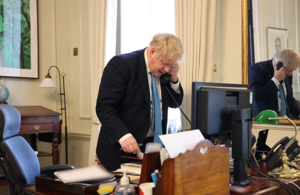



PM call with President Zelenskyy of Ukraine: 18 March 2022

Press release

Prime Minister Boris Johnson spoke to Ukrainian President Volodymyr Zelenskyy this morning.

Boris Johnson stands at his desk on the phone to President Volodymyr Zelenskyy of Ukraine.

The Prime Minister spoke to Ukrainian President Volodymyr Zelenskyy this morning.

The Prime Minister reiterated his disgust at Russia’s barbaric actions in Ukraine and his admiration for the steadfast resistance of the Ukrainian people in the face of tyranny. He said the entire United Kingdom stands with Ukraine.

President Zelenskyy updated on the situation on the ground and Ukraine’s evolving military and humanitarian needs. The Prime Minister set out the additional defensive aid the UK intends to provide and committed to work with allies at next week’s NATO meeting to step up military support to Ukraine.

They also discussed progress in ongoing peace talks. The Prime Minister offered his support for Ukraine’s position in negotiations and the President said the UK’s close involvement was highly valued. The UK will continue to exert pressure at all levels to oppose Putin’s act of aggression, including through sanctions, lethal aid and diplomatic action.

Published 18 March 2022


Government providing extra £150 million to tackle crime and anti-social behaviour

As announced in the Levelling Up White Paper, £150 million is available over the next three financial years for police and crime commissioners and local authorities across England and Wales, as well as certain civil society organisations.

The Safer Streets Programme provides funding to areas most affected by crime and anti-social behaviour and will allow local authorities, civil society organisations and police and crime commissioners to bid for up to £500k per year for each project. The latest round of the fund targets neighbourhood crime, violence against women and girls and – for the first time – anti-social behaviour.

Projects from previous rounds of funding have made a huge impact on local communities. For example, in Northampton funding has improved the security for thousands of homes that were vulnerable to burglary with alleyway gates installed to prevent an easy escape for offenders.

In Humberside, one of the most deprived areas in the country, money was given to improve communal entrances to prevent drug dealing, as well as installing storage units to stop bike and motorbike theft. Funding was also used for youth activities such as football and boxing.

The Home Secretary said:

Our local communities are the beating hearts of the UK and I want our streets to be safe for everyone to go about their daily lives without fear inflicted on them by criminals.

The Safer Streets Fund improves the safety and security of areas blighted by crime and helps the police and local councils ensure that everyone is safe on our streets, going to the shops, seeing friends. It also prevents potential perpetrators committing such crimes in the first place so our communities are able to flourish.

Crime, Policing and Probation Minister Malthouse said:

As well as being tough on criminals, we need to outsmart them where we can, preventing their crimes. The Safer Streets Fund does exactly that, giving neighbourhoods the money they need to “target harden” their homes and streets, outfoxing villains and making them think twice before offending.

We want everyone to feel safe in the public space, and as we build safer streets, town by town, I hope that we can restore pride, alongside safety, as something people say about where they live.

Stephen Mold, the Police, Fire and Crime Commissioner for Northamptonshire, said:

We have seen first-hand how important the Safer Streets funding has been here.

We’ve issued thousands of home security packs to residents, installed new CCTV cameras across the county to deter criminal behaviour, have erected alley gates to cut off anti-social behaviour and are installing new doors to improve security at residential properties.

The Safety of Women at Night fund has also helped us to launch our SNOvan for Safer Nights Out, as well as encouraging pubs, clubs and restaurants to take the Licensing Security & Vulnerability Initiative (Licensing SAVI) assessments to improve security at their venues.

All of these schemes have been made possible thanks to Home Office funding which has totalled more than £2 million over the last 18 months, and which has had a hugely positive impact in Northamptonshire.

The funding is also used to tackle violence against women and girls. In Sussex, for example, they have invested in a number of programmes to improve safety for women including providing bystander training sessions to encourage members of the public to feel able to challenge inappropriate behaviour and support victims.

Other projects across the country have focused on setting up neighbourhood watch groups, increased CCTV and introducing wardens to undertake community engagement and train members of the public in crime prevention – demonstrating levelling up in action.

The government has already committed £70 million to the Safer Streets Fund to support local areas across England and Wales to introduce initiatives aimed at preventing crime from happening in the first place. We have also invested £5 million in the Safety at Women at Night Fund.

The Beating Crime Plan also set out our plans to keep our communities safe, to stop crimes happening in the first place, and to keep serious offenders in prison for longer. The plan also lays out the government’s plan for tackling crime and anti-social behaviour with a commitment to working with local agencies and partners to use the full powers and tools available.


Lower Otter Restoration Project saves rare plants from sea level rise

Press release

Some of Devon’s rarest plants are to be moved to new sites in the county as work continues on the Lower Otter Restoration Project (LORP).

Hand holding the roots of a plant

In Devon, divided sedge only grows in the Lower Otter but must be moved due to rising sea levels

The Lower Otter is currently the only known place in Devon where the divided sedge (Carex divisa) is found and is one of only a few sites in the South West where it grows – it is deemed nationally scarce.

The survival of these plants is threatened by rising sea levels and the deterioration of embankments at the Lower Otter. Volunteers will be helping to move the yellow-tipped grass-like plant to new sites nearby on 22 March 2022.

Also being moved are some populations of galingale (Cyperus longus), which is also scarce nationally, though less so in Devon than the divided sedge. Unlike the divided sedge, the galingale will be able to continue to survive in some areas of the lower Otter valley.

Three sites with similar ecological characteristics have been chosen to replant these rare species and their progress will be monitored over the next 12 months. One of the chosen sites is grazing marsh associated with the Axe estuary, where divided sedge had been known to grow but was last recorded as present in 1934.

Moving the rare plants follows on from 400 southern marsh orchids that grew on the Lower Otter being relocated elsewhere last year.

Dr Sam Bridgewater, Head of Wildlife and Conservation for landowners, Clinton Devon Estates, said:

The divided sedge is an unassuming little plant which you could be forgiven for overlooking, but it’s the rarest living thing that the LORP scheme will provide help to.

We hope it will thrive in the new sites it is to be moved to.

New hedgerow planting, using biodegradable protection tubes

This week also saw planting of hedgerows to the north of Little Bank begin. Native species, including hawthorn, blackthorn and dog rose, have been planted in among gaps to existing hedgerows. The LORP project will see a net gain of 1.5km of hedgerow when completed.

The Environment Agency-led LORP project is one of two schemes under the ERDF’s Interreg France Channel England funded Promoting Adaptation to Changing Coasts project. The second site of the total €26m project is in the Saâne Valley in Quiberville, Normandy.

Published 18 March 2022