AAIB Report: DJI Matrice M210 v1, Battery communication warning appeared and control lost, Poole, Dorset

News story

During the operation of a DJI Matrice M210 Version 1, stronger than forecast winds caused the unmanned aircraft to drift beyond visual line of sight and communication with it was lost, 19 November 2020.

Damage to UA

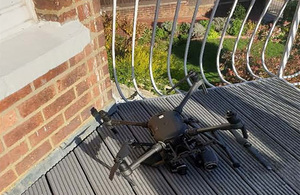
A DJI Matrice M210 Version 1, quadcopter unmanned aircraft (UA) was being flown during a police operation when the wind at 400 ft exceeded the forecast wind, the manufacturer’s wind limit and the maximum restricted speed of the UA. The UA drifted beyond visual line of sight and then communication with it was lost. When the battery level was low it entered an auto-land mode but collided with the wall of a house, damaging its propeller blades before coming to rest on a balcony.

The investigation revealed that shortly after takeoff one of the UA’s two batteries had disconnected which resulted in its maximum speed being restricted, but this restriction is not referenced in the user manual and neither the remote pilot nor operator were aware of it. When the UA detected that the manufacturer’s wind limit had been exceeded, the message triggered on the pilot’s controller display was ‘Fly with caution, strong wind’ instead of advising the pilot that the limit had been exceeded and that the UA should be landed as soon as possible.

Three Safety Recommendations are made to the UAS manufacturer and one to the CAA on Visual Line of Sight guidance.

Read the report.

Media enquiries call: 01932 440015 or 07814 812293

Published 7 April 2022


9-year ban for Glasgow coffee wholesaler boss

Filippo Dioguardi, 58, based in Glasgow has been disqualified as a director for nine years.

He was sole director of Camardo Coffee (Scotland) Ltd, which was incorporated in 2015 and was registered initially at an address in East Kilbride, before relocating to Glasgow around May 2018.

Dioguardi was appointed as a director in September 2019, becoming sole director two months later.

The business went into liquidation shortly afterwards, in August 2020, at which point the last filed accounts showed assets totalling over £800,000.

However, due to the lack of company records kept by Filippo Dioguardi, it was impossible for the liquidator or the Insolvency Service to establish the accuracy of these, or whether any assets were disposed of at fair value and to the benefit of the company or its creditors.

Instead, Dioguardi refused to co-operate with the Insolvency Service investigation, which also identified he had taken out a taxpayer-backed Bounce Back Loan of £50,000 on 27 May 2020, less than two months before liquidation.

The investigation also noted outgoings from the company account between April 2020 and August 2020 of nearly £150,000, including cash withdrawals of over £70,000. Whether these funds were used for legitimate business use or for repaying creditors could not be established.

The Secretary of State for Business, Energy and Industrial Strategy accepted a disqualification undertaking from Filippo Dioguardi after he admitted failing to maintain or preserve, or provide, adequate accounting records. His ban runs from 25 March 2022 to 24 March 2031.

The disqualification undertaking prevents him from directly, or indirectly, becoming involved in the promotion, formation or management of a company, without the permission of the court.

Rob Clarke, Chief Investigator at The Insolvency Service said:

Keeping proper records is a pivotal duty for directors and there is no place in the corporate arena for those who neglect their responsibilities in this area and thereby cover up the activities of the companies they manage.

The lack of records in this case made it impossible to determine whether there was other, more serious, misconduct involved and what became of £50,000 in Government backed funds which have not been accounted for. This is reflected in the lengthy period of disqualification.

Notes to editors

Filippo Dioguardi is an Italian national born March 1964 residing in Glasgow.

Camardo Coffee (Scotland) Ltd company number – SC500544

A disqualification order has the effect that without specific permission of a court, a person with a disqualification cannot:

  • act as a director of a company
  • take part, directly or indirectly, in the promotion, formation or management of a company or limited liability partnership
  • be a receiver of a company’s property

Disqualification undertakings are the administrative equivalent of a disqualification order but do not involve court proceedings.

Persons subject to a disqualification order are bound by a range of other restrictions.

Information about the work of the Insolvency Service, and how to complain about financial misconduct.

Contact Press Office

You can also follow the Insolvency Service on:


Crime news: process change for intermediaries helping court users

News story

Criminal Bills Assessment manual updated to reflect new guidance on the use of intermediaries to help vulnerable users of courts and tribunals.

Open book with reading glasses on top

We are updating our guidance following changes to the process governing the use of intermediaries to help vulnerable users of the court system.

This follows the launch of the HMCTS Appointed Intermediary Service on 1 April 2022. This aims to help vulnerable people with specialist communication needs to take part in court or tribunal hearings.

COVID-19 contingency record

We are also taking the opportunity to add in an annex of the COVID-19 contingencies now that these are mostly no longer in effect.

This annex will serve mainly as an historical record for the use of providers and the LAA. It also confirms the position regarding travel and remote attendances as we move forwards to business as usual.

Further information

Legal aid guidance: crime – to view and download Criminal Bills Assessment Manual

HMCTS intermediary services

Published 7 April 2022


National Underground Asset Register public consultation launched

News story

The Geospatial Commission is seeking views on current ways of working, the need for potential legislative reform and the future operating model of NUAR.

animation of a city above and below ground showing pipes underground and people, a bus, car and tram above ground

The Geospatial Commission today launches its public consultation on the future operating model of the National Underground Asset Register (NUAR), a digital service for sharing data on the location of underground pipes and cables. The Commission is inviting those that will benefit from the service and the wider public to provide their views on what the future of NUAR could look like, and is particularly keen to receive responses from those working in the industry.

The deadline for responses is 11.59pm on Thursday 2 June 2022.

The consultation

The current build phase of the NUAR project is well underway. The Geospatial Commission is now holding a consultation on what the future operating model of the service could be. This consultation is a chance for you to provide your views on how the service could be run.

Questions

The public consultation asks nine questions in total on the following areas:

  • Current ways of working
  • Assessing the need for legislation and potential measures
  • Who should be charged to support the running of NUAR in the future

Published 7 April 2022


Call for evidence launched to understand people’s experiences of extremism and its impact on social cohesion

  • Public urged to have their say in a major independent review into social cohesion and resilience to extremism
  • Dame Sara Khan, Independent Adviser for Social Cohesion and Resilience, gathering evidence for key report
  • Review to examine measures to protect and support victims, how we can strengthen social cohesion and build resilience in society against extremism

Victims and communities are being urged to share their experiences as part of a major independent review into the impacts of extremism.

Dame Sara Khan, the government’s Independent Adviser for Social Cohesion and Resilience, today (7 April 2022) launched an 8 week call for evidence that will help examine the impact, harm, and response to extremism at a local level.

Dame Khan’s review – commissioned by No.10 – aims to understand the breadth and depth of the impact on individuals, communities and social cohesion.

She wants to hear directly from those who have been targeted by extremists to understand the impact on their lives and the support they received. As well as representatives from local councils and civil society, members of the public are being asked to explain what has gone well and what more could be done. These responses will help her understand the impact extremism is having at a local level and what could be improved to protect and build up social cohesion.

Responses will help develop Sara’s independent recommendations on how the government can better support and protect victims of extremism and those working to stamp it out, as well as communities that are affected.

Dame Sara Khan, Independent Adviser on Social Cohesion and Resilience, said:

As the former Counter-Extremism Commissioner I saw first-hand the impact of extremist and other divisive activity in our towns and cities. Too often, the response to those sowing hatred and division is slow and ineffective.

That is why I have been asked by the Prime Minister to examine what more is required to protect social cohesion and build resilience against extremism at a local level.

I will be seeking to hear from victims of extremism whose life-changing experiences are often unrecognised and from local authorities and communities who play an invaluable role. I will be taking an independent, impartial and evidence-based approach and I want to hear from all those who have experience of these issues. This public consultation will give everyone an opportunity to contribute.

Minister for Levelling Up Communities Kemi Badenoch said:

Our landmark Inclusive Britain strategy makes clear that we are a welcoming country whose strength lies within its communities. So, when people try to create divisions amongst us, we must be unwavering in our resolve to stay united.

By sharing your views, you will be helping ensure that our work to tackle extremism continues on the right track – so that risks in our communities are easily recognised and swiftly dealt with, and we can build resilience and promote social cohesion.

Our levelling up mission includes empowering communities – and this call to action is a great example of that ideal in action.

Brendan Cox, Co-Founder and Adviser, Together said:

I know first-hand the terrible impact extremism can have on individuals, families and our communities. This is a serious challenge for our society and it is vital we do more to respond to this threat. Sara’s review examining how extremism impacts individuals, local communities and social cohesion is important and I encourage everyone to take part so she can build your views into her recommendations to the government.

Jo Broadwood, CEO, Belong – The Cohesion and Integration Network said:

Belong’s own research has shown that local areas that prioritised social cohesion prior to and during the pandemic maintained stronger social connections, trust, neighbourliness and more positive attitudes towards others during the crisis. As such, actively attending to and maintaining social cohesion is a vital part of building social capital and supports communities and places to be resilient to the forces of division and polarisation, including violent extremism.

It is vital that we understand cohesion in this broader sense. We therefore welcome this call for evidence and encourage all those with a concern for building a more cohesive, inclusive society to respond.