UK to lead the way in climate and sustainability education

Secondary school students will be able to study the natural world through an exciting new GCSE in natural history to be introduced by September 2025.

It forms part of new plans announced by Education Secretary Nadhim Zahawi today (Thursday 21 April), detailing how the UK education sector is to become a world leader in climate change by 2030, as part of the launch of the government’s flagship Sustainability and Climate Change Strategy.

The new Natural History qualification will enable young people to explore the world by learning about organisms and environments, environmental and sustainability issues, and gain a deeper knowledge of the natural world around them.

They will also develop the skills to help them carve a future career in the natural world if they wish to – for example observation, description, recording and analysis, through sustained and structured field study.

The government will also confirm its plans to accelerate the rollout of carbon literacy training to support at least one sustainability lead in every locally maintained nursery, school, college and university. The training will support settings to develop climate action plans that will bring together and drive activity to improve climate education, put in place measures to protect them against the effects of climate change, and increase climate resilience through adaptation initiatives.

The Education Secretary will also pledge greater support for teaching climate change at all levels and by 2023 there will be new requirements for further education teachers to build sustainability into their teaching.

Young people will also be able to bolster their environmental education gained in existing subjects, including changes to landscapes and urbanisation in geography, and habitats and ecosystems in science.

Education Secretary Nadhim Zahawi said:

We are delivering a better, safer, greener world for future generations and education is one of our key weapons in the fight against climate change. The entrepreneurial, can-do spirit of this country makes me confident that we will win this fight.

It shouldn’t come as a surprise to anyone that young people are already very committed to a more sustainable planet. We should be proud of this, and I want to do everything I can to encourage this passion so they can be agents of change in protecting our planet.

The new natural history GCSE will offer young people a chance to develop a deeper knowledge and understanding of this amazing planet, its environment and how we can come together to conserve it.

The measures are expected to build on the government’s pledge for every new school, and delivered under the department’s school rebuilding programme, to be cleaner, greener and net-zero in operation.

The rollout of ultra-low carbon education buildings will also be accelerated, and by 2025 at least four schools and one college will have been built via the Gen Zero Platform that the department demonstrated at COP26.

The strategy also details the development of additional measures first announced at COP26.

This includes the National Education Nature Park that will help children and young people to get more involved in the natural world. It will help the increase of biodiversity in the grounds of their nursery, school, or college by them taking small steps, such as installing bird feeders and ‘bug hotels’. Teachers will be provided with free, high-quality climate education resources as part of the Nature Park hub.

Children and young people will also be able to undertake a new Climate Award in recognition for their work to improve their environment, with a prestigious national awards ceremony held every year. The Climate Leaders Award will help children and young people develop their skills and knowledge in biodiversity and sustainability and celebrate and recognise their work in developing their skills and knowledge.


More than 200 British businesses celebrated as Queen’s Awards for Enterprise winners revealed

  • 232 winners announced in The Queen’s Awards for Enterprise – the UK’s most prestigious business awards
  • winners include World of Books, a West Sussex retailer selling over 12 million used books each year in over 175 countries, and 4 Mental Health, an organisation in Conwy providing mental health training courses across the globe
  • Applications for the 2023 Queen’s Awards for Enterprise will open on 1 May

The winners of the 2022 Queen’s Awards for Enterprise have been announced today (Thursday 21 April), celebrating the achievements of UK businesses.

This year, 232 businesses representing every part of the United Kingdom and a range of sectors have been recognised by Her Majesty The Queen on her birthday as among the best in the country.

Awards have been won in the categories of:

  • International Trade (141 winners)
  • Innovation (51)
  • Sustainable Development (31)
  • Promoting Opportunity (9)  

Small Business Minister Paul Scully said:

This country is renowned for its entrepreneurial achievements and there is no greater showcase for it than The Queen’s Awards. It’s vital we celebrate the success of our businesses and recognise the contributions they make to communities across the country.

I congratulate this year’s winners for their hard work and commitment over the last year and I wish them every success for the future.

The winners

This year’s winners include:

World of Books

World of Books is an online book retailer with a focus on technology and sustainability, based in West Sussex. It sells over 12 million used books per year to customers in over 175 countries, and 4,400 UK charity shops are supported through the purchase of surplus stock by World of Books Group. It also donates books to literacy programmes and recycles books and media that cannot be reused. The company has been awarded for both International Trade and Sustainable Development.

4 Mental Health

4 Mental Health provides mental health training courses and free self-help resources. Bite-sized modules are available for clinical and non-clinical audiences, with multiple delivery options including webinar conferences, direct-to-participant, train-the-trainer and e-learning. Overseas training significantly increased between 2018 to 2021, constituting 43% of their activity. 4 Mental Health is based in Conwy and has won an award for International Trade.

The Edinburgh Remakery

The Edinburgh Remakery is a social enterprise running workshops to teach sustainable reuse and repair skills, creating ways for businesses and members of the public to reuse second-hand electronics, reducing pollution and emissions. It is awarded the Queen’s Award for Enterprise in Sustainable Development.

Pearson Engineering

Pearson Engineering provides the Armed Forces with equipment to enhance the capability of its armoured vehicles, enabling them to overcome challenges on the battlefield, such as physical obstacles, minefields and improvised explosive devices (IEDs). Overseas sales grew by 144% between 2018 to 2021 and top markets include South Korea, United States, United States Sponsored Forces, Norway and Canada.

Winners’ awards are valid for 5 years. Winners are permitted to fly The Queen’s Awards flag at their main office and use the emblem on their marketing materials. Winners are also given a Grant of Appointment (an official certificate) and a commemorative crystal trophy.

Her Majesty’s Lord Lieutenants will be presenting the Awards to businesses locally throughout the year.

Eligible businesses are free to apply for one or more categories. The winners pass a robust assessment process, judged by senior officials in Whitehall and experts from industry, academia and the third sector. On that basis, the winners of The Queen’s Awards for Enterprise are recommended by the Prime Minister to Her Majesty The Queen.

Applications for the 2023 Queen’s Awards for Enterprise will open on 1 May 2022 and businesses are encouraged to apply.

Further information

The awards were created following the recommendation of a committee chaired by His Royal Highness The Duke of Edinburgh in 1965. The first awards, originally known as The Queen’s Awards to Industry, were made the following year.  


Courts to work at full capacity for second year to deliver swifter justice for victims

  • no limit on the number of days the Crown Court can sit for new financial year
  • nearly 17,000 more days were sat in the Crown Court last year after cap was lifted
  • part of a raft of measure to cut backlogs in the courts

The investment means more trials can take place, delivering swifter justice for victims and reducing the backlog of cases which rose significantly due to the pandemic.

The same decision last year meant that nearly 17,000 more days were sat in the Crown Court than the year prior to the pandemic.

The impact of these measures alongside other government action and the collective work of judges, court staff and the legal profession is already being seen. We were among the first in the world to resume jury trials, and the number of outstanding cases in the Crown Court has fallen by around 2,500 since its peak in June 2021.

Despite COVID-19 restrictions and social distancing measures meaning some courtrooms had to temporarily close, over 98,500 days were sat in 2021/22 after the Ministry of Justice lifted the cap, compared to around 82,000 in 2019/20.

Deputy Prime Minister, Lord Chancellor and Secretary of State for Justice, Dominic Raab said:

Getting the courts backlog down is a key priority for this Government so that we can ensure victims get the swift access to justice they deserve.

Alongside the extension of Nightingale Courts, digital hearings and investing significantly in criminal legal aid, we are removing the limit on sitting days for a second year to boost capacity and help drive down the Crown Court backlog of cases.

The Ministry of Justice has spent £250 million so far on dealing with the impact of the pandemic and is investing nearly half a billion pounds (£477 million) in the criminal justice system over the next three years which will help to tackle backlogs in courts and tribunals.

Over 60 Crown courtrooms previously unavailable due to the pandemic have been reopened in the last year and 30 Nightingale courtrooms, originally commissioned to provide extra capacity for socially-distanced trials, will stay open until March 2023. This means around 500 Crown courtrooms are now available for hearings and trials.

Today’s announcement builds on a raft of measures already introduced to speed up justice for victims and improve the justice system since the start of the pandemic, including:

  • Increasing spending on criminal legal aid by £135 million a year, including a fee increase which will see a typical criminal barrister earning nearly £7,000 extra per year.
  • Rolling out video technology to over 70 percent of all courtrooms and opening 3,265 virtual court rooms across all jurisdictions. These currently hold around 13,600 hearings per week, compared to just a handful before the pandemic.
  • Legislating to double the sentencing powers available to magistrates from 6 months to a year to free up an estimated 1,700 extra sitting days of Crown Court time each year.
  • Investing almost £450 million over the next 3 years into victim and support services.
  • Creating 2 ‘super courtrooms’ which can accommodate up to 12 defendants simultaneously; increasing capacity for large, complex trials.
  • Raising the statutory mandatory retirement age from 70 to 75 for judicial office holders, estimated to retain an extra 400 judges and tribunal members and 2,000 magistrates per year across all jurisdictions.


Earth Day 2022: Climate Change and Climate Action in The Bahamas pre and post COP26

Press release

UK Government’s Regional Ambassador for Latin America and the Caribbean, Fiona Clouder visits to The Bahamas pre and post COP26.

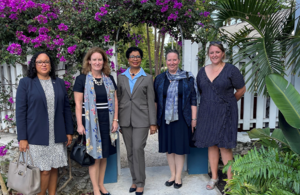
The Climate Action Team posing as a group

The Climate Action Team at OPM

On Earth Day 2022, and as the Bahamian Government prepares to host the first ever English-speaking regional youth conference on climate change, we reflect on Ambassador Clouder’s experience in The Bahamas pre and post COP26.

High Commissioner Sarah Dickson said:

Climate change is a global issue. The big policy issues are something we have to work on together internationally. No country can solve these problems by itself, but we can all play our role to achieve worldwide outcomes.

Ambassador Clouder visited The Bahamas in October 2021 to support the UK’s COP26 objectives. She met representatives of government, private sector and environmental NGOs. One of the key messages that Ambassador Clouder discussed was that governments play a critical role in reducing carbon emissions as part of their medium term to long-term policy priorities.

Ambassador Clouder accompanied by High Commissioner Dickson during a visit to Grand Bahama saw first-hand how extreme weather and other environmental challenges can impact The Bahamas — The damage caused by hurricane Dorian is being slowly addressed by organisations such as the Bahamas National Trust and Coral Vita.

Making sure the coastline is strong with reefs and mangroves will make a difference for the future. Climate change mitigation, adaptation, and resilience begin with everyday choices that we make. People can reduce their carbon footprints and participate in protecting and restoring the environment through tree planting and other nature based solutions to climate change.

In her follow-up visit in March 2022, Ambassador Clouder heard progress reports from the Ministers for Environment and Natural Resources; Agriculture, Marine Resources and Family Island Affairs; and Economic Affairs. The Bahamian Government’s climate policy priorities are: adaptation measures to protect communities and natural habitats form the effects of climate change, mobilising finance for green renewal, and accelerating collaboration between government and civil society (including youth) to deliver on Bahamian climate goals faster.

The Office of the Spouse of the Prime Minister

Meetings with Office of the Prime Minister

Bahamas National Park

Published 20 April 2022


Lord Parkinson speech at Venice Biennale

Good evening everyone,

I am very pleased to be with you all this afternoon, representing Her Majesty’s Government. It’s great to be here in person at La Biennale di Venezia and to be celebrating the British Pavilion, and Sonia Boyce’s wonderful art work.

I am very grateful to the British Council for inviting me to this auspicious event and to say a few words.

The Biennale is a much cherished opportunity to showcase some of the best artists in the UK, but also to see international artists and colleagues, reinforce connections, and to make the most of the face to face interaction which we have all been missing so much.

But of course we meet against the backdrop of the terrible situation unfolding in Ukraine. I know everyone here will want to extend our support and warmest wishes to our Ukrainian friends as they continue to suffer under the deplorable invasion by the Russian Federation.

I look forward to visiting the Ukrainian pavilion during my stay here in Venice, to demonstrate the UK’s solidarity with Ukraine – and to admire the wonderful artwork of that culturally rich country.

It is clearer than ever that to survive the challenges of this troubled world we must work together, and it is here that Sonia Boyce’s work has much to teach us. She is an artist who embodies the value of working together, of sharing a platform, whether she’s working with local communities in Barking and Dagenham or exhibiting at the Tate – or indeed the British Pavilion here at the Biennale.

Sonia has had a 30 year career as a teacher as well as an artist. She has influenced many generations, sharing her expertise and experiences as an artist and enriching those with whom she has come into contact.

We are very proud that she is representing Britain here in Venice.

She joins an august group of previous exhibitors, including Henry Moore, Barbara Hepworth, Anish Kapoor, Gilbert & George, and Jeremy Deller. The British pavilion has always been a showcase for the brightest and best of UK art, managed by the British Council, and I’m delighted to see this tradition continue this year.

On behalf of the HM Government I would like to thank the British Council for the brilliant job they have done managing the British Pavilion programme, which, together with their wider work around the globe, has promoted the best of the UK’s arts and culture on the world stage.

And may I also express my gratitude to the many sponsors, supporters and patrons of the British Pavilion, whose kind and generous support is so vital to its continued success. Thank you very much.

The Central Exhibition will also feature the work of five further artists from the UK, supported by the British Council through the Biennale Foundation.

The 59th Venice Biennale is therefore set to be a great showcase for British arts, demonstrating that the UK is an international cultural powerhouse, not only in our heritage but in our amazing and thought-provoking contemporary art.

So I would like to conclude by wishing the greatest success for the British Pavilion, and the UK artists in this year’s festival. And it’s now my pleasure to hand over to Stevie Spring, Chairman of the British Council.

Thank you