Support for low income countries following Russia’s invasion of Ukraine: Foreign Secretary statement

Press release

The Foreign Secretary has issued a statement on the largest ever World Bank financial commitment to low income countries

Foreign Secretary Liz Truss said:

“The UK and our partners have secured the largest ever World Bank financial commitment to low income countries around the world.

“It will provide $170bn over the next 15 months with $50bn delivered by the end of June, supporting countries faced with economic hardship as a result of Russia’s invasion of Ukraine.

“Russia’s bombardment across Ukraine has brought exports from the world’s breadbasket almost entirely to a halt, leading to steep price rises and jeopardising livelihoods across the globe.

“Through this support we are standing together with the most vulnerable countries in the face of Russian barbarism. The UK has led by stepping up our support through the World Bank, including nearly $1bn in loan guarantees so the Bank can lend more to Ukraine without taking resources away from rest of world.

“Despite Russia’s refusal to take responsibility for its actions, the UK and World Bank partners this week have delivered for the people of Ukraine and for the wider world.”

Published 22 April 2022


Education Secretary speech at the Natural History Museum

Hello everyone,

I hope that you are as thrilled as I am to be standing in this incredible hall, in one of the most famous museums in the world.

I really do feel very honoured to be with you.

None of us can be in any doubt just how critical climate change has become.

I want to thank all of you, and my colleagues from parliament but also my team, Minister Walker who’s led on this project, and are already doing so much to reverse the damage, to put our planet on a safer, more sustainable course. We will continue, I pledge to you, that we will continue to work tirelessly with you and of course to listen, listen to you, teachers, leaders, and of course young people themselves who are shaping much of what we do in the department.

But while the scale of the challenge is great, there is still much that we can do now and we are already making sure happens.

This is not, I think, a time for doom and gloom. This is a time, as Phoebe just reminded us, for positive action.

The entrepreneurial, that can-do, Bear Grylls spirit in this country can make all of us, certainly me, much more confident that we will win this fight.

At COP 26… it was the first time that I was able to bring together fellow ministers of education to a COP gathering. Environment Ministers coming together for that summit and I hope to build on that at COP27 in Egypt and COP28 in the United Arab Emirates. It was a proud moment to be able to announce how we are putting climate change and sustainability at the heart of education.

Today we see the proof of those words of that with the final version, I hope, of the Sustainability and Climate Change Strategy that we announced.

Young people have to be given a reason to believe that they can change the world for the better. If you give them the facts about a situation, it gives them the levers to change it for the better. And that will, I hope, give them hope. That move from anxiety to agency. We want them to be fired up by determination and not cast into despair.

So how are we going to do this?

Well, I announced two important measures at COP that we will be launching this autumn. The National Education Park, the education estate is the size of Birmingham, and we’re going to link it up so that students all around the country, and I hope that other countries, the Italian Minister when I shared this with him immediately thought this was something we could hopefully build together. They can do geospatial mapping, and they can see through sharing videos how they can rewild the education estate, as I know the Natural History Museum is determined to do here as well. This is alongside, The Climate Leaders Award. Both of these are going to shift the dial in how we approach sustainability in education.

It shouldn’t come as a surprise to anyone that young people are already very committed to a greener, more sustainable planet and I want to do everything to continue and to back them in this encourage this passion.

One of the most exciting announcements in our strategy is to capitalise on that passion and to extend learning about the natural world.

So we will introduce a natural history GCSE, giving young people a real chance to develop a deeper knowledge and understanding of our amazing planet.

We want to inspire the next generation of David Attenboroughs, on the day he was recognised by the United Nations for his work in preserving our wonderful planet, it really is a privilege to be here, and of course the future scientists and tech entrepreneurs who will preserve and protect our planet who will make the leaps we need to keep our world safe.

We are also taking steps to extend teachers’ skills and new professional development support, so that they can be confident in the classroom in teaching about climate change and sustainability.

We’re going to speed up carbon literacy training throughout our education communities, so that by 2025 every nursery, school, college and university can put in place a climate action plan.

But innovation and green growth will not flourish unless we deliver a workforce with the right skills to make them a reality.

It is not enough to simply hope that talented people find green career pathways, we need to build these career pathways and provide those people, who want to join in this endeavour with the skills they need to fulfil that career in the future.

This strategy sets out how we are rapidly skilling, reskilling and upskilling our workforce for green jobs.

For example, there are a wide range of green apprenticeships already up and running from nuclear desk engineers, wind turbine maintenance and research scientists.

By September 2023 students will be able to apply for a T Level – a T Level is a fusion between an A Level and an apprenticeship and I am determined to make them as famous as A Levels – in agriculture, land management and production.

We have already promised that all new schools and colleges are going to be net zero in operation and of course resilient for a 2oC temperature rise. It means that our school building standards will be the best in the world.

We are committed to building four new schools and one college using this innovative technology, so that one day all our schools can be built in this way, from natural materials.

I would urge you to have a look at our wonderful Gen Zero prototype– we’ve brought a portion of the prototype that we had at Glasgow, here to the Museum tonight. Have a look at it, it really is a remarkable piece of engineering and design.

Future generations will judge us on how we responded to this challenge. This strategy shows how we will not let them down.

Education is how we will equip young people with the future agency to make real difference, with the skills they need to look after this precious Earth.

Education is how we unlock the unlimited potential of the next generation to make that difference.

We must not, and I am determined, that we will not, give in to despair.

Together, I know that Phoebe and her generation can do this, and they have our full backing.

Thank you.


National Clinical Impact Awards 2022: resources for applicants and employers

News story

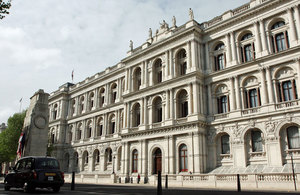
The ACCIA secretariat has created resources and information on the newly reformed national Clinical Impact Awards scheme.

Working with NHS Employers, the ACCIA secretariat have created resources for NCIA applicants and employers.

The resources provide further information on and address key concerns relating to the national Clinical Impact Awards scheme in England and what the reforms mean for both applicants and employers in practice.

The resources can be downloaded and shared to raise awareness of the scheme and encourage more applications from previously under-represented groups.

The 2022 awards will open on Wednesday 27 April and will close on Wednesday 22 June. Please review the ACCIA application guidance for advice and further information.

For further detail on the reforms please review the joint DHSC and Welsh government consultation response.

Published 22 April 2022


Government aims to eradicate modern slavery from NHS supply chains

Press release

The government has tabled a landmark amendment to the Health and Care Bill aiming to eradicate the use of goods and services in the NHS that are tainted by slavery and human trafficking.

  • Landmark Health and Care Bill amendment will crack down on the use of goods and services in the NHS tainted by modern slavery
  • Part of UK’s mission to eradicate slavery and human trafficking in global supply chains

The government has tabled a landmark amendment to the Health and Care Bill aiming to eradicate the use of goods and services in the NHS that are tainted by slavery and human trafficking.

The amendment will help ensure the NHS, which is the biggest public procurer in the country, is not buying or using goods or services produced by or involving any kind of slave labour. This represents a significant step forward in the UK’s mission to crack down on the evils of modern slavery wherever it is found.

The power will allow tough regulations to be made which can set out steps that the NHS should be taking to assess the level of risk associated with individual suppliers, and the basis on which they should exclude them from a tendering process.

Health and Social Care Secretary Sajid Javid said:

“I want this to be a turning point in the UK’s mission to eradicate slavery and human trafficking in supply chains around the globe. As the biggest public procurer in the country, the NHS is well placed to spearhead this work.”

Background

  • The amendment was tabled on Thursday 21 April ahead of the next stage of Commons Consideration of Lords Amendments for the Health and Care Bill which will take place on Monday 25 April.

Published 22 April 2022


PM statement in India: 22 April 2022

Good afternoon,

before turning to the topic of visit we have had, the fantastic visit we’ve had here in India,

I just want to say something about the latest situation in Ukraine.

Because I know everyone is deeply concerned about events, the barbarism we have seen, that barbarism by Vladimir Putin in the Donbas region,

and in particular his brutal offensive against Mariupol,

which is why yesterday I announced we would be sending more artillery and doing everything possible to help the people of Ukraine defend themselves those areas.

And at the same time, the extraordinary fortitude and success of President Zelenskyy and the Ukrainian people in resisting Russian forces in Kyiv,

means that I can today announce shortly, next week, we will re-open our embassy in Ukraine’s capital city.

I want to pay tribute to those British diplomats who remained elsewhere in the region throughout this period.

The United Kingdom and our allies will not watch passively as Putin caries on this onslaught.

And what I think we’ve seen here in New Delhi

is one of the world’s oldest democracies, and the largest democracy, sticking together,

And confronting our shared anxieties about autocracies and autocratic coercion around the world

and acting together to make our countries safer and more prosperous.

Our new and expanded Defence and Security Partnership

will enable India to strengthen its own domestic defence industry

as well as protecting vital shared interests in the Indo-Pacific.

Our collaboration on energy security

– including our new offer on offshore wind, the new UK-India Hydrogen Science and Innovation Hub and our joint work on solar power –

will help to reduce our collective dependence on imported hydrocarbons in favour of cheaper, more sustainable home-grown renewables.

And our Global Innovation Partnership will help transfer climate and energy-smart innovations to developing countries across the wider Indo-Pacific.

As we deepen the partnership between our countries, we won’t just make our people safer, we’ll make them more prosperous too,

creating new jobs, driving up wages, and driving down prices for consumers,

all of which will helps with the cost of living.

And our partnership with India is particularly powerful in achieving these things

because India is an incredible rising power in Asia,

with one of the fastest growing economies in the world

– already worth £2.25 trillion –

and set to be the world’s third largest economy by 2050.

India is also our biggest partner in the Indo-Pacific,

which is increasingly the geopolitical centre of the world,

with two-thirds of humanity, and a third of the global economy – and that share is rising every year.

Indian investment already supports almost half a million British jobs,

and with a population bigger than the US and the EU combined,

there is so much potential for us to take our trade and investment to a whole new level.

On this visit alone we’ve secured new deals worth £1 billion, creating more than 11,000 jobs.

And perhaps most significantly of all, we’re using our Brexit freedoms to reach a bi-lateral Free Trade Agreement,

and today Prime Minister Modi and I told our negotiators

to get it done by Diwali in October.

This could double our trade and investment by the end of the decade,

driving down prices for consumers,

and increasing wages across the UK by as much as £3 billion.

So what we have been getting on with here

is getting on with the job of delivering on the priorities of the British people,

deepening a friendship with a nation with whom we have profound ties of culture, language and kinship,

while making both our countries safer and our economies stronger.