Shri Ram Vilas Paswan inaugurates National Consultation meeting of the State Secretaries and Controllers of Legal Metrology in New Delhi
Right measurement is a powerful instrument for a sustainable growth of the industry and trade: Shri Paswan
The Minister of State for Minority Affairs (Independent Charge) & Parliamentary Affairs Shri Mukhtar Abbas Naqvi has said that the Central Government has been working on priority basis to provide better education as well as job-oriented skill training to the Minority Communities.
Soldiers from the 5th Battalion The Rifles Battlegroup (5 RIFLES), including members of an Armoured Engineer Squadron, Military Police Detachment, Artillery Group and Port Task Group, arrived at Amari airbase last night.
They were welcomed by Estonia’s Defence Minister Margus Tsahkna, having flown from RAF Brize Norton by Voyager aircraft.
The 120 soldiers are fundamental to setting up a UK headquarters in the country before the rest of the UK deployment arrives next month, increasing the total number of troops in Estonia to around 800.
Soldiers from the 5th Battalion The Rifles Battlegroup arrive at Amari airbase, Estonia.
The UK is taking a leading role in NATO’s enhanced Forward Presence, alongside several other contributing nations. The deployments are designed to assure NATO allies of the mutual commitment to collective European security.
Working alongside the UK forces this year will be French personnel, and from next year, Danish partners. All are there at the request of the Estonian Government. The Battlegroup will provide a proportionate, defensive, and combat capable force to defend our NATO ally and deter any form of hostile activity against the Alliance.
An AS90 and a Challenger 2 tank being loaded onto cargo ship in the port of Emden, Germany, before deployment to Estonia.
The UK-led Estonia Battlegroup is one of four NATO multinational deployments to the eastern part of the Alliance. Other nations are deploying to Latvia, Lithuania and Poland, the last of which will include 150 UK personnel, on a persistent, rotational basis.
Defence Secretary Sir Michael Fallon said:
In the face of an increasingly assertive Russia, NATO is stepping up its commitment to collective defence. British troops will play a leading role in Estonia and support our US allies in Poland, as part of wider efforts to defend NATO.
Our rising defence budget means we can support those deployments in the long-term and strengthen our commitment to European security.
Commanding Officer of 5 Rifles Lieutenant Colonel Mark Wilson added:
The UK and Estonia have a long and proud history of serving together, including in Afghanistan, so it is an honour to lead 5 RIFLES on this deployment as part of NATO’s enhanced Forward Presence. My soldiers are looking forward to again be working, training and exercising alongside their Estonian counterparts.
This week, around 300 UK vehicles have also departed to Estonia, including Warrior infantry fighting vehicles, Challenger 2 tanks and AS90 self-propelled artillery pieces. These vehicles, loaded onto a Roll-On-Roll-Off ferry, are currently on their way and set to arrive towards the middle of next week. French armoured vehicles, including tanks, are also due to arrive in Estonia via train after being loaded yesterday.
Personnel from the 5th Battalion The Rifles depart from RAF Brize Norton for Estonia.
|
|
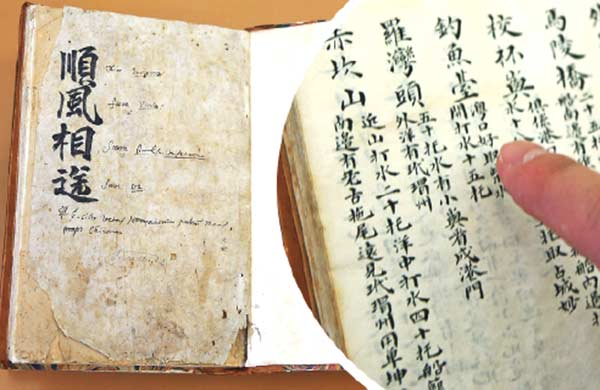
| The original volume of Shun Feng Xiang Song, and an entry about the Diaoyu Islands. [Kevin Wang/China Daily] |
A facsimile edition of two manuscripts that are believed to be the earliest-known historical references to China’s Diaoyu Islands was unveiled at the University of Oxford on Thursday as part of this year’s London Book Fair. China Publishing Group presented the copy of the manuscripts to a group of European Sinologists at Oxford’s Bodleian Library.
The Diaoyu Islands are an uninhabited group of islands in the East China Sea.
The two ancient books, Shun Feng Xiang Song (Voyage With a Tail Wind), and Zhi Nan Zheng Fa (Compass Directions), are believed to be the world’s last existing copies that offer concrete proof of China’s sovereignty over the islands. Both original books are kept at Bodleian Library.
David Helliwell, curator of the Chinese Collection at the Bodleian, said: “These two manuscripts are important because they are the only two surviving manuscripts of the books of this kind. … This is the first time that Diaoyu is mentioned in any Chinese texts, according to what we know.”
The manuscripts are known as rutters, which are charts of compass bearings of sea routes and directions.
“These books must be common, because we know that Chinese merchants were going to all parts of the world in the late Ming Dynasty (1368-1644),” said Helliwell.
Both books record facts about the Diaoyu Islands, written among a list of place names and a list of routes in the charts.
“Diaoyu, these little islands, represent a turning point in that voyage, and they are used as markers from which to take compass bearings,” Helliwell said.
The publication of the facsimile edition is the result of a chance visit last year to the Bodleian Library by Wang Jun, department head of Zhonghua Book Co, which is owned by China Publishing Group. Wang got to know and respect Helliwell.
“Helliwell talked to us and, after a testlike little chat, invited us into the Bodleian’s internal library,” Wang said.
“He may look like a British gentleman, but I know he is Chinese inside and was Chinese in his previous life,” Wang said, praising Helliwell’s passion and knowledge of ancient Chinese books.
Speaking at the launch ceremony, Jiang Jun, vice-president of China Publishing Group, said: “The production of these two books means a lot for preserving and sorting out ancient books and sets an example for international cultural exchange and cooperation.”
The two ancient books were first identified and transcribed by Chinese historian Xiang Da when he was sent by Peking Library on an exchange program to work at the Bodleian from 1935 to 1936.
Shun Feng Xiang Song had been given to the library in 1639 by Archbishop William Laud, who was chancellor of the University from 1620 to 1641. Xiang Da strongly suspected it had been produced in the 16th century. Nan Zheng Fa is part of the Backhouse Collection, which was donated to the library in stages between 1913 and 1922. It is believed to have been written in the late Ming and early Qing (1644-1911) dynasties.
China has successfully created the world’s first production line to turn coal into ethanol, or drinking alcohol, the Chinese Academy of Sciences said on Friday.
Created by Shaanxi Yanchang Petroleum and the academy’s Dalian Institute of Chemical Physics in Liaoning province, the production line went into operation in January and has the capacity to make more than 100,000 metric tons of pure ethanol every year, according to Liu Zhongmin, the institute’s deputy director.
By 2020, China will build a factory capable of producing 1 million tons of ethanol each year using the same technology, he said.
The country currently produces 7 million tons of ethanol each year using other methods, which can “hardly satisfy” its industrial and energy needs, according to Liu.
“Most countries produce ethanol using food, such as corn or sugar cane, but this is not a viable option for China given its massive population,” he said.
“By turning China’s abundant coal resources into ethanol, the technology will help safeguard our energy and food security,”
Moreover, ethanol is a green fuel and versatile ingredient. “Utilizing it could reduce our dependency on fossil fuels, and make our industrial production and energy structure more environmental friendly,” Liu said.
In addition to alcoholic beverages, ethanol can be used to produce thousands of everyday products from plastics to detergents. It can also replace more toxic ingredients, such as methanol, during industrial production.
Other uses include mixing it with petroleum to increase its fuel efficiency and reduce pollution. An abundant supply of ethanol would also make ethanol-fueled vehicles more viable, Liu said.