UK and Japan set to rapidly accelerate defence and security ties with landmark agreement

  • PM will host Japanese leader Fumio Kishida in London today as an RAF fly-past marks his first Guest of Government visit to the UK.

  • Leaders expected to agree in principle a landmark new defence agreement to deepen military ties in the Indo-Pacific.

  • UK and Japan expected to agree joint action to help key economies reduce reliance on Russian energy supplies.

  • Meeting will boost trade links as PM announces new trade envoy to Japan and plans to lifts remaining restrictions on food produce from Fukushima.

The Prime Minister will host his Japanese counterpart today to deepen the UK’s relationship with our closest Asian security partner, and rapidly accelerate collaboration across defence, trade and green energy.

The leaders will agree in principle a Reciprocal Access Agreement, allowing Japanese and British forces to work, exercise and operate together, boosting the UK’s commitment to the Indo-Pacific and further safeguarding global peace and security. The UK will be the first European country to have such an agreement with Japan.

The landmark defence partnership, which will see UK and Japanese Armed Forces deploy together to carry out training, joint exercises and disaster relief activities, will build on our already close collaboration on defence and security technology, such as the Future Combat Air System programme.

Symbolic of the UK and Japan’s close ties, the leaders will observe a Royal Air Force fly past and inspect a Guard of Honour as part of the official welcome to the United Kingdom for Prime Minister Kishida. Prime Minister Boris Johnson said:

As two great island democracies, and the third and fifth largest economies in the world, the UK and Japan are focussed on driving growth, creating highly skilled jobs and ensuring we remain technology superpowers.

The visit of Prime Minister Kishida will accelerate our close defence relationship and build on our trade partnership to boost major infrastructure projects across the country – supporting our levelling up agenda.

As two G7 leaders and each other’s closest security partners in Asia and Europe respectively, tomorrow’s bilateral meetings are expected to focus on Russia’s illegal invasion of Ukraine, and how international alliances can continue to exert maximum pressure on President Putin’s regime while supporting Ukraine and other European countries affected by the barbaric invasion.

They are also expected to agree closer collaboration as part of the UK’s Clean Green Initiative, allowing the UK and Japan to work together to support countries in Asia develop renewables, supporting their transition to green energy and helping to provide alternative supplies to Russian oil and gas.

Deepening trade and investment ties, the Prime Minister will also announce a new trade envoy to Japan – accelerating the strong trade and investment relationship between the two countries.

Greg Clark MP has been chosen to spearhead the next chapter between the UK and Japan, as Japanese companies invest billions of pounds into the UK economy through major infrastructure projects, including windfarms and high speed rail. The announcement comes as the UK negotiates accession to CPTPP, an Indo-Pacific trade block worth $11trn. Japan is chair of the UK accession working group to CPTPP.

During the meeting at Downing Street, the leaders are expected to enjoy food products from the Fukushima region, including Japanese popcorn, as part of the marking the lifting of remaining restrictions on food products from the Japanese region.


UK Prime Minister Boris Johnson announces new Trade Envoy to Japan

Press release

Prime Minister Boris Johnson has appointed a Trade Envoy to Japan.

  • Prime Minister Boris Johnson appoints Greg Clark MP as new Trade Envoy to Japan to reinforce the strong UK-Japan trading relationship.
  • New Trade Envoy will help UK businesses take advantage of opportunities in the third-largest economy in the world.

Prime Minister Boris Johnson has today (Thursday 5 May) appointed Greg Clark MP as Trade Envoy to Japan.

Clark has held positions in HM Treasury and then the Department for Business, Innovation and Skills, where he served as Secretary of State.

The UK has applied to join the Comprehensive and Progressive Agreement for Trans-Pacific Partnership (CPTPP), one of the largest and most exciting free-trading clubs in the world. Japan is its largest economy and the UK’s 13th largest trading partner. Strengthening our relationship is key to the UK’s tilt towards the Indo-Pacific region, expected to be home to half the world’s 2.3 billion middle-class consumers by the end of the decade. Trade Envoys promote UK trade and encourage inward investment from across the world.

Clark’s appointment takes the total to 37 Trade Envoys covering 77 markets across the globe. Trade Envoys are parliamentarians appointed by the Prime Minister, drawn from both Houses and across the political sphere. The role is unpaid and voluntary.

UK International Trade Secretary Anne-Marie Trevelyan said:

I welcome the Prime Minister’s appointment of Greg Clark MP as the new Trade Envoy to Japan. Our Trade Envoys play a vital role in promoting Global Britain across the world, and our trade deal with Japan provides huge opportunities for UK businesses.

The Indo-Pacific region is powering global growth, and Japan is a vital partner for us in the region. I look forward to seeing TE Greg Clark’s excellent work there.

Greg Clark MP said:

I am delighted to have been appointed the Prime Minister’s Trade Envoy to Japan. As Business Secretary from 2016 to 2019, I enjoyed strong relationships with Japan as a hugely significant trading partner with the UK. I look forward to building on this in the role, championing UK businesses and creating more opportunities for our two countries to deepen our already strong ties.

Published 4 May 2022


Russia’s hostile information actions are frankly destabilising the international order

Many thanks indeed, Mr. Chair. And, our thanks to you and the bureau for convening this debate, and for all the work that you do to bring us together to discuss this very important issue of information.

Indeed, information and communications are critical – they shape what people know, what people believe, and often how people act. And it’s important that we should recognise that. As we marked World Press Freedom Day yesterday, more than ever, we know the importance of verified information, and the reporting of facts, as the fundamental building blocks of free societies.

Indeed, we know that good journalism and freedom to report the news accurately and without fear is critical to good governance, and so in turn, critical to realising the ideals of the Charter. Conversely, we know that the rights and responsibilities set out in the Charter die in States where the truth is obscured by state propaganda and where media freedoms are denied.

Mr. Chairman, we commend the Under-Secretary-General for her leadership and the Department’s innovations in response to the complex communications challenges facing us. We had a good discussion on this in our ad hoc seminar recently. We look forward to their stewardship of new initiatives like the Global Code of Conduct and of Integrity in Public Information, two critical projects. The increased engagement reported again this year goes hand in hand with the growing global demand for accurate, impartial and comprehensive information on the world’s most pressing issues. People are looking to the UN now more than ever as a source of trusted information.

We also want to support those in this room who have called for effective multilingualism in that work, as so ably demonstrated just now by our Armenian colleague. The UN’s communications prove that it can rise to the disinformation and misinformation challenges surrounding both the pandemic and the discourse around climate change, and we salute the work they’ve done in this area. There is an opportunity and a need to now expand those efforts to combat disinformation on crises and on conflicts.

This Committee has a duty to ensure that our guidance to the Department on Information is ready to challenge disinformation accurately and captures the reality on the ground in 2022. What is at stake is nothing less than the core principles of the Charter.

Yesterday, our Russian colleague, in response to a statement by another colleague in the room, told us that what was happening in Ukraine, and the communications around it, was not the business of this Committee. And in fact, he read to us the language from our mandate, and I just want to read what he said. He said, “I would like to remind delegates, and the colleagues which support that delegates, that the founding documents of the Committee, which we discussed today, state that its priority goals are to promote establishing a more effective and robust world order in information and communications that will inform the world and international understanding, etc.”

Now, it’s no surprise, Mr Chairman, that in reading us that mandate, our Russian colleague omitted a key part of that mandate as he read it to us, because, in fact, it says, ‘more effective world information and communication order intended to strengthen peace and international understanding’. He dropped that phrase, and he dropped it because, as we know, our Russian colleagues like to bend the truth and fit it to their own purposes.

So, Mr Chair, we will raise Russian behaviour and communications around its invasion of Ukraine because we think that its behaviour in this space is indicative of its broader approach in communications and important to the work of this committee, because since launching its illegal war in Ukraine, the Kremlin’s propaganda machine has been in overdrive. They have used hostile information operations to undermine Ukrainian sovereignty, to create false pretexts for invasion, to obscure the truth, and to hide war crimes.

And this offensive against the truth has global consequences, because Russian disinformation operations threaten to undermine public trust in both media and in public and international institutions.

Let’s look at the facts because Putin wants the truth to be yet another casualty of this conflict. The Russian government said they would not invade Ukraine. They invaded Ukraine. They said they would not target civilian infrastructure. They have remorselessly attacked residential areas, schools, and hospitals – we’ve seen this with our own eyes. They told us, in the Security Council, that Ukraine had developed bioweapons on bats and birds and lice. The UN told us that there was no evidence for this whatsoever. The Russians said they would not harm civilians. Yet, we are seeing strong evidence of war crimes, including reports of mass graves and heinous atrocities in Bucha. And our Russian counterpart, who spoke today, has even used the Security Council’s media stakeout to broadcast across the UN’s own channels an accusation that the UN was spreading disinformation about the attack on the maternity hospital in Mariupol. We all know the appalling truth of what happened to that hospital.

Mr. Chairman, the Russian statement today was typical of its broader communications technique. It was laced with innuendo, but free of facts. Now, we all need to push back against this. And this week, the UK-funded research, has exposed a large scale Russian disinformation operation using a so called ‘troll factory’ that is paid to spread lies on social media and in comment sections on news websites and social media platforms including Telegram, Twitter, Facebook, and Tik Tok. Targets included audiences in the UK, but also in South Africa, and India, and the social media accounts of various world leaders. We’ve alerted the social media platforms and international partners to this.

Our Russian colleague complains about these social media platforms. Well, there’s a reason that they don’t get to broadcast on these platforms. It’s because they have standards. For the same reason, in the UK, our organisation that looks after communications, independent to government, withdrew the broadcasting licence for RT. It’s not because we don’t like what RT says, it’s because their standards of truth fall below an acceptable standard. And, I think anyone who’s seen the broadcast news in the UK knows that our tolerance levels are pretty high. So, the troll factory is just one example, one example of many.

Russia’s hostile information actions are frankly destabilising the international order, particularly when it comes to media, and when it comes to information. We must take steps to counter this. This matters because if they succeed, then we will fail.

So, it’s our aim, Chairman, that through the work of this Committee, the leadership of DG Comms and collaboration with partners and the major platforms, we can mount a robust international response to disinformation and preserve the space for impartial and accurate reporting of the real threats and shared challenges that the UN was founded to address.

Mr. Chairman, anything less risks the very integrity of this organisation.

Thank you.


Health and Social Care Secretary meets with Nottingham maternity review families

  • Health and Social Care Secretary Sajid Javid met today with families involved in the Independent Thematic Review into Nottingham University Hospitals (NUH) maternity services
  • He listened to and expressed understanding about their concerns about the review, and remains committed to driving improvements in care for women and babies
  • NHS England confirms Julie Dent CBE has stepped down as Chair and is carefully considering next steps following engagement with families

The Health and Social Care Secretary Sajid Javid today met with some of the families involved in the review of maternity care at Nottingham University Hospitals to listen to and understand their concerns.

All affected families have now been informed that Julie Dent has, for personal reasons, stepped down as Chair of the review.

The Department of Health and Social Care is working with NHS England to put in place the right leadership to deliver an independent review to urgently bring about real change so that no families have to go through the same pain in the future.

Building on the discussions the Secretary of State had with some families today and on the feedback received so far, all affected families will be contacted by the NHS setting out next steps.

The NHS recognises there is more to do to improve the engagement and communication with families, and this is a priority as a new review process is established.

Health and Social Care Secretary Sajid Javid said:

Today, I met with families to listen and understand their concerns about the review into maternity services at Nottingham University Hospitals. My sympathies remain with all those tragically affected by these harrowing failures and I acknowledge the courage and strength shown by all.

It is crucial that the best possible leadership is in place to deliver an independent review that leads to real change, and I am working with the NHS to deliver on this and ensure no families have to go through the same pain again.

The NHS remains committed to ensuring that the experiences of families, any themes identified across maternity safety incidents, and concerns raised, all drive rapid improvements in care for women and babies in Nottingham.

Maternal patient safety failings are taken extremely seriously, and this is why the NHS is investing £127 million in maternity services to help increase the workforce and improve neonatal care, on top of £95 million to recruit 1,200 midwives and 100 consultant obstetricians.

Funding of £500,000 is also being invested in innovative NHS maternity leadership training. This will run alongside a new core curriculum for professionals working in maternity and neonatal services is being developed by the Maternity Transformation Programme in partnership with professional organisations, clinicians and service users to address variations in skills and safety training across England. This will help the workforce to bring a consistent set of updated safety skills as they move between services and Trusts.

In addition, the Health and Social Care Secretary and NHS have accepted Donna Ockenden’s recommendations from the independent review of maternity services at the Shrewsbury and Telford Hospital NHS Trust, and the NHS is now considering how to implement them at both a national and local level.


Trade Ministers’ Meeting on Economic and Trade Support for Ukraine

News story

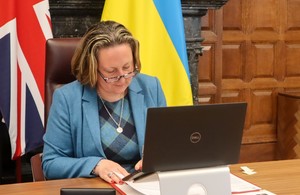
A statement by the Right Honourable Anne Marie Trevelyan MP, Secretary of State for International Trade and President of the Board of Trade, in her capacity as Chair of the 4 May 2022 Ukraine Economic & Trade Support Trade Ministers’ Meeting, on behalf of the United Kingdom and its partners.

Chair’s Statement

  1. The United Kingdom convened a virtual Trade Ministers’ meeting on 4 May 2022, chaired by the Rt. Hon. Anne Marie Trevelyan MP, Secretary of State for International Trade. The United Kingdom called on international allies and partners to work together to support Ukraine’s fight against Putin’s brutal and unprovoked invasion and help ensure the long-term security and prosperity of Ukraine.

  2. Today’s meeting brought together a broad coalition of countries to demonstrate their support for Ukraine and explore options to help Ukraine, in particular its trade and economy. Countries who attended were Ukraine, Argentina, Australia, Canada, Denmark, Estonia, European Commission, Finland, France, Germany, Hungary, Ireland, Italy, Japan, Latvia, Lithuania, New Zealand, Norway, Poland, Republic of Korea, Romania, Switzerland, the United Kingdom, and the United States of America.

  3. Ukraine’s First Deputy Prime Minister and Minister of Economy, Yulia Svyrydenko, provided an update on the present situation, outlined Ukraine’s immediate and future needs, and explained how best the international community can support Ukraine’s trade and economy.

  4. There was a comprehensive exchange of views on key measures to support Ukraine’s trade, economy, and recovery. Ideas and measures focussed on, but were not limited to, logistical and financial support, reconstruction, improving market access and the liberalisation of tariffs, support to Ukrainian businesses and trade associations. Partners also discussed the range of humanitarian measures they are taking, including the provision of support for refugees.

  5. Trade is a vital tool available to the international community to assist Ukraine. The United Kingdom was pleased to provide a forum in which to exchange views on economic and trade support options for Ukraine both in the immediate term and in longer-term reconstruction efforts.

  6. Countries agreed to work cooperatively on further measures and to reconvene as soon as possible.

Published 4 May 2022