New Bill to enable implementation of Australia and New Zealand trade deals

  • Bill will ensure Government is ready to enter the two trade agreements.
  • UK businesses can grow and take advantage of greater access into these markets.
  • Both the Australia and New Zealand deals will remove tariffs on 100 percent of UK goods exports, benefiting UK businesses.

The UK government has today introduced a bill which will help to bring into force its first independently negotiated Free Trade Agreements in more than 50 years.

The UK signed the Australia Agreement in December and the New Zealand Agreement in February. Together, they will deliver benefits to people, businesses and communities throughout the country and support the levelling-up agenda.

The UK-Australia Agreement is expected to increase trade by 53 percent, boost the economy by £2.3 billion and increase wages each year in the long-run. The UK-New Zealand Agreement is expected to increase trade by almost 60 percent and boost the economy by £800 million.

International Trade Secretary Anne-Marie Trevelyan said:

I am excited to see the UK implement its first ‘from scratch’ Free Trade Agreements in over 50 years and deliver on a key Brexit benefit – having our own independent trade policy.

This Bill will enable us to export our world-class goods and services and bring high-quality imports at reduced rates for British customers.

Introducing this Bill is an important step in ratifying these trade agreements so that UK businesses can begin benefiting and expanding their trade with Australia and New Zealand as soon as possible. To bring these agreements into force, the following will have to happen:

  • Parliament must formally scrutinise the agreements under the Constitutional Reform and Governance Act.

  • The Trade (Australia and New Zealand) Bill has to be agreed by Parliament.

  • Necessary secondary legislation has to be passed by Parliament to make the changes required to our procurement regime to meet the terms of the Agreements.

  • Only once the steps above have been completed can these agreements be ratified and brought into force.

In line with our commitment to transparency and scrutiny, the government has:

  • Published the full text for both agreements as soon as they were signed, along with full independently scrutinised impact assessments.

  • Ensured the Trade and Agriculture Commission – a panel of independent experts – has over three months to report on the agreements. The Trade & Agriculture Commission’s report on the UK-Australia Agreement was published on 13 April. The Commission is due to report on the UK-New Zealand Agreement in June.

International treaties are negotiated and then entered into force by the government. Treaties do not always require legislation to come into force, but on some occasions changes to domestic law might be needed to implement a trade deal. For these agreements, this Bill will change our rules on procurement which in turn will widen access for UK suppliers to procurement opportunities in Australia and New Zealand. The changes are needed to give Australian and Kiwi suppliers rights to access the benefits of the Agreements.

The new commitments in free trade agreements like these will not affect the power the UK has to reform its domestic procurement rules.

Both the UK-Australia and UK-New Zealand free trade agreements include commitments to addressing climate change like decarbonisation and increasing innovation in green sectors.

For the first time, UK service suppliers including architects, scientists, researchers, lawyers and accountants will have access to visas to work in Australia without being subject to Australia’s changing skilled occupation list. Britons aged 18 to 35 will also be able to travel and work in Australia with a Working Holiday Maker Visa for up to three years.

The agreements include protections for the agriculture industry and food and drink quality standards, with all imports needing to comply with the UK’s food regulations.


Lord-Lieutenant of Gwynedd celebrates high achievers from the Armed Forces community

Her Majesty’s Lord-Lieutenant of Gwynedd, Edmund Seymour Bailey Esq CStJ FRAgS appointed Cadet Flight Sergeant Duncan at an awards ceremony at Caernarfon Army Reserve Centre, Caernarfon, on April 28.

The role, which lasts for one year, includes attendance with the Lord-Lieutenant at a number of official engagements such as Remembrance events, Royal visits and parades.

More than 50 people attended the event, to mark the new appointment which will see Ysanne represent her peers and respective organisations at local and national level occasions.

Cadet Flight Sergeant Duncan will follow in the footsteps of Cadet Sergeant Elise Faragher from Tywyn, of Clwyd and Gwynedd Army Cadet Force and Cadet Flight Sergeant Mia Jones from Anglesey, of No 2 Welsh Wing RAF Air Cadets who were both awarded the Lord-Lieutenant’s Certificate and Badge for being the 2021 representatives.

At the ceremony which recognised high achievers from the reserves and cadet communities, two adults were recognised for their outstanding service and devotion to duty and awarded the Lord-Lieutenant’s Certificate of Merit.

They were Staff Sergeant Instructor Louise Hughes of Clwyd and Gwynedd Army Cadet Force and Mrs Ann Kennedy of Holyhead Sea Cadet Corps.

There are nearly 5,000 cadets in Wales who gain skills and qualifications through working with local communities, charities and taking part in a variety of practical activities. The cadet syllabus is delivered by 1,500 volunteering adult Instructors and civilian assistants, who give up their spare time on weeknights and weekends.

The awards ceremony was organised by RFCA for Wales – an organisation that has supported the Armed Forces for over 100 years.


Roofers and builders reminded to follow duty of care

Press release

The Environment Agency is reminding roofers and builders in Devon and Cornwall to take responsibility for their waste.

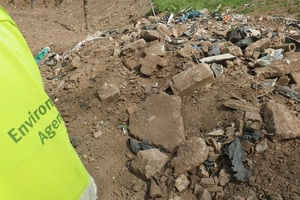
Environment Agency officer inspecting a heap of rubble and waste

Asbestos is a hazardous material and must be disposed of properly

Most roofers and builders are law-abiding and take their duty of care seriously when it comes to waste management. But the reminder comes after agency officers found a large amount of buried asbestos waste when executing a search warrant at a site in the South West. The operator of the site was arrested by the police and questioned.

Asbestos and other hazardous wastes require disposal by specialist contractors at sites that can legally and safely handle it. Mishandling it creates a serious risk to public health, the environment and wildlife.

Kevin Baker of the Environment Agency said:

Tradespeople that create waste, especially during activities like construction and roofing, must make sure that waste goes to a site legally able to accept it. Roofing tiles often contain asbestos so make sure you know what you’re dealing with.

When waste is transferred between different parties it needs a waste transfer note. If a site or waste operator asks for cash for tipping, and provides zero paperwork to you, then be suspicious. If it sounds too good to be true, it probably is.

If you get rid of asbestos or other waste at illegal sites, don’t be surprised if you get a knock on the door.

Unscrupulous people posing as genuine waste collectors cause serious harm to the environment by taking construction waste and dumping it. This waste causes air, ground and water pollution and odour issues. Criminal actions like this also undermine legitimate waste collection businesses.

Managers, owners, and staff of all construction businesses must use a registered waste carrier to collect, recycle or dispose of their waste. Check the Environment Agency public register of waste carriers before using them. Make sure the waste is accurately described and know where your waste is going. Follow the EA blog for all the steps builders can take to follow their duty of care.

Anyone who suspects illegal waste activity can report it anonymously to Crimestoppers on 0800 555 111.

Published 11 May 2022


Prime Minister signs new assurances to bolster European security: 11 May 2022

  • Prime Minister Boris Johnson visiting Sweden and Finland today to fortify European security

  • Nations to sign mutual security assurances with the UK to tackle traditional, hybrid and cyber threats

  • Security declarations will see a step-change in defence and security cooperation, including the sharing of new intelligence and joint military operations

The Prime Minister is signing historic declarations with Sweden and Finland today to reinforce their security and fortify northern Europe’s defences, in the face of renewed threats.

As fellow liberal democracies, and members of the Joint Expeditionary Force, both nations are already vital security partners in Northern Europe, with world-leading defence capabilities and cutting-edge technology development.

Visiting Harpsund, the Swedish Prime Minister’s country residence, and Helsinki, the Prime Minister will set out the UK’s intention to support the two nations’ armed forces should either face crisis or come under attack.

This morning the Prime Minister signed mutual security assurances with Prime Minister Andersson in Sweden, and this afternoon he will travel to Finland to sign a similar security declaration with President Niinistö.

The declarations will see a step-change in defence and security cooperation between the UK and each country, intensifying intelligence sharing, accelerating joint military training, exercising and deployments, and bolstering security across all three countries and northern Europe.

They will also see the UK bolster its collaboration on traditional threats facing all three nations, while working also with Sweden and Finland to tackle new geopolitical challenges, such as hybrid and cyber threats.

The Prime Minister will also make clear the UK’s unwavering support for NATO’s open door policy during the visit.

Prime Minister Boris Johnson said:

We are steadfast and unequivocal in our support to both Sweden and Finland and the signing of these security declarations is a symbol of the everlasting assurance between our nations.

These are not a short term stop gap, but a long term commitment to bolster military ties and global stability, and fortify Europe’s defences for generations to come.

The declarations signed today will allow the UK to cooperate with key Nordic partners and their armed forces, in all domains, including cyberspace. They will also allow for closer collaboration on new technology and intelligence gathering.

As part of increased defence cooperation with Sweden and Finland, the Prime Minister will offer to increase deployments to the region, including with Royal Air Force, British Army and Royal Navy assets and personnel.

Both Sweden and Finland have played a key role in supporting Ukraine to defend itself in recent weeks and months, while British, Swedish and Finnish forces have exercised together across the High North and the Baltics.

Both nations are part of the UK-led Joint Expeditionary Force taskforce, which brings together 10 countries in support of stability and security in the North Atlantic, Baltic Sea Region and the High North. The assurances made today build on the already close ties of that defence grouping.

Today’s visit comes after the Prime Minister welcomed the Swedish and Finnish leaders to Downing Street in March to discuss closer security and defence ties.


NET ZERO PROGRAMME: Looking beyond carbon emissions

The Climate Change Act 2008 is the UK’s approach to reducing emissions and preparing for climate change. It set a statutory target to reduce UK Greenhouse Gas (GHG) Emissions by at least 80 percent (against 1990 levels) by 2050. Then in June 2019, secondary legislation was passed that extended that target to “at least 100 percent”. Simply put, if this audacious target is met it will mean the UK will stop contributing to global emissions by 2050.

The property industry has a huge role to play in reducing carbon emissions: according to the UK Green Building Council, the UK built environment (buildings and infrastructure) is responsible for 25 percent of UK greenhouse gas emissions. And a recent United Nations report shows the global building industry alone contributes 38 percent of total global emissions.

Leading the Government’s drive towards emissions reduction is the Government Property Agency (GPA) – the public sector property holding company responsible for delivering the Government’s property agenda across its office and warehouse portfolios. The GPA currently manages more than 700,000 square metres of office estate across the UK. Its vision is a transformed, shared, sustainable and value for money government estate. To achieve this the GPA is rationalising, refurbishing and retrofitting the existing estate, as well as constructing modern, sustainable, digitally-connected and inclusive Government Hubs.

Crucially, the GPA is aiming to go beyond just reducing carbon emissions. It’s also minimising consumption of energy, water and waste, improving resilience to climate change (temperature change, flood risk etc.) and reducing carbon embodied in construction.

In late 2020, the GPA established a Net Zero Programme which is being delivered in strategic partnership with Atkins/Faithful+Gould. The Programme exists to:

  • Improve energy efficiency (reduce consumption)
  • Increase the use of green energy (decarbonise)
  • Generate and store green energy (locally)
  • Reduce embodied carbon (in construction) for the Government’s office portfolio

One year, many successes

In just one year of its Net Zero Programme, the GPA has already made carbon savings to the equivalent of more than 2,000 flights from London to New York, or planting circa 47,000 trees.

Net Zero and sustainability initiatives are being designed into spaces as early as possible, starting from construction design where possible. For example, the Croydon Hub new build – which is designed to exceed BREEAM Excellent – is generating solar gain through building facades

In Titchfield, energy usage from lighting has been reduced by a forecasted 75 percent by replacing circa 2,000 aged luminaries with modern LED lighting products. This also returned significant maintenance cost savings, and saw 100 percent of the packaging from the upgrade works returned to the supplier to reuse for the next supply of lighting.

Ageing external car park and access lighting has been replaced in Coventry returning an estimated 60 percent energy saving.

Lagging was installed to more than 2,000 metres of pipework on the Whitehall boiler system in London. This, along with new plate heat exchanges, will achieve greater than 17 percent carbon reduction, with an expected 91 percent carbon reduction when the project is completed.

An obsolete Building Management System (BMS) was replaced in Nottingham with a modern system that is allowing more efficient building control strategies. This is creating a more comfortable environment for building users, as well as offering greater insights into how the building can be better managed to maximise efficiencies.

But it doesn’t stop there:

  • 43 lighting upgrade projects have been completed across 20,000 light fittings
  • Heat pumps are being installed at six sites to support heat decarbonisation
  • 60 sites are being upgraded to smart metering for more efficient energy usage monitoring and data-driven decision making
  • 100 percent green tariff electricity is being provided to all GPA-managed buildings
  • Targeting 80 percent material designed for reuse and 50 percent reused

Looking forward to a sustainable future

The Government has made the additional commitment to achieve a 78 percent reduction in carbon emissions across the public sector by 2035 (against a 2017 baseline). Leading by example when it comes to making buildings Net Zero and sustainable, the GPA has committed to reaching the same target (to reduce emissions by 78 percent by 2035) for Government offices – the ones that it manages – by 2032, three years ahead of the Government’s target.

The property industry as a whole faces many unique challenges in the journey to Net Zero. By looking beyond carbon emissions, it’s clear there are opportunities to take great strides in achieving a carbon neutral society.

Find our more about the Government Property Agency here.