News story: GC team contributes to ongoing discussions on honey authenticity

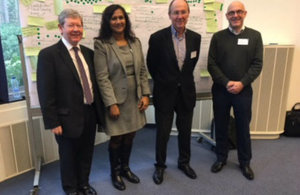
GC team at meeting with Franz Ulberth Michael Walker, Selvarani Elahi, Franz Ulberth and John Warren

Validating honey authenticity claims with regards to botanical source or geographical origin is a global issue. An EU Coordinated Control Plan on honey adulteration indicated that 38% of the 2,264 honey samples examined in the EU were non-compliant with authenticity criteria.

The European Commission’s Joint Research Centre (JRC) convened a Technical Round Table on Honey Authentication on 25 January 2018 to help in the fight against food fraud.

The meeting was opened by the Director of the JRC, Elke Anklam and was chaired by Franz Ulberth (Head of Fraud Detection and Prevention at JRC). It was attended by approximately 45 delegates from EU member States and included policy officials, academic researchers, Official Control Laboratory scientists, industry scientists and the Chairman of the UK Honey Association. Selvarani Elahi, Michael Walker and John Warren, from the UK Government Chemist team, attended and contributed to the meeting.

The meeting identified many technical areas where further work and clarity would be beneficial for the authentication of honey. These will be covered in a forthcoming note from the JRC.

Published 7 February 2018


Press release: British Prime Minister appoints Trade Envoy for Sri Lanka

Ranil Jayawardena, MP, as British Prime Minister's trade envoy for Sri Lanka Ranil Jayawardena – UK trade envoy for Sri Lanka

Mr Jayawardena’s role as trade envoy will be to support and enhance the development of Britain’s trade and investment with Sri Lanka.

The Prime Minister’s Trade Envoy will be visiting Sri Lanka from 15th to 17th February to meet with senior members of the government and engage with British business’s working in Sri Lanka.

Mr. Jayawardena was elected as the Member of Parliament for North East Hampshire in May 2015 and was reelected in 2017. He has a degree in government from the London School of Economics. In Parliament he is the chair of the All Party Parliamentary Group (APPG) on Sri Lanka. Mr. Jayawardena’s father is of Sri Lankan origin.

Mr. Jayawardena said:

Given the shared history and close bonds of friendship between Britain and Sri Lanka – and with my family ties to Sri Lanka – I am looking forward to serving as the Prime Minister’s Trade Envoy at an exciting time for both our countries.

There’s lots of scope for further trade and investment between Britain and Sri Lanka. I recently visited ‘Port City’, one among many initiatives that the Sri Lankan Government is pushing forward that demonstrate its commitment to creating the right conditions for economic growth. Port City will provide a range of opportunities for UK-based professional services to work with Sri Lankan partners to take forward our shared ambitions to develop international business. I am confident that engagement by the UK’s professional services sector will help Port City to attract international investment and build its reputation.

British High Commissioner to Sri Lanka James Dauris said:

For centuries Britain has been a global trading nation. Today we have one of the world’s largest economies and strong commercial relationships with countries around the globe. As the Sri Lankan economy grows we are seeing an encouraging increase in the number of British companies wanting to do business with Sri Lanka. Mr. Jayawardana’s appointment will help us to encourage more UK firms to look at options for doing business in and with Sri Lanka and to boost bilateral trade.

Published 7 February 2018


News story: Investigation into the policy and process followed by the Victim Contact Scheme in the Worboys case

On 19 January, Secretary of State David Gauke told Parliament he had asked Chief Inspector of Probation, Dame Glenys Stacey, to urgently review the way the victim contact scheme engaged with victims in the Worboys case.

Dame Glenys Stacey has completed this report and submitted her findings to the Justice Secretary.

Investigation into the policy and process followed by the Victim Contact Scheme in the Worboys case

Receiving the report, Secretary of State David Gauke said:

I am extremely grateful for Dame Glenys Stacey’s thorough report into the operation of the Victim Contact Scheme in the Worboys case – it will be an invaluable part of our urgent work to review parole transparency and victim contact.

It is reassuring that the correct procedures were followed and that in some respects Victim Liaison Officers have gone above and beyond the victim contact requirements.

However, I fully accept that there are things we can do much better. That’s why we have already changed the letters we send to victims to make them more compassionate, clearer and more informative, but there is more to do. We will take these findings and improve the system.

Read the Secretary of State’s oral statement on Transparency of the Parole Board and Victim Support


News story: £60m farming productivity fund launched at Dairy-Tech

Speaking to attendees and delegates at this year’s Dairy Tech event held in Stoneleigh Park, Minister Eustice praised the variety of technology on show at the event and explained how farmers can benefit from the grants.

Many of the items eligible for funding are highly relevant to the dairy sector, including specialist foot trimming crushes and calving detectors, but there is a range of innovative items from which the majority of farmers can find something they would want to apply for.

Farmers can apply online to the Countryside Productivity Small Grant Scheme, requesting a grant between £3,000 and £12,000 towards the costs of farm equipment.

Opening the event alongside Lord Curry and the Chairman of the RABDF Mike King, Minister Eustice explained how the scheme has been designed with simplicity in mind, to save farmers valuable time.

Farming Minister George Eustice said:

It’s fantastic to see the scale of innovation here in Stoneleigh, where over 250 exhibitors are showcasing some truly advanced products and services which have come to the market for dairy farmers to improve productivity.

The dairy industry is our largest agricultural sector and we want to make sure farmers can become more resilient, competitive and able to capitalise on the growing global interest in quality British produce as we leave the EU.

By opening this small grants scheme, we hope more farmers will be able to access this equipment and embark on more innovative and ambitious projects.

Last year Defra also opened a series of offers for larger grants through the Countryside Productivity scheme. Farmers can apply for grants of over £35,000 for a range of different projects, including for making more efficient use of resources, processing products, and other innovative projects.


News story: New National College for the nuclear industry launches

A new college that will train thousands of technicians and engineers to support Britain’s future nuclear programmes, create cleaner energy and provide a highly skilled workforce has opened its doors today (7 February).

The National College for Nuclear has hubs in Cumbria (Lakes College) and Somerset (Bridgwater & Taunton College), and state of the art facilities that include virtual, simulated laboratories. The college will help thousands of young people and learners gain the knowledge and skills they need to work in the growing nuclear sector, that provides vital low carbon power to businesses across the country.

The facility is one of five National Colleges being established by the government. The colleges are a key part of the Industrial Strategy, the Government’s plan to develop the technical skills of young people, provide industry with a skilled workforce across a range of sectors and support the country’s long-term economic growth. Other colleges already open include the College of Creative and Cultural Industries; Digital Skills and High Speed Rail.

The growing nuclear sector will see the development of twelve new reactors across five sites in the future, and with approximately 6,000 people each year needed for technical and professional roles, the National College for Nuclear will key part of producing the workforce and expertise required.

Apprenticeships and Skills Minister Anne Milton said:

I am thrilled to announce the launch of the National College for Nuclear.

This College will provide our nuclear industry with the highly skilled engineers, scientists, technicians it needs to grow – as well as giving more people the opportunities they need to get on in today’s competitive job market.

The impressive training facilities in Somerset and Cumbria demonstrate what can be achieved when Government, employers and providers work together to deliver high-quality education. I wish all the trainees and apprentices the very best of luck for the future as they embark on this exciting journey.

Leading nuclear industry experts Sellafield Ltd and EDF Energy will work alongside the University of Cumbria and the University of Bristol to train up to 3500 learners by 2020.

Stuart Crooks, EDF Energy’s Hinkley Point C Managing Director, said:

EDF Energy is proud to be a partner in the National College for Nuclear. It will support the new nuclear renaissance in Britain and is a prime example of industrial strategy in action.

The southern hub in Somerset will stand alongside the excellent training facilities at Bridgwater & Taunton College which are already helping to provide essential skills needed for Britain’s economy. Together they show the big and positive impact new nuclear is having on jobs, skills and industrial capacity.

Chairman of the National College for Nuclear Colin Reed said:

It is with pride and expectation that we open the Northern and Southern hubs of the National College for Nuclear today. The journey to this point has been challenging and rewarding. We have students in place at both hubs benefiting from high level vocational education in state of the art facilities that were funded through Government vision.

From this start we are poised to grow to meet the challenge of nuclear skills in the years to come, both in student numbers at the existing hubs and also as we add further training deliverers at other locations to support the National demand.

Business Minister Richard Harrington said:

This is a pivotal moment for the future of nuclear energy in the UK. Through our Industrial Strategy, we are building a Britain fit for the future. These new learning hubs will give young people a fantastic opportunity to enter a highly skilled and well paid industry.