News story: Extra checks make form DS1 more secure

We have started to make more checks when customers apply to remove a mortgage from a title register. The new checks will help to identify and prevent fraudulent applications at the earliest opportunity, but some applications to remove a mortgage may take longer to complete.

Property fraud is a risk that is constantly evolving. The new checks are a necessary part of the continuous improvement to our counter-fraud processes and systems.

Customers can apply to remove a mortgage from the register by using one of 3 ways:

When customers apply to remove a mortgage with form DS1, the extra checks mean it may take us longer to complete the application.

Customers can help by removing mortgages from the register using an e-DS1 or an electronic discharge. These are submitted directly by the lender or their agent and help to reduce the risk of property fraud. They will also help customers avoid delays with their applications.

Lenders can also help by responding quickly to our checks.

Maintaining the integrity of the Land Register is vital because it provides:

  • a reliable record of information about the ownership of and interests affecting land and property

  • land and property owners with a title which is guaranteed by the state

  • the financial sectors capability to secure lending against property


News story: Don’t be a victim of ‘Insolvency Service’ telephony scam

Don’t be a victim of ‘Insolvency Service’ telephony scam – GOV.UK

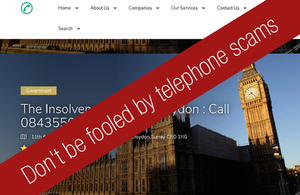
Members of the public are being warned not to fall for a telephony scam which asks you to make unnecessary and premium-rate calls to the Insolvency Service.

A screenshot of the rogue website

The Insolvency Service has been made aware of a scam where members of the public are receiving telephone messages to make unscheduled and unnecessary calls to the Insolvency Service.

Not only are unsuspecting members of the public being asked to make unnecessary calls but they are being asked to dial a telephone number that although does connect to the Insolvency Service, is not one of our official numbers and is a premium-rate number that costs a lot of money.

The scam appears to be instigated by a website based outside of the UK, helplinecall.com, which provides direct telephone numbers of businesses in the UK but when used, will cost the caller a lot of money.

The following tips will help prevent you being made another victim of telephony scams:

  1. If you’re being asked to call the Insolvency Service but you are not going through a bankruptcy or insolvency matter – be careful as it could be a scam phone call

  2. Take a look at the number you’re being asked to call – if it looks like it’s a premium rate number then it might not be legitimate

  3. If you’re still unsure about the number, check the official Insolvency Service website to see if it is one of our numbers

  4. You can also check numbers using a standard search engine as if it is a legitimate number you will be taken to an official website

  5. If you think you’re a victim of a scam – report it to our friends at Action Fraud (0300 123 2040) or to the Insolvency Service directly

Published 3 April 2018


News story: SpaceX delivers UK missions to International Space Station

International Space Station. Credit: NASA.

In the cargo hold is a UK-built satellite that will test different approaches to removing space junk from the Earth’s orbit, as well as an international science package to study powerful lightning from space.

Led by the University of Surrey, built by the world’s leading small satellite manufacturer Surrey Satellite Technology Limited, and with technology on board designed by Airbus, the RemoveDEBRIS mission will experiment with cost effective technologies that could be used to tackle the problem of space junk.

Science Minister Sam Gyimah said:

“Space debris is one of the key challenges we face and it’s great to see a British university and some of our innovative space companies leading the way on the search for solutions. It’s also a fantastic example of the unique expertise found in the UK’s growing space sector and the value that it adds to international projects.

“The UK Space Agency continues to work closely with industry to develop new technologies and infrastructure to grow our share of the global space market as part of the Government’s industrial strategy.”

The RemoveDEBRIS satellite will be deployed from the International Space Station and attempt to capture simulated space debris using a net and a harpoon, while also testing advanced cameras and radar systems. Once those experiments are complete, it will unfurl a drag sail to bring itself and the debris out of orbit, where it will burn up as it enters the Earth’s atmosphere.

The experiment is important as there are thousands of pieces of space debris circulating the planet – many travelling faster than a speeding bullet – posing a risk to valuable satellites and even the International Space Station itself.

Professor Guglielmo Aglietti, Director of the Surrey Space Centre at the University of Surrey, said:

“It is important to remember that a few significant collisions have already happened. Therefore, to maintain the safety of current and future space assets, the issue of the control and reduction of the space debris has to be addressed.

“We believe the technologies we will be demonstrating with RemoveDEBRIS could provide feasible answers to the space junk problem – answers that could be used on future space missions in the very near future.”

Also on board the SpaceX Dragon capsule is a science experiment known as the Atmosphere-Space Interactions Monitor (ASIM), which will study high-altitude lightning above severe thunder storms. Scientists are interested in these electrical discharges which can produce bright colours – sometimes called red sprites and blue jets – as they can alter the chemistry of the stratosphere and potentially affect the Earth’s climate. ASIM is travelling to the International Space Station in the trunk compartment of the Dragon capsule. Once it arrives, the station’s robotic arm will transfer the payload from the capsule to the external payload facility on the European Space Agency’s (ESA’s) Columbus module.

Dr Martin Fullekrug, the lead UK scientist on the project based at the University of Bath, said:

“I have been researching and investigating space and lightning events for over 15 years and the launch of ASIM feels like the pinnacle of my journey into understanding this phenomenon.

“This is the first time such a detailed and technologically-advanced measurement device will be flown into space to observe lightning and will hopefully provide us with new knowledge about how lightning is initiated and how the properties of lightning can affect our daily lives in so many different ways.”

The experiment, part funded by the UK Space Agency through our investment in ESA and built by the Danish company Terma, will be operated by ESA with involvement from scientists in the UK.

Dr Graham Turnock, Chief Executive of the UK Space Agency said:

“This experiment will give scientists all over the world the opportunity to study the effects of powerful lightning storms from the unique vantage point of the International Space Station. It’s another exciting moment for international space collaboration and commercial spaceflight, which the UK Space Agency supports through the Government’s Industrial Strategy.”


Press release: Government confirms UK ban on ivory sales

The UK will introduce a ban on ivory sales, Environment Secretary Michael Gove confirmed today as he set out our plans to help protect elephants for future generations.

The Government is publishing the response to its consultation on a UK ivory sales ban, and confirming robust measures that will be brought into force through primary legislation.

The ban will cover ivory items of all ages – not only those produced after a certain date. The maximum available penalty for breaching the ban will be an unlimited fine or up to five years in jail.

There were more than 70,000 responses to the consultation, with over 88 percent of responses in favour of the ban.

The number of elephants has declined by almost a third in the last decade and around 20,000 a year are still being slaughtered due to the global demand for ivory.

Environment Secretary, Michael Gove said:

Ivory should never be seen as a commodity for financial gain or a status symbol, so we will introduce one of the world’s toughest bans on ivory sales to protect elephants for future generations.

The ban on ivory sales we will bring into law will reaffirm the UK’s global leadership on this critical issue, demonstrating our belief that the abhorrent ivory trade should become a thing of the past.

In line with the approach taken by other countries, including the United States and China, there will be certain narrowly-defined and carefully-targeted exemptions for items which do not contribute to the poaching of elephants.

The exemptions have been tightened since the Government published its proposals for consultation, but still provide balance to ensure people are not unfairly impacted:

  • Items with only a small amount of ivory in them. Such items must be comprised of less than 10% ivory by volume and have been made prior to 1947.
  • Musical instruments. These must have an ivory content of less than 20% and have been made prior to 1975 (when Asian elephants were added to CITES).
  • Rarest and most important items of their type. Such items must be at least 100 years old and their rarity and importance will be assessed by specialist institutions such as the UK’s most prestigious museums before exemption permits are issued. In addition, there will be a specific exemption for portrait miniatures painted on thin slivers of ivory and which are at least 100 years old.
  • Museums. Commercial activities to, and between, museums which are accredited by Arts Council England, the Welsh Government, Museums and Galleries Scotland or the Northern Ireland Museums Council in the UK, or the International Council of Museums for museums outside the UK.

By covering ivory items of all ages and adopting these narrow exemptions, the UK’s ban will be one of the toughest in the world. The US federal ban exempts all items older than 100 years as well as items with up to 50% ivory content. The Chinese ban exempts ivory “relics”, without setting a date before which these must have been produced.

The UK is already showing global leadership in the international fight against the illegal ivory trade, and at a recent European Environment Council called for EU member states to follow the Government’s lead and ban commercial trade in raw ivory – which is already banned in the UK – within the EU as soon as possible.

In October, the UK will host the fourth international conference on the illegal wildlife trade, bringing global leaders to London to tackle the strategic challenges of the trade. This follows the ground breaking London 2014 conference on the illegal wildlife trade, and subsequent conferences in Botswana and Vietnam.

A ban on ivory sales in the UK would build on government work both at home and overseas to tackle poaching and the illegal ivory trade. The UK military is training African park rangers in proven poacher interception techniques in key African countries, and Border Force officers share their expertise in identifying smuggled ivory with counterparts worldwide to stop wildlife trafficking.

The CEO of Tusk Trust, Charlie Mayhew MBE said:

We are delighted that the Government has listened to our concerns and given the overwhelming public response to their consultation is now moving decisively to introduce tough legislation to ban the trade in ivory in the UK.

The narrowly defined exemptions are pragmatic. The ban will ensure there is no value for modern day ivory and the tusks of recently poached elephants cannot enter the UK market. We welcome the fact that Ministers are sending such a clear message to the world that the illegal wildlife trade will not be tolerated and every effort will be made to halt the shocking decline in Africa’s elephant population in recent years.

Tanya Steele chief executive at WWF said:

Around 55 African elephants are killed for their ivory a day, their tusks turned into carvings and trinkets. This ban makes the UK a global leader in tackling this bloody trade and it’s something WWF has been fighting hard for.

But if we want to stop the poaching of this majestic animal, we need global action. We hope the UK will continue to press countries where the biggest ivory markets are, most of which are in Asia, to shut down their trade too.

ZSL Director of Conservation, Matthew Hatchwell, said:

Legal domestic ivory markets are intrinsically linked to the illegal ivory trade that is driving the current poaching crisis. With almost 20,000 elephants poached in the last year, it is vital that countries take significant steps such as those outlined by the UK government today to close their markets and help make the trade in ivory a thing of the past. No one in the UK today would dream of wearing a tiger-skin coat. Thanks to this move, in a few years’ time we believe the same will be true for the trade in ivory.

John Stephenson, CEO Stop Ivory said:

This is a significant day for the future of elephants. The UK government has taken a momentous step. The proposed ban, with its narrow and clear exemptions, places the UK at the forefront of the international determination to halt the extermination of elephant populations by banning trade in ivory. The Secretary of State for DEFRA has shown clear leadership in demanding legislation whilst there is still time to secure a future for elephants in the wild.

The end of the ivory trade in the UK removes any hiding place for the trade in illegal ivory, and sends a powerful message to the world that ivory will no longer be valued as a commodity. Ivory belongs on an elephant and when the buying stops the killing will stop.

As profits become ever greater, the illegal wildlife trade has become a transnational organised enterprise, estimated to be worth up to £17 billion a year.

The further decline of elephants would also deprive some of the poorest countries in the world of their valuable natural capital, affecting economic growth and sustainable development.


News story: MAIB safety digest 1/2018 published