Press release: Royal Navy Ship HMS Albion to visit Indonesia 22-25 April 2018

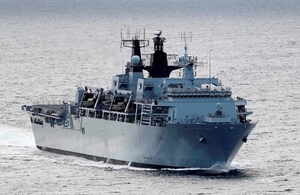
The British Royal Navy ship HMS Albion The British Royal Navy ship HMS Albion

The British Royal Navy ship HMS Albion will be docked at Tanjung Priok port in Jakarta for a three day visit, aimed to increase defence engagement with the Indonesian Armed Forces. During the visit, members of the ship crew will conduct bilateral talks with the Indonesian Navy, UK defence industry and visit a local orphanage.

British Ambassador Moazzam Malik, said:

We have a growing defence relationship with Indonesia that supports our joint security interests and promotes prosperity. The deployment of HMS Albion in Indonesia provides an opportunity to support our partners in delivering maritime security in the region. Like Indonesia, the UK has a strong maritime history. We share a naval trading heritage. We will both remain maritime nations. It is in both of our interests to enjoy secure, accessible and sustainable maritime domains.

Captain Tim Neild, HMS Albion’s Commanding Officer, said:

HMS Albion is a very capable warship, manned by a crew of highly trained and hugely professional sailors and Royal Marines and we are greatly looking forward to visiting Jakarta to help strengthen the bonds between the UK and Indonesia. The presence of the Royal Navy’s flagship in Asia-Pacific demonstrates that the UK is ready to work with our friends and allies to promote peace, security and prosperity throughout this vital region.

Notes to Editors

  1. HMS Albion is a Landing Platform Dock – a type of amphibious operations vessel with a small force of embarked Royal Marines.
  2. HMS Albion will be visiting Jakarta at the same time as the French Navy ship FS LHD Dixmude and Frigate Surcouf
  3. Media are invited to attend the welcome ceremony and tour of HMS Albion at Tanjung Priok port on Sunday, 22 April at 1100hrs (JICT 2, Dermaga 203 Kaluku)
  4. Crew of HMS Albion will also be visiting Nuruz Zahroh orphanage for social activities on Sunday, 22 April at 1330hrs. Logistics for media will be provided.
  5. For further information please contact Embassy’s press officer Raras Tulandaru at raras.tulandaru@fco.gov.uk

Published 20 April 2018


News story: Foreign Secretary launches Platform for Girls’ Education

At a launch reception attended by Ms. Meghan Markle and HRH Prince Harry, the Foreign Secretary Boris Johnson made his case to global leaders to sign up to 12 years of quality education for the world’s most marginalised girls.

Britain will lead by example and will provide £212 million in UK aid money to help one million vulnerable girls across the Commonwealth receive 12 years of quality education by 2030.

Mr Johnson also launched his Platform for Girls’ Education, a group of 12 influential figures from across the Commonwealth to drive forward the political momentum on girls’ education. The group will hold countries to account and champion best practice across the Commonwealth. Amina Mohammed, the Kenyan Cabinet Secretary for Education will co-chair.

Foreign Secretary, Boris Johnson said:

Girls’ education is the Swiss Army knife, the Rosetta Stone, the Black and Decker toolkit that solves a multitude of the world’s problems.

Educating girls is in all our interests. If we fail, we store up huge problems for the future and wilfully miss out on boosting economic growth, managing population pressures and creating stable, prosperous societies.

As a Commonwealth we’ve pulled together to make one of the great problems of our time a global priority. We must keep up the momentum, we must drive forward change and we must do everything to ensure that the world’s poorest girls get 12 years of quality education.

Prince Harry and Ms. Markle met and spoke with Commonwealth ministers and individuals who work to promote girls’ education worldwide.

Despite global efforts, poverty, cultural taboos, poor teaching and a lack of resources is shutting the world’s girls out of the classroom. The recently launched Policy Lab will bring the UK’s world-class expertise to help Commonwealth countries deliver for girls – supporting developing countries to ultimately become self-sufficient and provide quality education. This will begin with a pilot of five countries.

All children have the right to learn in safe environments. However, in conflict zones schools are often used as bases for the military and become targets. That’s why the UK has this week endorsed the Safe Schools Declaration and is lobbying Commonwealth countries and the wider international community to do the same. This is a real and urgent problem – globally over 130 million girls are not in school, and in conflict areas girls are over twice as likely to be out of school.

Australia, Ghana, Kenya and Sierra Leone are among other Commonwealth countries that have this week confirmed their own commitments to provide 12 years of quality education for all.

Further information


Speech: UK stands with Colombia in support of Peace Agreement

Thank you very much Mr President.

It is an honour to have their Excellencies the Vice-President and Foreign Minister with us today.

I too would like to open by expressing my personal condolences to our Côte d’Ivoire colleagues, to Bernard’s family and friends and on behalf of the British government and the British people to our friends in Côte d’Ivoire, the government and the Côte d’Ivoirian people as well. It is a great loss and we send you all our condolences and sympathy.

Turning to Colombia Mr President, it is very good to have the SRSG back here. He and I have known each other for a very long time. I’d like to thank him for his work and also the work of all your team on the ground.

This is a historic peace agreement. I think Colombia is to be congratulated on taking this tremendously important and historic step. It ended 50 years of conflict. This is a huge achievement and it serves global inspiration for others. It shows what can be done for peace when you have bold leadership. The United Kingdom knows from Northern Ireland that implementation of these sorts of agreements is very challenging and I think it has proved to be no less challenging for Colombia. The United Kingdom is proud to stand with Colombia in support of the implementation process – and you can rely on us to do so over the months and years ahead.

I was very interested to hear from the SRSG of some of the remarkable progress that there has been over the past three months. What he had to say about the ruling and about the banks is an important step forward and we welcome also the congressional elections in March that saw FARC participate in Colombia’s democratic process for the first time. Mr President, we believe that this is indeed a key point in the FARC’s political transformation and a truly remarkable achievement in the short time since the signing of the Peace Agreement in 2016.

We also welcome the progress there has been in implementing the Peace Agreement, notably the structures for truth, justice and reparations for victims of the conflict and the activation of the Special Jurisdiction for Peace, and the Special Unit for the Search for missing persons are two very important steps.

On the resumption of talks with the ELN, we very much welcome the return to dialogue but I would also like to turn to the very real challenges that remain to the implementation of the Peace Agreement. These challenges include continued insecurity in some of the areas affected by the conflict and they include violence and threats against former FARC members. The protection measures, including FARC participation in close protection of their leaders are key steps in helping address this. It is vital that the Government’s strategy for security guarantees is properly resourced and coordinated with the police, the Fiscalia (Attorney General’s Office) and judicial authorities.

I was reassured by what the SRSG had to say about the arrest of the FARC leader and we would like to echo those calls for calm and for ensuring that the provisions of the peace agreement continue to be followed. One of our other concerns Mr President, is also the levels of violence against community leaders and also human rights defenders. It is very good that the Special Investigative Unit in the Fiscalia will be able to investigate these attacks. The launch of Plan Horus represents is a bold and comprehensive response to security challenges in vulnerable areas and we look forward to seeing an ongoing and coordinated stabilisation approach with police and civilian agencies. I think this will be vital for long-term stability.

Turning to the Office of the High Commissioner for Human Rights, we would like to thank those staff and Mr Todd Howland in particular for his leadership of the office and we welcome the appointment of his successor, Mr Alberto Brunori. This office has played a key role in supporting the peace process and we will continue to watch its work very closely.

In the next weeks and months, it is vital that reintegration projects are active in all 26 Areas for Training and Reintegration and this will help prevent further former FARC members from joining dissident groups. We look forward to seeing resources unlocked, and timelines accelerated, for crop substitution, rural development and reintegration of former combatants.

The United Kingdom encourages further progress in the implementation of the Peace Agreement over the coming months to support continued progress towards a sustained peace in Colombia. Colombia can definitely count on the United Kingdom’s continued and deep support.


Press release: PM meeting with Prime Minister Lee Hsien Loong: 19 April 2018

This afternoon the Prime Minister held bilateral talks with Prime Minister Lee Hsien Loong of Singapore at the Commonwealth Heads of Government Meeting.

The leaders agreed that the Commonwealth was a unique and diverse institution, capable of delivering real change through practical action. They both noted the importance of the Commonwealth’s youth to its future success.

They agreed that the UK-Singapore trade and investment relationship was strong and would continue to grow, noting the potential for an even stronger future bilateral trade and investment partnership between our two countries as we leave the European Union. They welcomed the approach agreed at the March European Council to provide continuity during the implementation period for international agreements, which could be swiftly transitioned into new bilateral agreements once the implementation period ends.

They agreed the attack in Salisbury had been an outrageous act, and agreed on the importance of upholding the global norm against chemical weapons use, including in the context of Syria. They discussed the importance of tackling Russian disinformation and of preserving the rules-based international system.

They also discussed evolving challenges on cyber security and noted increasing UK-Singapore co-operation in this area. The leaders agreed that they were looking forward to working together more closely in this area after the two governments signed a Memorandum of Cooperation on the matter earlier this week.


News story: Defence Secretary launches £132m Scots sub-hunting aircraft home

‘Defence Secretary Gavin Williamson cut the first turf on a £132m facility for the UK’s new fleet of submarine hunting Poseidon Maritime Patrol Aircraft (MPA) at RAF Lossiemouth today. Crown copyright.’

The site will be the future home to the country’s nine-strong, new P-8A Poseidon MPA fleet. The aircraft’s key role will be to protect the UK’s submarine-deployed nuclear deterrent and its two new aircraft carriers, whilst it can also deploy missiles capable of destroying enemy submarines beneath the sea.

The aircraft will work alongside eight cutting-edge new Type 26 warfare frigates – which also have their roots firmly in Scotland, where they are being built at BAE Systems’ yard in Govan. Later today the Defence Secretary will visit the shipyard to view the first completed unit of the new anti-submarine warship, HMS Glasgow, in the shipbuilding hall where it is being connected to the second unit and will be joined by others as the ship takes shape.

The MOD is investing £3 billion over the next decade in its Maritime Patrol Aircraft capability, and last year confirmed £3.7bn to start building the first three of eight Royal Navy Type 26 frigates on the Clyde as it continues to boost its capabilities.

Defence Secretary Gavin Williamson said:

These submarine hunters will play a vital role in keeping the UK safe from the increasing threats and aggression we face in the skies, on the sea and below the waves.

This massive investment demonstrates the huge contribution Scotland makes to protecting Britain and how defence generates prosperity and opportunity.

Moray is benefitting from 200 local construction jobs during this building phase, with the number of personnel employed at RAF Lossiemouth growing by 470 to 2,200 people when this is complete.

The news comes at a time when the Defence Secretary has warned that Russian submarine activity has increased ‘ten-fold’ in the North Atlantic sea.

Together the aircraft and ships will protect the UK’s submarine-deployed nuclear deterrent and its two new aircraft carriers. In addition to boosting the UK’s surveillance capabilities, they are both designed to conduct anti-submarine and anti-surface warfare, search and rescue and to conduct intelligence gathering.

The new Lossiemouth facility will be completed in 2020, to coincide with initial operating capability of the Poseidon aircraft being available in the UK. Built by Elgin-based Robertson Northern, it will comprise a tactical operations centre, an operational conversion unit, squadron accommodation, training and simulation facilities and a three-bay aircraft hangar.

At the peak of construction, the project will support 200 local jobs. When the fleet is fully operational, some 470 additional personnel will be based at RAF Lossiemouth, taking the total number of people employed there to 2,200. Further roles are also expected when the training and support services are established at the new facility.

In addition to that, the Type 26 frigate programme will sustain 1,700 BAE Systems jobs in Scotland, safeguarding a total of 4,000 jobs across the wider UK supply chain until 2035. The next generation highly capable and versatile multi-mission warship designed to support anti-submarine warfare, air defence and general purpose operations anywhere on the world.