Government response: UK response to Council minutes statement on territorial scope

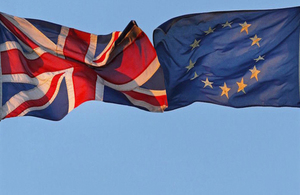
UK and EU flags

The UK’s Permanent Representative to the EU has sent letters to the Secretary General of the Council and the Secretary General of the Commission to recall that the UK has no doubt about the sovereignty of the UK over Gibraltar. In addition, the UK will never enter into arrangements under which the people of Gibraltar would pass under the sovereignty of another state against their wishes, nor enter into a process of sovereignty negotiations with which Gibraltar is not content.

These letters were sent in response to the letter of 24 November 2018 from the President of the European Council and the President of the European Commission to the President of the Government of Spain, and in response to the Statement to the minutes of the European Council (Article 50) meeting on 25 November 2018 on the territorial scope of the future agreements to be concluded between the Union and the United Kingdom. The letters also restates that the UK will negotiate future agreements on behalf of all territories, including Gibraltar, for whose external relations it is responsible.

Published 25 November 2018


Press release: PM’s EU Council press statement: 25 November 2018

Today marks the culmination of a long and difficult process of negotiation between the UK and the EU.

There were those who said that reaching a Brexit agreement that worked for both sides was an impossible task.

From the start, I rejected that counsel of despair and set about negotiating a deal that worked for the UK and the EU – one that delivered on the result of the referendum and set us on course for a prosperous future while maintaining a close relationship with our friends and neighbours. Thanks to the hard work of both sets of negotiators, that is what we have today agreed.

I want to take a few moments to speak directly to the British people and explain what this deal means.

First, control of our borders. Not an emergency brake on free movement or a promise of greater transition controls in the future – but an end to the free movement of people, in full, once and for all. That is what this deal delivers. It will allow us to put in place an immigration system based not on where people come from but on the skills and talents they have to offer. That is in our national interest.

Second, control of our money. Not a reduction in our membership fee, not a bigger budget rebate – but an end to vast annual payments being sent to the EU. That is what this deal delivers. Instead, we will be able to spend taxpayers’ money on our priorities, like the £394 million per week of extra investment we are putting into our NHS. That is in our national interest.

Third, control over our laws. Not just the return of some areas of control from Brussels – but an end to the jurisdiction of the European Court of Justice in the UK, with our laws being made in our country by democratically elected politicians, interpreted and enforced by British courts. That is what this deal delivers and that is in our national interest.

In agriculture, it does not just deliver a better deal under the Common Agricultural Policy, it takes us out of the CAP completely, meaning we can design new systems of support for farmers that work for the UK.

And in fishing, it does not just deliver a bigger annual quota within the Common Fisheries Policy, it sets us free of the CFP for good and forever. The UK will be an independent coastal state once again, in full sovereign control of our waters, able to decide for ourselves who we allow to fish in them, with that access not tied to any other aspect of our economic partnership. That is in our national interest too.

On borders, laws and money – this deal delivers for the British people.

But I have been just as determined that as well as taking back control, this should be a deal that protects the things we value in our relationship with our European friends and sets us on course for a future of opportunity and prosperity and this deal does that too.

So if your family’s livelihood depends on a skilled job in our manufacturing sector, you need a deal that keeps goods flowing easily across borders and keeps supply chains intact. This deal does that. We will be outside the single market and the customs union but have an economic partnership with the EU closer than any other country enjoys. Good for business and in our national interest.

If you are one of the over 3 million EU citizens who has come and built your life in the UK – come to be our colleagues, our neighbours and our friends – you need a deal that guarantees your rights. If you are one of the almost 1 million UK nationals living elsewhere in the EU, you need the same. This deal delivers for you all.

And because each one of us is made safer by the close security co-operation between the UK and the EU, we all need a deal that keeps that close partnership intact and this deal does that too.

As Prime Minister of the United Kingdom I have felt very keenly my responsibility to deliver a deal that works for the whole UK and for all of its parts. So what we have agreed protects the constitutional integrity of the United Kingdom. We rejected proposals which would have compromised that integrity and insisted on keeping all parts of our UK in a single customs territory – this deal delivers that. It also honours the solemn commitment we made to the people of Northern Ireland that there should be no hard border between Northern Ireland and Ireland.

This deal will safeguard the hard-won progress of the last twenty years and allow the people of that part of our United Kingdom to carry on living their lives as they do today.

This is a deal that works for the whole UK family – including our Overseas Territories and the Crown Dependencies.

On Gibraltar, we have worked constructively with Spain throughout this process and I want to thank Fabian Picardo for the statesmanlike role he has played.

We have ensured that Gibraltar is covered by the Withdrawal Agreement and by the Implementation Period.

Let no-one be in any doubt: for the future partnership the UK will be negotiating for the whole UK family, including Gibraltar.

I am proud that Gibraltar is British and its constitutional status will not change.

The deal we have agreed today unlocks a bright future for the UK. Outside the EU we will be able to strike new trade deals around the world and open up new markets in the world’s fastest growing economies.

We will be able to focus our energies on the many other important issues that matter to the British people at home. Creating more good jobs and spreading prosperity more widely, taking care of our public services like the NHS and schools, building more homes, and tackling the social injustices that prevent too many people fulfilling their potential.

In any negotiation, you do not get everything you want. You need to identify what your vital interests are and stick to them, but be prepared to compromise in other areas in order to achieve a result. I think the British people understand that. When they look at this deal they will see it is a good one for our country and that it is in the national interest for everyone to get behind it.

It honours the referendum, protects what we value and sets us on course for a bright future.

Today marks the culmination of our exit negotiations with the EU – but it also marks the start of a crucial national debate in our country over the next few weeks.

Before Christmas, MPs will vote on this deal. It will be one of the most significant votes that Parliament has held for many years. On it will depend whether we move forward together into a brighter future or open the door to yet more division and uncertainty.

The British people don’t want to spend any more time arguing about Brexit. They want a good deal done that fulfils the vote and allows us to come together again as a country.

So I will take this deal back to the House of Commons confident we have achieved the best deal available and full of optimism about the future of our country. In Parliament and beyond it, I will make the case for this deal with all my heart and I look forward to that campaign.


News story: 40 reasons to back the Brexit deal

placeholder
  1. Free movement will come to an end, once and for all, with the introduction of a new skills-based immigration system.
  2. We will take back full control of our money which we will be able to spend on our priorities such as the NHS. We will leave EU regional funding programmes – with the UK deciding how we spend this money in the future.
  3. The jurisdiction of the European Court of Justice in the UK will end.
  4. In the future we will make our own laws in our own Parliaments and Assemblies in Westminster, Edinburgh, Cardiff and Belfast.
  5. We will leave the Common Agricultural Policy.
  6. We will leave the Common Fisheries Policy and become an independent coastal state again, with control over our waters.
  7. We will be able to strike trade deals with other countries around the world. Deals can be negotiated and ratified during the implementation period and put in place straight afterwards.
  8. We will be an independent voice for free trade on the global stage, speaking for ourselves at the World Trade Organisation, for the first time in decades.
  9. We will be freed from the EU’s political commitment to ever closer union.
  10. We will be out of the EU’s Charter of Fundamental Rights, recognising the UK’s long track record in protecting human rights.
  11. A fair settlement of our financial obligations, which will be less than half what was originally predicted.
  12. Both the one million UK citizens living in the EU and the three million EU citizens living in the UK will have their rights legally guaranteed so they can carry on living their lives as before.
  13. We will have a free trade area with the EU, with no tariffs, fees, charges or quantitative restrictions across all sectors, helping to protect UK jobs. We will be the only major economy with such a relationship with the EU.
  14. We’ve agreed with the EU that we will be as ambitious as possible in easing the movement of goods between the UK and the EU as part of our free trade area.
  15. We will have an implementation period after we leave the EU during which trade will continue much as it does now. This will allow government, businesses and citizens time to prepare for our new relationship.
  16. The deal will see a greater reduction in barriers to trade in services than in any previous trade deal.
  17. There will be an agreement that means UK citizens can practice their profession in the EU.
  18. A comprehensive deal that secures access to the EU market for our financial services sector meaning the EU cannot withdraw it on a whim. This will provide stability and certainty for the industry.
  19. A best in class agreement on digital, helping to facilitate e-commerce and reduce unjustified barriers to trade by electronic means.
  20. We have agreed that there will be arrangements that will let data continue to flow freely, vital across our economy and for our shared security.
  21. Trade arrangements for gas and electricity will help to ease pressure on prices and keep supply secure.
  22. Strong rules will be in place to keep trade fair, so neither the UK nor EU can unfairly subsidise their industries against the other.
  23. We will have a comprehensive Air Transport Agreement and comparable access for freight operators, buses and coaches.
  24. We have agreed that there will be arrangements so we can take part in EU programmes like Horizon and Erasmus.
  25. There will be a co-operation agreement with Euratom, covering all the key areas where we want to collaborate.
  26. Visa-free travel to the EU for holidays and business trips will continue.
  27. Our new security partnership will mean sharing of data like DNA, passenger records and fingerprints to fight crime and terrorism, going beyond any previous agreement the EU has made with a third country.
  28. Our new security partnership will enable the efficient and swift surrender of suspected and wanted criminals.
  29. Close co-operation for our police forces and other law enforcement bodies.
  30. We will continue to work together on sanctions against those who violate international rules.
  31. We will work together on cyber-security threats and support international efforts to prevent money laundering and the financing of terrorism.
  32. Disputes between the UK and the EU on the agreement will be settled by an independent arbitrator, ensuring a fair outcome.
  33. We will meet our commitment to ensure that there is no hard border between Northern Ireland and Ireland.
  34. We will keep the Common Travel Area between the United Kingdom and Ireland, ensuring everyday life continues as now.
  35. We will keep the Single Electricity Market between Northern Ireland and Ireland, which will help maintain a stable energy supply and keep prices down in Northern Ireland.
  36. Both sides will be legally committed, by the Withdrawal Agreement, to use “best endeavours” to get the future relationship in place by the end of the implementation period, helping to ensure the backstop is never used.
  37. An agreement to consider alternative arrangements to avoid a hard border on the island of Ireland, including all facilitative arrangements and technologies, and to begin preparatory work on this before we leave the EU, reflecting shared determination to replace the backstop.
  38. In the unlikely event we do have to use the backstop, a UK-wide customs area will ensure there is no customs border in the Irish Sea.
  39. Gibraltar’s British sovereignty will be protected.
  40. The deal delivers on the referendum result. It takes back control of our money, borders and laws whilst protecting jobs, security and the integrity of the United Kingdom.

Published 25 November 2018


Press release: Crackdown to stop rogue bailiffs making lives a misery

  • Government moves to end bad practice for good
  • Families and vulnerable people to be better protected from aggressive tactics
  • Public urged to speak up about experiences and provide views on bailiff behaviour

Sweeping Government reforms in 2014 significantly curtailed bailiffs’ powers, as well as improving transparency and ensuring those with outstanding debts knew their rights.

Having listened to concerns from charities, debt advice organisations and others, the Government has today launched a Call for Evidence to seek views on what more should be done to protect the public.

Justice Minister Lucy Frazer said:

The majority of bailiffs work within the law, but it is clear some are making lives a misery and ruining the industry’s reputation.

My message to those individuals is clear – there is absolutely no excuse for aggressive tactics and such behaviour will not be tolerated.

We will not hesitate to take action, so we’re asking the public to share their experiences to help rid our society of rogue bailiffs for good.

Vulnerable individuals, families, and other victims of unacceptable bailiff behaviour will be asked about tougher protections, including the option of an independent regulator.

The Call for Evidence will allow all those with an interest – including charities and other stakeholders – to speak out on the impact of earlier reforms and on how best to end underhand tactics.

In detail, the Government is seeking views on:

  • Ensuring compliance with earlier curbs on bailiff powers;
  • The recognition and treatment of vulnerable people when collecting debt;
  • The complaints process;
  • The current fee structure and how this is working to incentivise early payments; and
  • Suitability of current bailiff regulation and the possibility of an independent regulator.

The collection of debt is necessary for both the economy and the justice system, and bailiffs must be able to carry out their job safely and effectively. But Ministers are clear they must act professionally and with respect. Where poor behaviour takes place, the Government will not hesitate to take action.

The Call for Evidence sits alongside wider government initiatives to support vulnerable debtors, for example the ‘Breathing Space’ scheme. It will run for 12 weeks, and responses will be analysed to inform next steps.

Notes to Editors

Debts which enforcement agents (formerly known as bailiffs) enforce include council tax arrears and unpaid debts owed to individuals and businesses.

In 2014 the government introduced reforms to strengthen protection from rogue enforcement agents, while at the same time making sure that debts could still be collected fairly.

The reforms centred on the implementation of Part 3 and Schedule 12 of the Tribunals, Courts and Enforcement Act 2007. The reforms provided legal protection by introducing a comprehensive code governing, amongst other things:

  • when and how enforcement agents can enter somebody’s premises;
  • the safeguards to prevent the use of force against debtors;
  • what goods they can and cannot seize and, if necessary, sell; and
  • what fees they can charge.

The reforms also stopped enforcement agents entering homes when only children are present, and introduced mandatory training and a new certification process for enforcement agents.

Ministers pledged to review the impact of the reforms after one, three and if necessary five years. The Ministry of Justice conducted the first review in 2015, which it published in 2018, after extensive gathering of views from key stakeholders including creditors, the advice sector, other government agencies and enforcement agents.

The review found that, at the one-year point in 2015, the reforms were having many positive benefits. This included better awareness around debtor rights and how to complain, more clarity for debtors about the fees that can be charged, the processes that should be followed, and where to go for advice. It was also reported, however, that debt advisors and debtors still perceived some enforcement agents to be acting aggressively and in some cases not acting within the regulations.


Speech: Chancellor of the Duchy of Lancaster speech at the Onward Dinner: 22 November 2018

I really welcome the foundation of Onward and hearing about the work that this new think tank plans.

It seems to me when I look back on those days, growing up and going to university in the late 1970s and early 1980s, it was a time of really exciting intellectual ferment on the centre right of British politics.

I think what all supporters of a liberal free enterprise society – a responsible society that cares about the values expressed in communities – needs now is a resurgence of that intellectual energy.

In those days that was brought about through the Centre of Policy Studies, the Institute of Economic Affairs, and the Adam Smith Institute. Today Onward is contributing to that renewal of ideas.

That is important as today those of us who support free enterprise and the market economy are confronted by a paradox.

On the one hand, living standards globally are higher than they have ever been in human history. That is largely down to the success of capitalism, free markets and free trade.

Generations of people in Asia, South America and in many countries in Africa…

… men and women whose parents and grandparents lived with the real fear of food running out if the harvest failed…

… are now able to look forward to greater prosperity and security than ever before.

In 1950 three-quarters of the world were living in extreme poverty; by 2015, fewer than a tenth were in that condition, despite a massive increase in the global population in that period of time.

The global poverty rate is now lower than it has ever been in recorded history.

That progress has led to knock-on improvements:

Global illiteracy rates have fallen from a third in 1930 to less than one-fifth today.

And child mortality – measured in terms of the percentage of children dying before their fifth birthday – has fallen tenfold since 1800 to 4.3% today.

There have been real improvements in the developed world, too.

We probably all know this from talking to our own parents or grandparents, but if you look at household goods – things like fridges, freezers, washing machines, dishwashers – which in the 1950s were considered luxury products are now seen as standard.

Things that were once counted as the exceptional rewards for high living standards are now seen as a measure of the ordinary expectations.

We carry smartphones in our pockets – giving instant access to information from every part of the world – which carry in them greater computing power than that of a mainframe computer a few decades ago.

Customers are now able to get what they want, often the next day, after shopping from the comfort of their homes.

Online retailing has cut costs and delays.

One might have expected that this unprecedented rise in human prosperity should cause people to celebrate the success of free enterprise and of market economies.

Yet that is not the case.

Rather here in the United Kingdom, and in much of the developed world, what we see is a level of scepticism higher than for many years. Not just about the conduct of individual businesses or particular sectors, but about the virtues of the free enterprise system itself, on a scale that we haven’t seen for about 40 years.

Citizens today are better informed than previous generations and young people today are increasingly motivated. They want and expect businesses to behave responsibly.

And as they look at the world they conclude that that is not what they are seeing.

Polling by the Legatum Institute shows that a majority of the British people now view capitalism as ‘greedy’ and ‘selfish’.

That research actually found remarkable consistency across the generations on economic issues – and shared by Labour and Conservative voters alike.

When asked for their top three word associations with capitalism, 32% of the public said ‘corrupt’ and only 7% said ‘for the greater good’.

And earlier this year another poll found that 61% of ordinary working people feel they don’t get their fair share of the nation’s wealth.

There are reasons for this scepticism.

There is no doubt that the crash of 2008 and the downturn which ensued damaged people’s confidence in the virtues of free and open markets.

Making matters worse has been the contrast between high profile examples of corporate excess or malpractice, and the reality for many families of squeezed living standards.

Effective competition in markets – something that underpins public trust in those markets – has in too many markets stalled.

Data from The Economist this week shows that over the last 20 years market concentration has risen in two-thirds of US industries; in Europe the trend is similar, with the average market share of the biggest four firms in each industry having risen since 2000.

But of course, underlying this widespread public concern and to some extent public anger lies not just the events of the last ten years…

… but the profound long-term changes in our economy and in assumptions about work and careers, changes being driven by globalisation and digital technology.

Both those phenomena present us with great opportunities.

Tens of millions of new customers around the world heading towards the kind of consumer expectations that are taken for granted in Britain or Germany or the United States.

And new jobs and firms – indeed entirely new professions and occupations – being created by digital technology.

So there is a paradox. Higher living standards around the world than ever before. A triumph of capitalism. Yet at the same time we see deep public discontent, for understandable reasons, with the very system that has made this prosperity possible.

So how do we respond to this challenge?

I want to touch on three ways we can go about doing so.

Our philosophical approach, how we think about free enterprise and capitalism…

… what government should do in its words and its actions…

… and what business itself ought to be doing in order to restore its public reputation.

In part what we need to do is to rediscover and renew the arguments that we made and won in the 1970s and 1980s about the success of a market system at meeting human needs and wishes, when compared with a model that looks instead to extensive state control.

Debates that we thought perhaps had been won conclusively, but have now been reopened.

To do that we have to engage with a generation for whom talk about the stagflation of the 1970s, or Trade Union power or the Soviet model, is at best a matter of remote history.

For those of us who are older, we think back to the 1970s. The great impersonator of that time, Mike Yarwood, had a big show on Saturday evenings. He could take off six trade union leaders in a show and everyone would instantly know who those people were. You could not do that today.

We have to deliver the key messages once again. You cannot distribute wealth unless it has first been created. Individuals and businesses are better at spotting opportunities and pursuing innovations than is government. A modern economy, in all its complexity and diversity, is something that no government, however good its intentions, will be able to micromanage successfully.

And putting politicians in charge of everything from railways to electricity to water supplies, as some advocate, would mean there would be nowhere else to turn when things went wrong.

We have to re-establish in the minds of today’s opinion formers and today’s public the principle that free enterprise, far from being incompatible with ethical values, is actually rooted in and depends upon a moral framework.

This actually is something where we can look to history for guidance.

The Harvard scholar David Landes in his book The Wealth and Poverty of Nations and the Cambridge historian and anthropologist Alan Macfarlane in The Culture of Capitalism have written about how it was the moral and cultural environment of European nations which enabled a capitalist economy to take off and to thrive.

Indeed the father of free enterprise, Adam Smith, recognised that markets were, as my colleague Jesse Norman puts it in his recent biography, “living institutions embedded in specific cultures and mediated by social norms and trust”.

Political stability, a sound currency representing a reliable store of value and medium of exchange, independent courts to resolve disputes, effective mechanisms to deter and punish corruption: these all help provide the essential foundations on which a market economy can flourish and grow and command public trust.

And of course these foundations are made possible by governments and by parliaments – in other words by effective, but limited, state action. Indeed, many of the things upon which businesses rely – limited liability, patents, copyright, enforcement of contracts – are embodied in law.

Over the centuries, as trade and markets have grown, governments have been at their most successful in reforming and renewing capitalism when they drive effective competition and recognised the social dimension of free enterprise.

We saw that with the impact of the Factory Acts of the mid-nineteenth century and in the trust busting drive of Teddy Roosevelt in the United States.

Roosevelt’s concern was not with big business per se – rather, he wanted to act to enforce what he termed a “rule of reason” on companies that grew through unfair practices rather than through reasonable means.

[political content removed]

Today we are acting with measures such as the proposed digital services tax, our work to implement the Taylor Review, our push for regulators to do more to protect vulnerable consumers, and our legislation to outlaw the practice of unscrupulous freeholders charging onerous ground rents.

I cannot emphasise hard enough: these reforms are about restoring the reputation of the free market system by demonstrating that it can and it should work for everyone.

This is not a task that government can undertake on its own.

Part of the reason why the Government is responding is that companies themselves do not always act in a way that benefits the public good or delivers for working people.

But increasingly, I sense that businesses are willing to rise to the challenge of strengthening faith in capitalism. Working with Jeremy Wright, I have introduced ways to use the Government’s buying power on public procurement to drive social value and promote a more diverse market…

… and I have been heartened by the welcome that those proposals have had from many of the Government’s major suppliers.

But there are habits too that need to change. The detailed information now held about consumers can be used by suppliers both for and against customers.

Consider the loyalty penalty – where consumers who stick with their suppliers find themselves placed on the highest tariffs and actually end up subsidising other consumers.

The Government has acted to stop this behaviour in the energy sector and we are willing to act in other markets too to make them work for people.

The increased shareholder activism that we have encouraged in recent years, especially around executive pay, is also a vital element in renewing the public standing of free enterprise.

Scrutiny by shareholders of the decisions of companies is making a real difference.

It was after all the vocal opposition of shareholders that persuaded Unilever to abandon its plans to make Rotterdam its HQ.

And it was condemnation, not just from politicians or even from campaigners but ultimately also shareholders, that led to the departure of Persimmon’s chief executive following the controversy over his bonus payment.

By encouraging stewardship, active and diligent shareholders can improve the reputation of capitalism and I believe have a responsibility so to do.

It is not enough to fix broken markets – we have to fix public perceptions of them too.

We have to do so in a way that recalls the Prime Minister’s first speech on the steps of Downing Street – reaffirming the Government’s commitment to championing responsible capitalism and asking businesses for their part to accept their share of social and moral responsibility.

So we should celebrate businesses that create wealth and provide jobs and livelihoods in communities across the country…

We should drive effective competition – removing barriers to entry, making sure our competition powers are fit for purpose to regulate digital markets, and promote innovation.

We should be clear about our expectations of businesses because public support for their licence to operate depends how they act.

I think these are the steps that will help to break this paradox of capitalism.

Business done right is a force for good.

The best businesses play a highly positive role in society, not just by reacting to social or environmental problems, but by driving innovation and delivering products or services that meet consumer needs.

The best businesses – whether that’s manufacturing or finance or technology – lead the way in putting social and environmental impact at the heart of what they do.

The best businesses also lead the way on promoting diversity, tackling injustices, and encouraging talent regardless of people’s background.

By taking these steps we can help raise standards, stimulate investment and drive long-terms returns, and continue that improvement in living standards which has been free enterprise’s greatest achievement.

Companies acting more responsibly and markets working more competitively are the twin pillars of restoring trust in those free markets.

Thank you very much.